
How to rank on Perplexity: the citation playbook for 2026
Perplexity is the easiest of the four AI engines to win citations on with a content rewrite. The pipeline, the seven levers, and a 14-day sprint.
Perplexity processes around 780 million queries a month and growing, and it's the easiest of the four major AI engines to win citations on with a content-side rewrite. That's not a marketing claim — it's a structural fact about how the engine picks sources. This post walks through the source-selection pipeline, then the seven levers that actually move citation rate.
What "ranking" on Perplexity actually means
Perplexity isn't a list of blue links, so the rank-tracking instinct from traditional SEO doesn't translate. There's no position one. There's no SERP. There's a generated answer, and somewhere in that answer — or in the footnote panel beside it — three or four numbered sources get cited. You're either one of them or you're not.
The unit of victory is the citation, not the rank. A "Perplexity ranking" is shorthand for citation rate across a fixed prompt set — what percentage of your target prompts surface your domain as a cited source. This is the same measurement frame the AEO playbook uses across all four engines, but Perplexity's transparency makes it the cleanest engine to track. Every source is footnoted. There's no ambiguity about who got the credit. (For the engine-by-engine differences in what counts as a citation, see What actually counts as a citation.)
How Perplexity selects sources
Every Perplexity answer goes through a six-stage Retrieval-Augmented Generation (RAG) pipeline, but for AEO purposes the part that matters is what happens between query and citation list. Three steps decide whether you make it in.
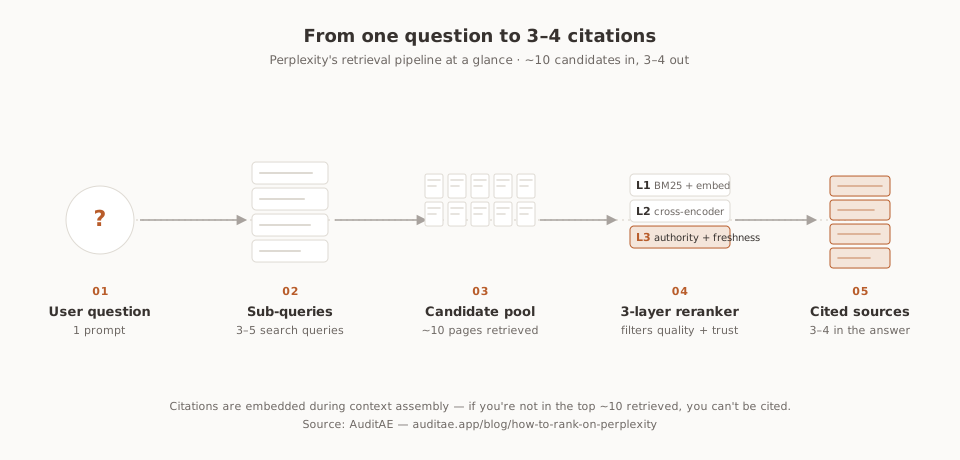
1. Retrieval. When you ask Perplexity a question, the engine doesn't pull from a frozen training set the way ChatGPT often does. It runs live web searches against its own crawled index of roughly 5 billion URLs, falling back to Bing for long-tail queries. A complex question gets decomposed into 3–5 sub-queries, each one pulling candidate pages. This stage uses a hybrid of BM25 (keyword matching) and dense embedding search, so both keyword presence and semantic similarity matter.
2. Reranking. Candidates pass through a cross-encoder that scores each query–document pair jointly, then a third-layer ML reranker that adds entity-level signals, domain authority, recency, and source-diversity requirements. Public reverse-engineering work points to an XGBoost model at the L3 stage, with manually curated authority lists giving boosts to high-trust platforms (GitHub, Reddit, LinkedIn, mainstream publishers, etc.).
3. Citation. Of the ~10 pages that survive reranking, only 3–4 actually get cited in the response. The selection at this final stage favors pages that directly answer the user's question in clean, extractable language — answer shape matters as much as authority.
Two things fall out of that pipeline that don't get talked about enough:
- Citations are embedded during context assembly, not retrofitted after the answer is written. The model is constrained to the retrieval pool from the first token. If you're not in the top ~10 retrieved pages, you have a zero percent chance of being cited, no matter how good your content is.
- Roughly 60% of Perplexity citations overlap with the top 10 Google organic results for the same query. Strong traditional SEO is the dominant retrieval signal. You can't skip the SEO step and "Perplexity-optimize" your way around poor rankings.
Why Perplexity is the easiest engine to win on
Among the four engines AuditAE audits, Perplexity is the most retrieval-driven. ChatGPT leans heavily on training data and brand recall the model already has. Gemini grounds in Google's index but layers on heavy E-E-A-T weighting. Google AI Overviews lean on the same plus structured data and named-author signals. Perplexity, by contrast, weights what you published this week much more aggressively than the other three, and its citation pool is larger and more open to mid-DA publishers.
In practice that means a focused content rewrite can move you onto Perplexity citations within days of a fresh crawl, while moving the same brand into ChatGPT's citation set usually takes months of off-page work. If you only have bandwidth to optimize for one engine, Perplexity is where the marginal hour pays back fastest.
Seven levers that move Perplexity citations
These are ordered roughly by ratio of effort to payoff. Run them in order if you're starting from zero.
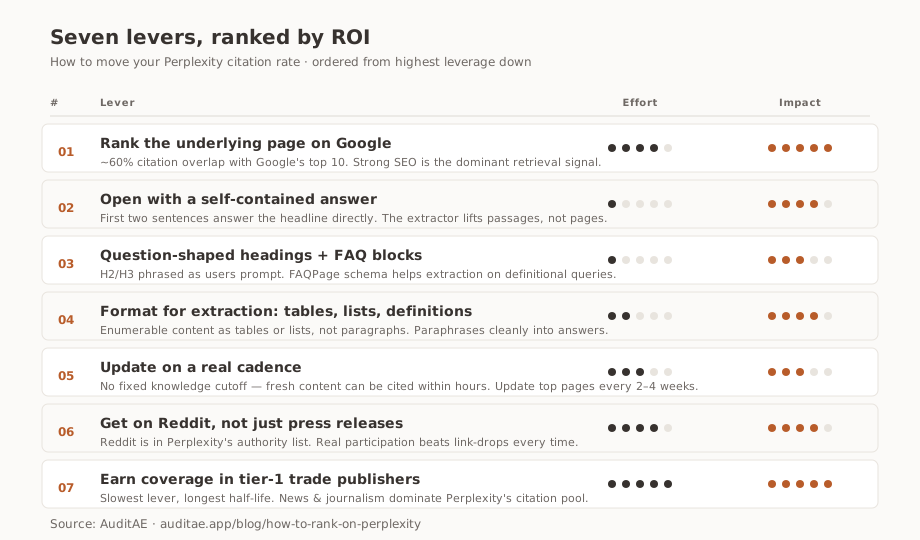
1. Rank the underlying page on Google
This is unsexy, and it's the highest-leverage thing on the list. With ~60% citation overlap between Perplexity and Google's top 10, the fastest way to get cited is to rank the page that should be cited. Topic relevance, working internal links, fast load, clean indexing — all the standard SEO hygiene.
If you're in a competitive head term and not in the top 10, the practical play is to target a more specific long-tail variant of the query. Perplexity falls back to Bing for long-tail, where competition is thinner.
2. Open with a self-contained answer
Perplexity's extraction model lifts passages, not whole pages. The first one to two sentences after a relevant heading should answer the headline directly, with no preamble, no founder story, no "in today's fast-moving landscape" lead-in.
A test that works: take any H2 on the page in isolation, and read the paragraph immediately under it without any other context. If it doesn't make sense as a standalone answer, rewrite it.
3. Use question-shaped headings and FAQ blocks
H2s and H3s phrased the way a user would prompt — "How does X work?" not "Our Approach" — match the engine's query reformulation step. FAQ blocks at the end of the page extend coverage to adjacent prompt phrasings cheaply. Schema.org FAQPage markup helps the extractor parse them, especially for definitional and procedural queries.
4. Format for extraction: tables, lists, definitions
Perplexity's extractor pulls structured information disproportionately well. Comparison tables, numbered step-by-step lists, and labeled definitions are paraphrase-friendly in a way that flowing prose isn't. Where you have enumerable content — feature comparisons, pricing tiers, version differences, ranked options — present it as a table or list, not a paragraph.
5. Update on a real cadence
Perplexity has no fixed knowledge cutoff. Its index is continuously refreshed, and freshness is one of the explicit ranking signals in the L3 reranker. High-priority pages should get meaningful updates every two to four weeks: refreshed stats, current-year examples, updated source links, new sections that respond to recent developments.
The cheap version: maintain a "Last updated" date in the page metadata and actually do a substantive edit when you bump it. The expensive version: build an editorial calendar that re-touches your top citation candidates monthly.
6. Get on Reddit, not just press releases
Reddit appears as a citation source disproportionately often in Perplexity results — the engine's authority list explicitly boosts it, and its real-time index ingests Reddit threads quickly. The win condition isn't "post a link to your blog on r/whatever." That's spam and gets removed. The win is participating as a real account in threads adjacent to your category, contributing actual value, and getting your brand named (linked or not) inside conversations that match buyer prompts.
The rule of thumb: if a Redditor wouldn't read your comment and learn something specific, don't post it. The other rule: ten substantive answers in your category beat one promotional post any day.
7. Earn coverage in tier-1 trade publishers
Perplexity's citations skew toward news and journalism content. Earned media in publications its authority list values — major industry trades, business press, technology outlets — does double duty: the placement itself often gets cited directly, and the brand mention inside the article shows up in Perplexity's entity recall when other publishers cover the same topic later.
This is the slowest of the seven levers. It's also the one with the longest half-life. A single well-placed feature in a trade publication keeps showing up in citations months after publication.
What matters less than you think
A few things that get over-indexed on in generic "rank on Perplexity" guides:
- Random high-DA backlinks. Authority is real, but Perplexity's authority signal is topical, not generic. A backlink from a high-DA site outside your category does very little. A mention in a niche newsletter inside your category does a lot.
- Keyword density and SEO-coded phrases. Perplexity's reranker actively discounts content that reads like it was written for a model. Tight, useful writing wins. Keyword stuffing is a negative signal at the L3 layer.
- Domain age. Perplexity's index includes ~5 billion URLs, much smaller than Google's, and it's not biased toward old domains the way some legacy ranking factors are. A focused 50-page site published this year can outperform a 5-year-old site that's drifted off-topic.
- Page volume. Twenty deep, interlinked pages on one topic outperform two hundred shallow pages spread across fifty topics. This is the same topical-authority dynamic as classic SEO, but more pronounced — the reranker explicitly weights entity-level topical fit.
How to measure it
The standard rank tracker doesn't work here. There's no SERP position to track. The measurement that matters is citation rate against a fixed prompt set, run on a schedule.
The minimum useful version:
- Write 25 prompts your buyers would actually type into Perplexity. Real, full-sentence questions. Not keyword phrases.
- Run each prompt through Perplexity. Record whether your domain shows up in the citation footnotes, what position, and which competitor domains were cited alongside you.
- Re-run weekly or biweekly. Track citation rate over time on the same prompt set.
- After any meaningful content change — a rewrite, a new page, a Reddit thread that took off — re-audit and look for movement on the affected prompts specifically.
You can do this manually for 25 prompts. Beyond that, the cell-by-cell math gets unwieldy. AuditAE was built for exactly this loop: pay-per-check audits, 5¢ per cell for Perplexity (5–12¢ across the four engines), all four engines including Perplexity. Build the prompt set once, re-run whenever you want a current readout. (For the workflow that turns the audit into a monthly client deliverable, see Writing a monthly client report in ten minutes.)
A 14-day Perplexity sprint
If you want to apply all of this on a real timeline:
Days 1–3: Pick 25 prompts. Audit Perplexity for each. Note current citation rate, which competitors are getting cited instead, and which of your existing pages should be the cited answer.
Days 4–7: For each priority prompt where a competitor is cited and you aren't, rewrite the corresponding page on your site. Open with a one-sentence answer to the prompt. Restructure H2s as question-format. Add an FAQ block of 3–5 adjacent questions. Convert any enumerable content to tables or lists.
Days 8–10: Pick three to five Reddit threads, niche newsletters, or industry forum threads in your category. Engage substantively. Don't link-drop.
Days 11–14: Wait for fresh crawls (Perplexity is fast — usually within a week). Re-run the original 25 prompts. Measure citation-rate delta.
Two weeks is short for off-page work to compound, but it's enough to see the on-page rewrites move citations. The Reddit and earned-media work compounds on a 30–90 day curve.
Want to see your current Perplexity citation rate before you start? Run a free audit on AuditAE — drop in your prompts and we'll show you exactly which ones cite you, which ones cite competitors, and where the gap sits across all four engines.
FAQ
How long does it take to start ranking on Perplexity?
Page-level rewrites can move citations within days of a fresh crawl, because Perplexity has no fixed knowledge cutoff and re-indexes continuously. Building the off-page signals — earned media, Reddit presence, topical authority — takes 30–90 days to compound. Plan for both timeframes.Do I need backlinks to rank on Perplexity?
Backlinks help indirectly because they push your underlying page up Google's rankings, and ~60% of Perplexity citations overlap with Google's top 10. But Perplexity weighs topical authority and content extractability more than raw backlink volume. A 20-page niche site with focused topical depth can outperform a higher-DA site that's spread thin.Can a small site get cited by Perplexity?
Yes, more readily than on most other AI engines. Perplexity's index is smaller (~5 billion URLs vs Google's much larger index), and its reranker weights topical relevance and content shape heavily. A focused small business with 20 deep pages on one topic can win specific prompts that an unfocused enterprise can't.Does Perplexity use schema markup?
It uses structured data signals modestly — Article, FAQPage, and HowTo schemas help the extractor parse content, especially on definitional and procedural queries. It's not a primary ranking factor, but it's cheap to add and removes ambiguity at the extraction step.How is "ranking on Perplexity" different from ranking on ChatGPT?
ChatGPT relies more heavily on training data and brand recall the model has already learned. Perplexity does live retrieval on every query. So Perplexity is more responsive to recent content changes; ChatGPT is more responsive to long-running brand presence in the training corpus. Same brand, very different tactical playbook per engine.How often should I re-audit?
Weekly during an active optimization sprint, biweekly or monthly in steady state. Perplexity citations shift more than you'd expect — fresh crawls, model updates, and competitor publishing all move the needle.
Aaron is the founder of AuditAE. He has run AI-visibility audits for SEO agencies and in-house brand teams, and writes about how generative answer engines are reshaping the practice of search marketing.
Related reading
- 10 min readHow to Improve Brand Visibility in AI Search Engines: 8 Fixes You Can Ship This MonthAI engines already have an opinion about your brand. Here is how to check what it is, and the eight fixes, in order, that change it — with the WordPress path for each one.
- 9 min readHow to Show Up in ChatGPT Results (2026): A Complete, Tested PlaybookTwo paths get you into ChatGPT's answers: be crawlable and indexed in Bing so ChatGPT Search can cite you live, and build mentions across the web so the model brings you up on its own. The complete playbook — real schema, the Bing setup, multi-engine differences, and how to measure it.
Run the citation report on your own brand.
See which prompts cite you on ChatGPT, Perplexity, Gemini, and Google AI Overviews — the first one’s free, no card.