
What is Answer Engine Optimization (AEO)? A 2026 guide
Answer engine optimization (AEO) is the practice of getting your brand cited inside ChatGPT, Perplexity, Gemini, and Google AI Overviews — the surfaces replacing the blue-link click. Here's how AEO works, how it differs from SEO, and how to measure it.
Answer Engine Optimization (AEO) is the practice of structuring your content so that AI answer engines — ChatGPT, Perplexity, Google Gemini, and Google AI Overviews — cite your brand when users ask questions in your category.
Where SEO competes for blue-link rankings, AEO competes for inclusion inside the AI's actual sentence. The unit of victory has changed. A user asking "best CRM for solo consultants" no longer scrolls a list of ten results — they read a single paragraph that names two or three brands. Your job is to be one of those names.
This guide covers what AEO is, how it differs from SEO, why it matters now, and how to measure whether it's working. For the longer take on why this shift is happening, see our companion piece on AI visibility vs. SEO.
What is answer engine optimization?
Answer engine optimization is the practice of optimizing your content, brand entity, and off-page signals so that AI answer engines name your brand when they generate a response to a user's question. The "answer engines" in scope today are ChatGPT (OpenAI), Perplexity, Google Gemini, and Google AI Overviews — the four surfaces that increasingly answer user questions inline instead of returning a list of links.
The practical definition: AEO is what you do in addition to SEO so that, when an AI synthesizes an answer for your category, your brand is one of the names in that answer. It's measurement-led — you can't optimize what you're not auditing, and there's no Search Console for AI engines. The discipline is roughly two years old, often used interchangeably with GEO (Generative Engine Optimization).
How do answer engines decide what to cite?
Answer engines build their responses in roughly three stages:
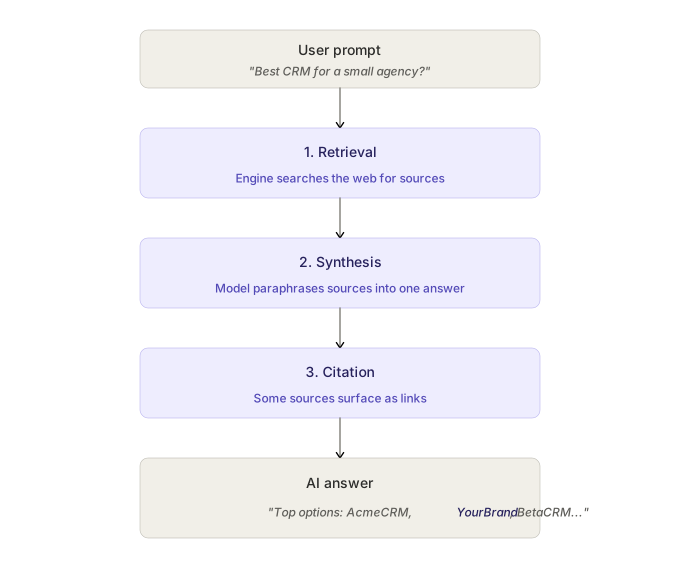
- Retrieval — the model issues live web searches (or uses a curated index) to pull candidate sources for the user's prompt.
- Synthesis — the model reads those sources and generates a single answer, paraphrasing across them.
- Citation — some, but not all, of the sources surface as links or footnotes attached to the answer. The three big engines define "cited" differently — we break down those differences in What actually counts as a citation.
Three things drive whether your page makes it through that pipeline:
- The model can find you. Your domain ranks for the underlying query the model is searching for, or it's already in the model's training data with enough authority to be recalled directly.
- The model can quote you cleanly. Your content states the answer in a self-contained sentence near the top of the page, not buried under five paragraphs of preamble.
- The model trusts you. Brand mentions across the open web — Reddit, forums, news, comparison posts — push your name into the LLM's working representation of the topic, even when those pages don't link to you.
That last one is the part SEOs underestimate. Backlinks still matter, but unlinked brand mentions have become a primary AEO signal because they shape what the model "knows" about your category.
How is answer engine optimization different from SEO?
AEO doesn't replace SEO. It sits on top of it. Most of the technical foundations — crawlable pages, structured data, page speed, internal links — carry over directly. What changes is the surface you're optimizing for and how you measure success.
| SEO | AEO | |
|---|---|---|
| Goal | Rank in the top 10 blue links | Get named inside the AI's answer |
| Surface | Google SERP | ChatGPT, Perplexity, Gemini, AI Overviews |
| Unit of success | Click | Citation / mention |
| Measurement | Position, CTR, organic traffic | Cited / not cited, position in answer text, share of voice vs competitors |
| Best content shape | Long-form pillar pages | Self-contained answers + Q&A blocks |
| Off-page signals | Backlinks | Backlinks + unlinked brand mentions |
The biggest practical difference: traffic isn't the right success metric anymore. A perfect AEO outcome is the user reading your brand inside a Perplexity answer and never visiting your site at all. The win is the impression, not the click.
That's why AEO measurement has to happen at the answer-engine layer — you can't see it in Google Analytics.
Does AEO replace SEO?
No. The same page that wins a blue-link ranking is usually the page that gets cited in AI answers, because the retrieval step is still doing search. If your page ranks #1 on Google for "how to do X," it has a strong chance of getting pulled into the AI Overview for the same query.
What changes is what you do on top of that ranking page. AEO-aware pages tend to:
- State the answer in the first paragraph (often the first sentence) so it can be lifted as a quote.
- Use clear H2 / H3 questions that match how users phrase prompts.
- Include comparison tables, definitions, and FAQ blocks — all of which paraphrase well.
- Avoid burying the conclusion behind anecdote or brand backstory.
If you're already writing solid SEO content, the lift to make it AEO-friendly is usually structural, not topical.
Why does answer engine optimization matter now?
Three things converged in 2024–2025:
- AI-generated answers became the default surface for many queries. Google AI Overviews now sit above the organic results for a large share of searches. ChatGPT and Perplexity have meaningful, sticky audiences for product research, comparison, and how-to queries.
- Click-through rates on the underlying blue links have dropped for queries where an AI answer satisfies the user inline. Position 1 on a query with an AI Overview is no longer worth what it was.
- There's no analytics dashboard for any of this. Google doesn't tell you when AI Overviews cite you. ChatGPT doesn't either. The visibility problem is real.
If your category has high informational intent — SaaS, B2B services, healthcare, finance, legal, consumer products — your buyers are increasingly making short-list decisions inside an AI answer before they ever land on your site.
How do you measure answer engine optimization?
The honest answer: you have to ask the engines directly.
The workflow looks like this:
- List the prompts your buyers actually type. Not keywords — full natural-language prompts. ("What's the best project management tool for a 5-person agency?" not "project management tool.")
- Run each prompt against each engine — ChatGPT, Perplexity, Gemini, Google AI Overviews — and record whether your brand appears, where in the answer, and which competitors are named alongside you.
- Re-run on a schedule. Answers shift week to week. A prompt that cited you on Monday may not cite you on Friday after the model gets a fresh crawl.
- Track share of voice. Across your prompt set, what percentage of answers name you? What percentage name competitor X? That ratio is your AEO scorecard.
You can do this manually for a handful of prompts. For ongoing tracking across dozens of prompts and four engines, you need tooling — which is the gap AuditAE's answer engine optimization platform was built to fill. Submit a prompt, get back whether ChatGPT, Perplexity, Gemini, and Google AI Overviews cite your brand, who your competitors in the answer are, and the exact response text. Pay-per-check at 5–12¢ per engine, no subscription. (Want to see what an audit looks like end to end? Browse a sample audit report.)
How do you optimize for answer engines? A starter AEO checklist
If you're starting from a working SEO foundation, here's the shortest path to AEO traction:
- Pick 20 prompts your buyers would type into ChatGPT or Perplexity. Be specific.
- Audit those prompts now. Note which engines cite you, which don't, and who they cite instead.
- For the prompts where you're missing, identify your top-ranking competitor's page and study its first 200 words. That's the quote zone.
- Rewrite your matching page's opening to state the answer in one self-contained sentence, then expand.
- Add an FAQ block with three to five questions phrased exactly as users prompt them.
- Earn unlinked brand mentions in Reddit threads, comparison posts, podcasts, and newsletters in your category. These move LLM recall more than backlinks alone.
- Re-audit monthly. AEO is a tracking problem more than a one-time fix. The monthly reporting workflow we use bundles AEO checks with rank and traffic into a single client deliverable.
Want to see whether your brand is getting cited right now? Run a free AEO audit across ChatGPT, Perplexity, Gemini, and AI Overviews — drop in your prompts and we'll show you what ChatGPT, Perplexity, Gemini, and Google AI Overviews are saying about you and your competitors.
Two free tools to see where you stand, no login: the citation check shows whether ChatGPT, Perplexity, Gemini and Google AI Overviews cite you for a real buyer prompt; the AI search audit shows whether those engines can fetch, read and trust your site in the first place.
FAQ
What is answer engine optimization?
Answer engine optimization (AEO) is the practice of structuring content so AI answer engines — ChatGPT, Perplexity, Google Gemini, and Google AI Overviews — cite your brand when users ask category-relevant questions. Where SEO competes for blue-link rankings, AEO competes for inclusion inside the AI's actual sentence.How is AEO different from SEO?
SEO measures whether your pages rank in Google's blue links and whether users click through. AEO measures whether your brand is named inside the AI's generated answer — often without any click happening. Same content investments help both, but they measure different surfaces. AEO's unit of success is the citation; SEO's is the click.How do you optimize for answer engines?
Three structural moves drive citations: (1) state the answer in a self-contained sentence near the top of the page so models can lift it as a quote; (2) use question-shaped H2/H3 headings that match how users prompt; (3) earn unlinked brand mentions across Reddit, comparison posts, and trade media so the model's training-data recall includes you. The technical SEO foundations (crawlability, structured data, page speed) still apply — they feed the retrieval step.What's the difference between AEO and Generative Engine Optimization (GEO)?
They're effectively the same idea under two names. AEO emphasizes 'answer engines' (the user-facing surface). GEO emphasizes 'generative' (the underlying model behavior). Both describe optimizing for AI-generated answers. GEO is more common in academic and Semrush-adjacent contexts; AEO is the operator-facing term.Is AEO worth it for small businesses?
Yes if your buyers research with AI before buying. If your category sees a lot of 'best X for Y' or 'how do I do Z' prompts, you should at minimum be auditing whether you get cited. Pay-per-check tools like AuditAE make it cheap enough to baseline ($5 of free credit covers about 3 typical audits, where each audit is 5 prompts × 4 engines = 20 checks at 5–12¢ each, $1.65 in total) before committing to a measurement cadence.How long does AEO take to show results?
Faster than SEO in some ways, slower in others. A page rewritten with a clean answer paragraph can start getting quoted within days of a fresh crawl. Building the unlinked brand mentions that drive recall in models like ChatGPT takes months.Can I track AEO in Google Analytics?
No. AI engines that cite you without sending a click leave no trace in GA. You need a tool that queries the engines directly and parses their answers — that's what an AEO measurement platform does.Does schema markup help with AEO?
Modestly. Structured data helps Google AI Overviews and traditional SERP features. It has less direct effect on ChatGPT and Perplexity, which read the rendered page. Don't skip it, but don't expect it to be the whole game.
Deep dives in this cluster
- 9 min readFAQ Schema in 2026: Google Retired the Rich Result — Here's Why You Should Still Ship ItGoogle stopped showing FAQ rich results on May 7, 2026, which removed the only reason most sites ever added FAQ schema. The markup didn't stop working — its audience changed. Here's what FAQPage does now, the rules that keep it valid, and how to write answers that answer engines actually quote.
- 2 min readAI visibility vs. SEO: what changes in 2026Ranking #3 on Google was a finishable game. Getting cited inside the answer is a different one — here's what carries over from SEO and what doesn't.
- 2 min readWhat counts as a citation in AI searchThree engines, three definitions of "cited." Here's how each one names sources, and what that means for the way you measure AI visibility.
- 4 min readWriting a monthly client report in ten minutes with AEBOTThe agency tax on monthly reporting is real — half a day per client, every month. Here's the workflow that gets it under fifteen minutes end-to-end.
Aaron is the founder of AuditAE. He has run AI-visibility audits for SEO agencies and in-house brand teams, and writes about how generative answer engines are reshaping the practice of search marketing.
Related reading
- 11 min readWhy your #1 ranked page is invisible in AI searchPages cited in AI Overviews that also rank top 10 dropped from 76% to 38% in seven months. Here's what Google's May 2026 AI search guide finally documented — and what to change about your content.
- 2 min readAI visibility vs. SEO: what changes in 2026Ranking #3 on Google was a finishable game. Getting cited inside the answer is a different one — here's what carries over from SEO and what doesn't.
Run the citation report on your own brand.
See which prompts cite you on ChatGPT, Perplexity, Gemini, and Google AI Overviews — the first one’s free, no card.