

Why your #1 ranked page is invisible in AI search
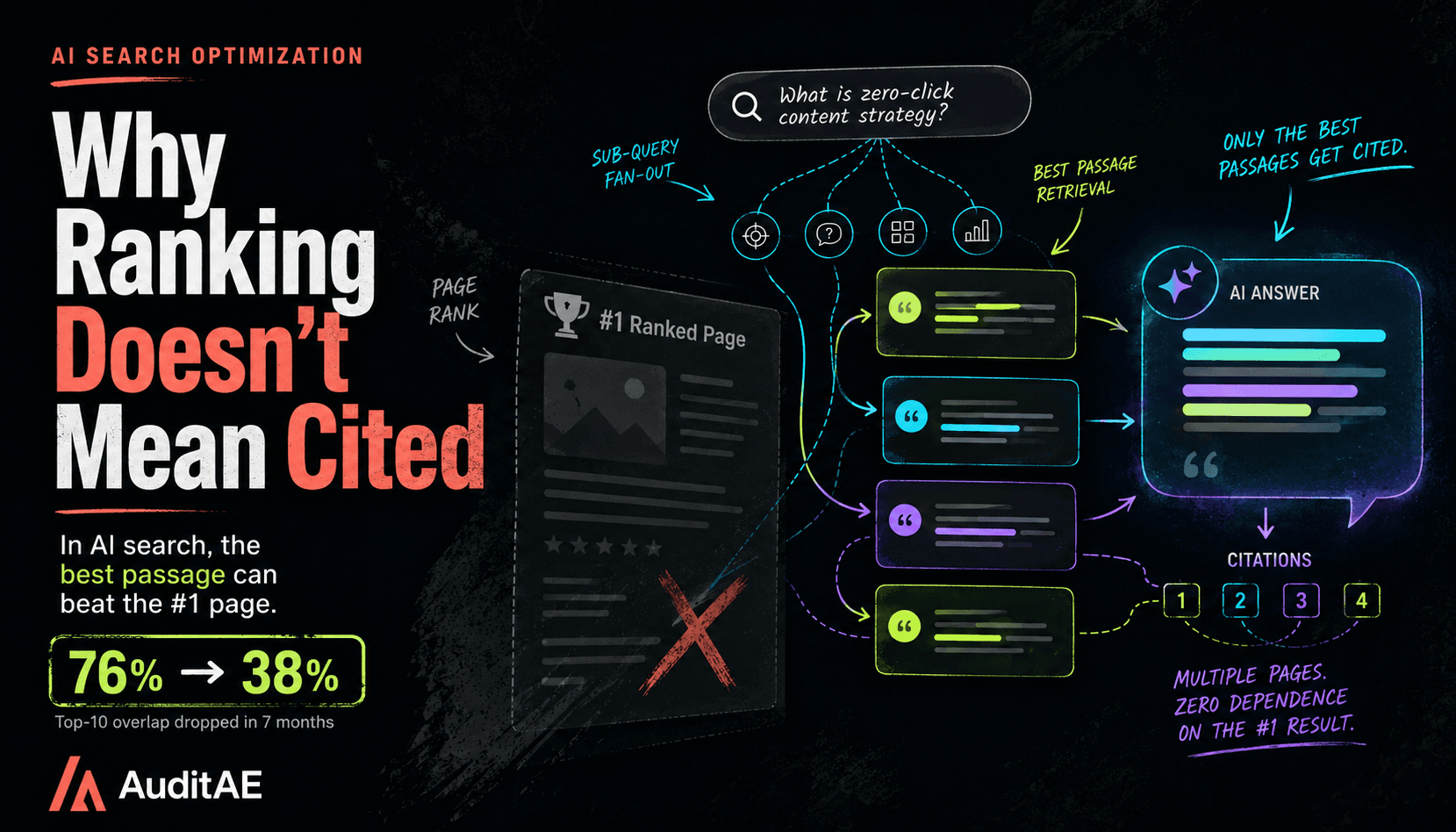
Pages cited in AI Overviews that also rank top 10 dropped from 76% to 38% in eight months. Here's what Google's May 2026 AI search guide documented, and what to change about your content.
On this page· 10 sections
On May 15, 2026, Google added a guide to optimizing for AI search to its Search documentation. The headline message: AEO and GEO are "still SEO." No separate framework needed, no special markup, no llms.txt files.
Then Ahrefs ran the numbers.
Across 863,000 keywords and 4 million URLs, pages cited in Google AI Overviews that also ranked in the top 10 dropped from 76% to 38% in eight months. BrightEdge, using a different dataset, puts the overlap even lower, closer to 17%. Surfer SEO found that 67.82% of AI Overview citations don't rank top 10 at all.
Both things are true. AI search is "still SEO." And a #1 ranking no longer predicts who gets cited.
This post reconciles those two facts: what actually changed inside Google's AI pipeline, what data the new behavior reveals, and what to change about your content if you want to keep showing up in the answer.
Citations stopped tracking rankings
The clearest single data point comes from Ahrefs. In a study analyzing 863,000 keywords against 4 million AI Overview URLs, only 38% of cited pages also appeared in the top 10 organic results for the same query. In Ahrefs' July 2025 version of the same study, that number was 76%.
That's a 50% drop in eight months.
The citations didn't disappear. They redistributed. Ahrefs found AI Overview citations now split almost evenly across three buckets:
- 37.9% from pages ranking in the top 10
- 31.2% from positions 11–100
- 31.0% from pages that don't appear in the top 100 at all
A separate BrightEdge analysis from early 2026 puts the top-10 overlap even lower at approximately 17%, depending on methodology and dataset. Surfer SEO's late-2025 study of 173,902 URLs found that 67.82% of AIO citations come from pages outside the top 10 organic results, for the main query or any of its fan-out queries.
The studies don't agree on the exact percentage, but they agree on the direction. Citation behavior changed materially between mid-2025 and early 2026. A top-10 ranking used to be a strong proxy for citation. Today it's a much weaker one.
Ahrefs flags one contributing factor: Google upgraded AI Overviews to Gemini 3 globally on January 27, 2026. The shift in citation behavior maps onto that timing. Ahrefs also improved how it parses AI Overview citations between the two studies, so some of the change may be measurement.
What Google finally documented
Google first named query fan-out when it launched AI Mode in May 2025, but it said little about how AI Overviews picked sources. On May 15, 2026, it published Optimizing your website for generative AI features on Google Search and explained the mechanism in its Search documentation.
Two systems run behind every AI search:
RAG (Retrieval-Augmented Generation). Google also calls this grounding. The model doesn't generate answers from training data alone. It first retrieves real documents from Google's index, then synthesizes an answer grounded in those documents.
Query Fan-Out. The original user query gets exploded into multiple parallel sub-queries that retrieve different passages from different sources.
Google's own example in the guide: a user searches "how to fix a lawn that's full of weeds." The system might rewrite that into sub-queries like "best herbicides for lawns," "remove weeds without chemicals," and "how to prevent weeds in lawn." Each one runs against the index. Each one pulls a different passage from a different page. The final AI Overview is assembled from those passages.
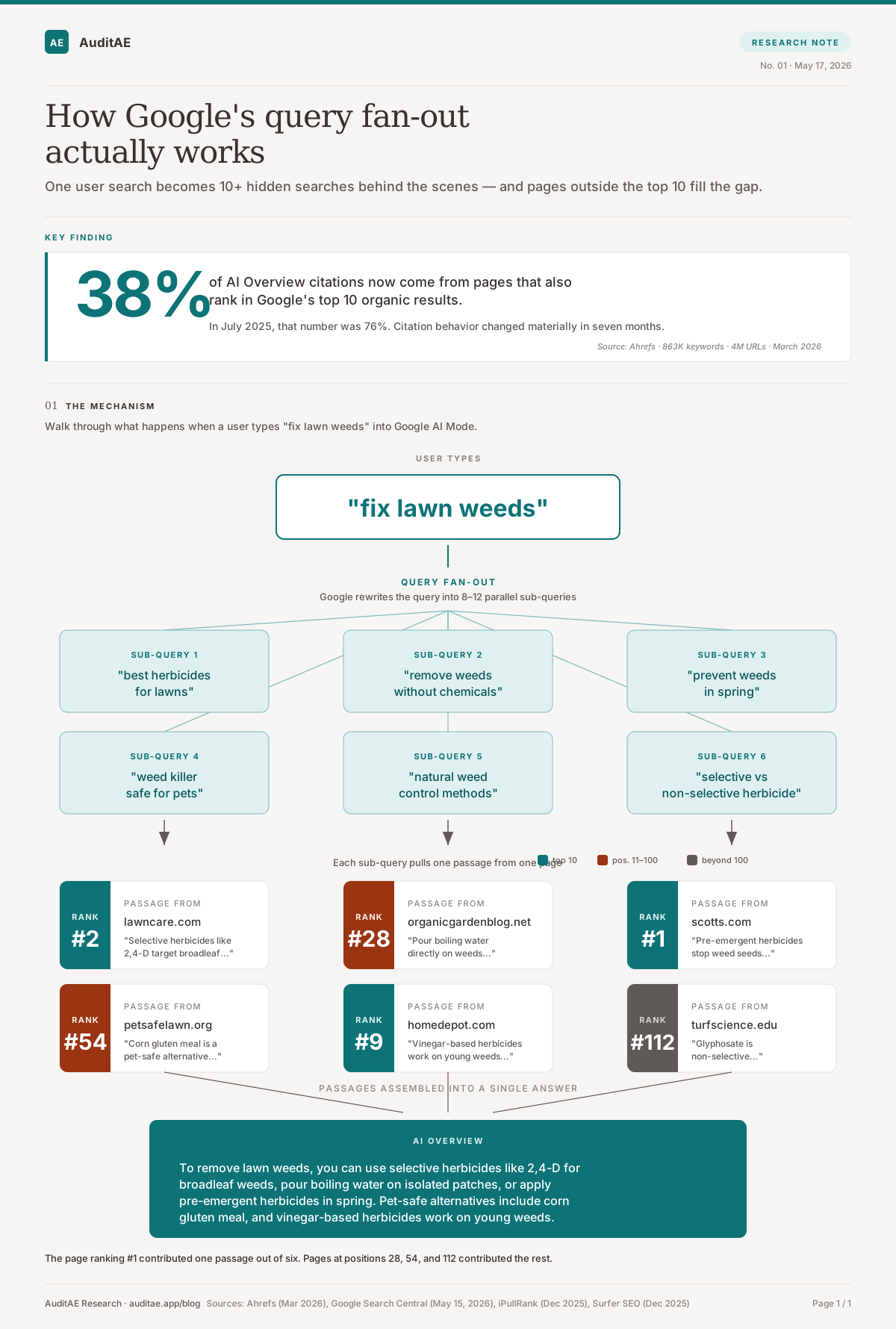
The scale can be large. When Google announced Deep Search in AI Mode in May 2025, it said the feature can issue hundreds of searches to build one fully cited report. The prompts going in are longer too: iPullRank's December 2025 analysis, based on Similarweb data, found that queries submitted to AI search tools average 70–80 words, compared to 3–4 words on Google.
This is the part nobody could see from the outside. Your "fix lawn weeds" page might rank #2 for that exact phrase and still lose every citation slot, because the AI ran a different search than the one the user typed, and your page didn't have the best paragraph for any of the sub-queries.
The contradiction that isn't
There's a second data point that, on the surface, seems to contradict the Ahrefs collapse.
iPullRank's relevance engineering team (Mike King's group, the same researchers who built Qforia for visualizing fan-out) reports that ranking position is still the gatekeeper for AI citation in their own data. Patrick Schofield, iPullRank's Lead Relevance Engineer: "Traditional ranking position is still the great gatekeeper in AI citations. Our data shows a stark drop-off in AI citations for any page ranking outside of the top 10."
So which is it? Is ranking still the gatekeeper, or are nearly a third of citations now coming from outside the top 100?
Both. Ranking still gives you the best odds; it just predicts citation far less reliably than it did. Look at it per ranking position: in the Ahrefs data, the ten top-10 positions share about 38% of citations, while the ninety positions from 11 to 100 share about 31%. Per page, a top-10 spot is still far better odds. It's just no longer close to a sure thing.
In mid-2025, a top-10 ranking was a strong predictor of citation. Today it's a weaker one, because the system might run a sub-query you don't rank for and pull from a page on position 30 that does. But ranking outside the top 10 on the underlying query still drops your citation probability sharply.
The new shape of the game:
- A top 10 ranking gives you the best odds of getting into the candidate pool.
- Inside the pool, the page with the best paragraph for the most fan-out sub-queries wins the citation.
- Below the top 10, you're one of ninety pages sharing the ~31% of citations Google pulls from positions 11–100, so your odds per page drop fast.
YouTube is the outlier worth flagging. Ahrefs' Brand Radar finds YouTube is now the single most-cited domain in AI Overviews, up 34% over six months, accounting for 18.2% of citations that come from outside Google's top 100. If you publish video, treat the transcripts as a citation surface too.
What cited pages have in common
Across the studies, the cited pages share four consistent traits.
Length. iPullRank's research found cited URLs average 1,800 words. Non-cited URLs average 1,200. That's not a case for padding. Thin content can't cover the breadth of sub-queries fan-out generates, but bloated content gets skipped just as fast.
Structured data. SE Ranking's analysis found ~65% of pages cited in Google AI Mode include schema markup. The number is even higher for ChatGPT at ~71%. Google's May 15 guide says structured data isn't required for AI features. And correlation isn't cause: when Ahrefs tracked 1,885 pages that added schema between August 2025 and March 2026, their AI citations barely moved. Use schema to describe the page accurately, not as an AI citation lever.
Entity density. iPullRank found mid-tail queries saw a 292% lift in citation probability when pages were optimized for entity density: the count and clarity of named brands, tools, methods, and adjacent concepts. AI systems retrieve pages that surface the right entities for a sub-query. Pages that paraphrase around the specific terms users search for get skipped.
Multi-format coverage. Cited pages tend to mix prose, definitions, comparison tables, and FAQ blocks. Each format paraphrases well into different sub-query answers. A 1,800-word essay with no tables, no lists, and no FAQ has fewer surfaces to be quoted from than a 1,400-word piece structured around multiple answer shapes.
The unit shifted from page to passage
Each H2 section on your page now functions like its own mini-result for whichever sub-query it answers best. Optimize accordingly.
Lead every section with the answer. Don't bury the lift behind anecdote or framing. The first sentence of each H2 should be quote-ready in isolation.
Use question-shaped H2s and H3s. Headers that mirror likely fan-out sub-queries make the retrieval step's job easier. "Best CRM features for small teams" beats "Features."
Add an FAQ block that targets fan-out sub-queries explicitly. Three to five questions per page, phrased exactly how a user might prompt them, with one-paragraph answers underneath. It's a small edit, and a good place to start on pages that already rank but don't get cited.
Increase entity density. Audit each page for the named brands, tools, methods, statistics, and adjacent concepts a user might search for. Mention them by name. Don't substitute generic phrases.
Use schema markup that matches the page. Article, Product, and FAQPage for visible Q&A. Google no longer shows FAQ or HowTo rich results, its guide says schema isn't required for AI, and Ahrefs found adding it didn't move AI citations. Google says it still uses structured data to understand pages.
Stop trying to rank for everything on one page. Pick the cluster of sub-queries you want to own, build each one a dedicated section with a dedicated answer, and let the page win citations across the cluster rather than fighting for the main keyword alone.
For the deeper engine-specific tactics, see How to rank on ChatGPT and How to rank on Perplexity. The principles above apply to all four engines; the per-engine deep dives cover the differences in retrieval behavior.
Finding the sub-queries Google generates
You can't optimize for sub-queries you can't see. Tools that surface fan-out expansions include:
- Qforia. Built by Mike King at iPullRank. Generates fan-out query expansions for any topic. The closest available view into how Google's AI Mode expands a user query.
- GoFishDigital's Gemini API + Screaming Frog workflow. A scriptable pipeline for extracting AI Overview fan-outs at scale across a site or competitor set.
- WordLift AI Visibility Fan-Out. Collaborative research interface for the same purpose.
You can also generate plausible fan-out queries yourself by prompting any frontier LLM: "Here's a search query: [X]. If you were a search system that needed to retrieve diverse passages to answer this comprehensively, what 10–15 sub-queries would you generate?" The exact queries won't match Google's (fan-out is probabilistic and varies per run), but the recurring themes will. Those themes are what your content architecture should cover.
The goal isn't perfect replication of Google's internal fan-out. It's identifying the cluster of intents your topic triggers and building content that answers each one in a discrete, citable passage.
Generating the sub-queries is the easy half
Every tool above stops at the same place: it hands you a list of sub-queries. None of them can tell you whether your page answers any of them, because none of them have your content. You get fifteen plausible questions and a manual reading job.
That gap is the whole reason we built fan-out coverage into the free AuditAE WordPress plugin. It runs in the post editor, and it does the second half:
- Models the fan-out for the post you're writing, from your own focus keyword, categories, post titles and Organization schema. Same caveat as everything else in this section: these are modeled sub-queries, not the ones Google ran. Nobody can show you those.
- Splits your draft at its heading boundaries, which is the closest approximation of the passages a retrieval system would chunk it into.
- Scores which passages answer which sub-queries, and sorts the misses to the top.
The output is a worklist rather than a score. Instead of "add more depth," you get "nothing in this post says what it costs," with the sub-query spelled out and a prompt to add an H2 with a short, direct answer. Sub-queries are grouped by fan-out type, so you can also see which kind of question your content keeps skipping: comparative gaps read very differently from pricing gaps.
It's free, it needs no account, and it makes no external requests. The sub-queries are built from your own database, so nothing about your draft leaves your server.
One deliberate omission worth explaining: it doesn't show you rows like "what is [your topic]". A reformulation restates your topic in different words, so there's no distinguishing term to look for, and any on-topic post covers it by construction. Scoring those rows would mean either passing them automatically (meaningless) or reporting a post that opens with a textbook definition as missing its own definition. The gaps that matter live in the other five fan-out types.
The measurement gap
Search Console tells you which queries your pages rank for and how often they get clicked. It doesn't tell you which paragraphs got pulled into an AI Overview, or which fan-out sub-queries you got cited on. GA4 doesn't see citations that never produced a click, and most don't.
Since June 2026, Google has been rolling out a Generative AI performance report in Search Console. It shows AI Overview and AI Mode impressions by page, with no queries, clicks or passages, and it covers Google only. Which paragraph got cited, and whether ChatGPT, Perplexity or Gemini cited you at all, still isn't in the standard tools.
The workaround is to query the engines directly: run your prompt set against ChatGPT, Perplexity, Gemini, and AI Overviews on a schedule, capture the full answer text, and track which prompts cite you, which cite competitors instead, and which sources the engines pulled from. That's the measurement layer that maps onto how AI search actually works.
For the methodology (what counts as a "citation," how different engines define it, and how to build a defensible prompt set), see What counts as a citation. For the monthly workflow that wraps citation tracking into a client deliverable, see Writing a monthly client report in ten minutes with AEBOT.
What "still SEO" actually means
Google's May 15 guide is right that AI search is "still SEO" in the technical sense. Same crawlers. Same index. Same core ranking systems. The page that gets cited is the page that earned the right to be in the index in the first place.
But the unit of optimization changed. A page used to compete as a whole: one ranking, one click, one sentence about you in the SERP description. Now it competes paragraph by paragraph against the fan-out queries Google generates in the background.
Top 10 is still the best starting position. The competition for citation happens at the passage level, against sub-queries the user didn't type.
Want to see which prompts cite you across all four engines? Run the free AI visibility checker: drop in your brand, your domain and one prompt your buyers actually ask. We'll show you which engines cite you, which cite competitors, and where the gap sits across ChatGPT, Perplexity, Gemini, and Google AI Overviews.
FAQ
Query fan-out is the process where AI search systems take one user query and explode it into multiple parallel sub-queries before retrieving content. In Google's example, 'how to fix a lawn that's full of weeds' fans out into sub-queries like 'best herbicides for lawns,' 'remove weeds without chemicals,' and 'how to prevent weeds in lawn.' Each pulls a different passage from a different page. The final AI answer is assembled from those passages. Google officially documented this in its May 15, 2026 AI search optimization guide.
Yes, but in a different way than it used to. A top-10 ranking still gives a page the best odds of being cited, and iPullRank's data shows citations drop off sharply below the top 10. But a top-10 ranking no longer predicts citation the way it did in mid-2025: in Ahrefs' March 2026 study, 62% of AI Overview citations came from pages outside the top 10. The page with the best paragraph for the fan-out sub-query often wins, regardless of organic position.
Tools that surface fan-out expansions include Qforia (built by iPullRank's Mike King), GoFishDigital's Gemini API + Screaming Frog workflow, and the WordLift AI Visibility Fan-Out tool. You can also generate plausible sub-queries yourself by prompting a frontier LLM with your main query. The exact queries won't match Google's, since fan-out is probabilistic, but the recurring themes will. Note that all of these stop at generating the list; none can tell you whether your own page answers them.
Yes, if you're on WordPress. The free AuditAE plugin adds a Query Fan-Out coverage panel to the post editor: it models the sub-queries for the post you're writing, splits your draft at its headings, and shows which passages answer which sub-queries, with the misses sorted to the top. The sub-queries are modeled from your own site rather than pulled from Google (nobody can show you Google's actual fan-out), but the coverage check runs against your real draft. It runs entirely on your own server and makes no external requests.
Not natively. Search Console tells you which queries your pages rank for but doesn't surface which paragraph got pulled into an AI answer. GA4 doesn't see citations that don't produce clicks. The workaround is to query the engines directly with your prompt set and capture the full answer text. That's the layer AuditAE was built to measure.
No. Google's guide says optimizing for generative AI search is 'still SEO': its AI features retrieve pages through the same core ranking systems and Search index that feed classic results. What changed is the unit of optimization: pages now compete passage-by-passage against fan-out sub-queries, not as wholes against a single keyword.
Run the citation report on your own brand.
See which prompts cite you on ChatGPT, Perplexity, Gemini, and Google AI Overviews — the first one’s free, no card.
Aaron is the founder of AuditAE. He has run AI-visibility audits for SEO agencies and in-house brand teams, and writes about how generative answer engines are reshaping the practice of search marketing.
Related reading
- 2 min readAI visibility vs. SEO: what changes in 2026Ranking #3 on Google was a finishable game. Getting cited inside the answer is a different one. Here's what carries over from SEO and what doesn't.
- 9 min readWhat is Answer Engine Optimization (AEO)? A 2026 guideAnswer engine optimization (AEO) is the practice of getting your brand cited inside ChatGPT, Perplexity, Gemini, and Google AI Overviews, the surfaces replacing the blue-link click. Here's how AEO works, how it differs from SEO, and how to measure it.
- 11 min readAI search optimization: the 2026 playbookA complete guide to AI search optimization: how AI engines pick what to cite, the five layers that drive citation, what differs between ChatGPT, Perplexity, Gemini, and AI Overviews, and how to measure it.