
How to rank on ChatGPT: the citation playbook for 2026
ChatGPT picks citations from two pipelines at once — the model's trained recall and SearchGPT's live Bing retrieval. The breakdown, the eight levers, and a 14-day sprint.
You "rank" on ChatGPT by getting picked as one of the 3-5 cited sources, and there are two completely different paths in: the model's trained recall (about 60% of answers) and SearchGPT's live Bing retrieval (about 40%). Most ranking advice optimizes for the wrong one. This post walks through both pipelines, the eight levers that move citation rate on each, and a 14-day sprint to apply them.
ChatGPT processes more than 1 billion queries a day and reaches around 900 million weekly active users. It's also the hardest of the four major AI engines to win citations on, because the path to a citation runs through two pipelines that respond to entirely different signals.
What "ranking" on ChatGPT actually means
Like Perplexity, ChatGPT doesn't have blue links, so the rank-tracking instinct from traditional SEO doesn't translate. The unit of victory is the citation, not the position. But unlike Perplexity, ChatGPT picks citations from two completely different sources, and which one gets used depends on the query.
About 60% of ChatGPT answers come from parametric knowledge — the model writing from what it learned during training, with no live web search at all. Brand mentions in those answers come from how often and how prominently your brand appeared in the training corpus. There's no URL to "earn" on this path; the model is recalling associations it already learned.
The other ~40% of answers trigger SearchGPT, ChatGPT's live retrieval mode. Here the model fetches pages from Bing's real-time index plus OpenAI's own OAI-SearchBot crawl, reads them, and synthesizes an answer with numbered footnotes.
Both pipelines feed the same answer surface in the chat window, but they respond to entirely different signals. Parametric citations move on what the model "remembers" from training. Retrieval citations move on what's currently published, indexed in Bing, and structurally extractable. A complete ChatGPT strategy works on both at once. (For the step-by-step version of both paths, see How to show up in ChatGPT results; for the cross-engine measurement frame this all sits inside, see the AEO playbook.)
How ChatGPT selects sources
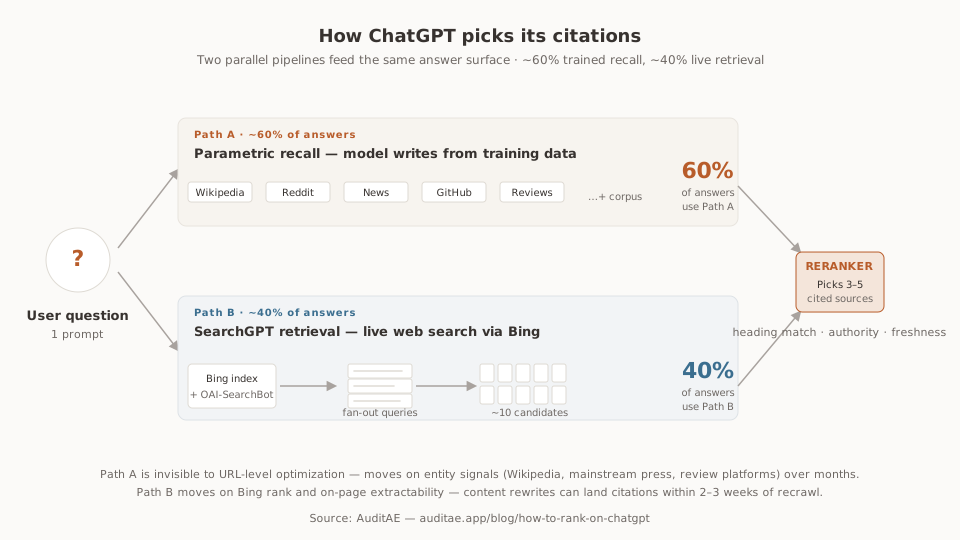
Five steps decide whether you make it into a citation, and they split into two parallel tracks.
Path A — parametric recall. When the query is general enough that the model is confident, ChatGPT skips web search entirely and answers from training data. The training corpus is heavily weighted toward Wikipedia, Reddit, GitHub, mainstream news, and major publisher content. Wikipedia alone accounts for roughly 7-8% of all ChatGPT citations and dominates top citations on definitional and explainer queries. If your brand is mentioned in those sources, the model has learned to associate you with the topic. If not, you're invisible on this path until you build that presence.
Path B — SearchGPT retrieval. When the query is recent, specific, or research-style, ChatGPT triggers a live web search. Most search queries get expanded into multiple sub-queries (the "fan-out" pattern), each one hitting Bing's index. Pages are pulled, ranked, and the top retrieval result gets cited about 58% of the time; position 10 only about 14%. Bing's rank is the dominant retrieval signal, and it's a separate index from Google.
The reranker. Both retrieved candidates and parametric recall pass through the same final filter: a GPT-class model that picks which 3-5 sources to actually cite. It weights heading-query match, content extractability, source authority (Wikipedia, mainstream press, review platforms), and freshness. Around 85% of retrieved pages are read but never cited.
Two things fall out of that pipeline that don't get talked about enough:
- The two paths are not equally addressable. Path A — parametric recall — moves on a 6-12 month timescale because it depends on training-corpus presence. Path B — retrieval — moves on a 1-4 week timescale because it depends on what's currently indexed. Most ChatGPT optimization wins come from path B, even though path A produces ~60% of the citations.
- Only ~12% of ChatGPT-cited URLs appear in Google's top 10 for the same query. Google ranking is not a reliable proxy for ChatGPT citation. Bing rank is. Most teams skip Bing entirely, which is most of why their content never surfaces.
Why ChatGPT is the hardest engine to win on
Perplexity is retrieval-heavy and rewards content rewrites in days. Gemini grounds in Google's index and rewards strong E-E-A-T. Google AI Overviews lean on the same plus structured data. ChatGPT splits the difference — it's the most parametric-heavy of the four, which means roughly half the work has to be invested in long-running entity signals (Wikipedia, mainstream press, review platforms) rather than on-page content. Those signals don't move with a rewrite. They move with months of earned-media work.
Practically: a focused content rewrite can move you onto SearchGPT citations within 2-3 weeks of a fresh Bing crawl, but lifting parametric citations is a 3-6 month project. If you only have bandwidth for one engine, ChatGPT is the slowest payoff. If you're optimizing for all four, ChatGPT is the one to start on first because of the long latency on path A.
Eight levers that move ChatGPT citations
These are ordered by ratio of effort to payoff. Run them in order if you're starting from zero — the first three are non-negotiable foundations.
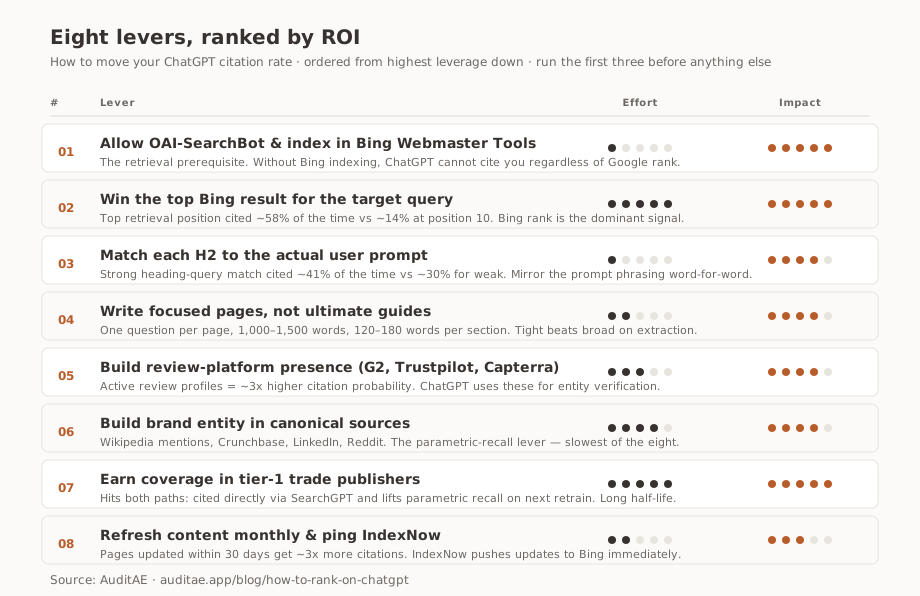
1. Allow OAI-SearchBot and index in Bing
This is the prerequisite for path B and the single most-skipped step. ChatGPT cannot cite a page that isn't indexed in Bing, regardless of Google ranking. Two specific actions:
- Check
robots.txt: confirmOAI-SearchBotandBingbotare not disallowed. Many security plugins block AI crawlers by default. (GPTBotis a separate bot for training; you can block it without affecting search citations.) On WordPress, the complete robots.txt guide covers how to check and fix this in a minute. - Create a Bing Webmaster Tools account and submit your XML sitemap. Use Bing's IndexNow API to push fresh and updated URLs immediately rather than waiting for natural recrawl.
This is a 30-minute job and gates everything else.
2. Win the top Bing result for your target query
With the top retrieval position cited 58% of the time, a strong Bing rank is the dominant lever on path B. Bing's index is smaller than Google's, which is good news — competition is thinner, and it tends to favor older established domains for head terms but is more open to mid-DA sites for long-tail. Run your priority queries through Bing directly. Note where you rank. Treat it like a separate SEO surface, because it is.
3. Match each H2 to the actual user prompt
Heading-query match is the strongest on-page citation signal. Pages with strong heading-prompt alignment get cited about 41% of the time vs ~30% for weaker matches. If a buyer would type "what's the best CRM for early-stage SaaS startups" into ChatGPT, your H2 should read "What's the best CRM for early-stage SaaS startups" — not "Our CRM Selection Framework." Match the prompt phrasing word-for-word where possible.
4. Write focused pages, not ultimate guides
ChatGPT consistently picks tightly-focused pages over comprehensive ones. A page that answers one specific question deeply outperforms a 5,000-word "ultimate guide" that touches eight loosely-related topics. The model is looking for a passage to lift. If your answer is buried in section 9 of 14, it's not getting picked. The 2026 pattern is one question per page, 1,000-1,500 words, and 120-180 words per section.
5. Build review-platform presence
Sites with active G2, Trustpilot, Capterra, or category-specific review profiles have roughly 3x higher citation probability than those without. ChatGPT uses these platforms for entity verification — they signal "this brand actually exists, has real customers, and operates in this category." For B2B SaaS, G2 is non-negotiable; for consumer, Trustpilot or industry-specific sites do the same job. Volume of reviews matters more than star rating once you're above ~50 reviews.
6. Build your brand entity in canonical sources
This is the parametric-recall lever and the slowest of the eight. The training corpus is heavily weighted toward Wikipedia, Crunchbase, LinkedIn, Reddit, and major publishers. Brands that are well-represented in those sources get recalled in parametric answers; brands that aren't, don't. Concretely:
- Get listed on Crunchbase with complete information.
- Maintain a real LinkedIn company page with active posts.
- Aim for Wikipedia presence — either a full page (hard, requires notability) or, more achievable, brand mentions inside Wikipedia articles about your category.
- Participate substantively on Reddit threads in your niche. (Same playbook as Perplexity — see How to rank on Perplexity for the participation rules.)
7. Earn coverage in tier-1 trade publishers
Earned media in mainstream and trade publications does double duty: the article itself can get cited directly via SearchGPT, and the brand mention inside it shows up in the next training-data snapshot, lifting your parametric recall. This is the slowest lever — the parametric half won't show up until the model retrains — but it has the longest half-life. A single Bloomberg or TechCrunch feature keeps showing up in citations for years.
8. Refresh content monthly and use IndexNow
ChatGPT's reranker weights freshness, especially on time-sensitive queries (pricing, "best of" lists, current-year topics). Pages updated within 30 days get roughly 3x more citations than older content. The cheap version: bump a "Last updated" date and do a substantive edit. The expensive version: editorial calendar that re-touches your top citation candidates every 2-4 weeks. After every update, ping IndexNow so Bing pulls the change immediately.
What matters less than you think
A few things that get over-indexed on in generic "rank on ChatGPT" guides:
- Google ranking. Only ~12% of ChatGPT-cited URLs are in Google's top 10. Optimize for Bing rank, not Google's, when the goal is ChatGPT visibility.
- Word count. Long pages aren't punished, but they aren't rewarded either. The 120-180-words-per-section pattern matters more than total page length.
- Page volume. Twenty deep, well-researched pages on one topic outperform two hundred thin ones. ChatGPT's reranker weighs topical authority — same as classic SEO but more aggressively.
- Blocking GPTBot. This is a different question from search visibility. Blocking GPTBot only affects training-data inclusion. Search citations come through
OAI-SearchBot, which is a separate bot with its own robots.txt rule. The mainstream-publisher default is now: block training, allow retrieval.
How to measure it
Same frame as the other engines: citation rate against a fixed prompt set, run on a schedule. The ChatGPT-specific wrinkle is that you need to measure both modes — parametric and SearchGPT — separately, because they move on different timescales.
The minimum useful version:
- Write 25 prompts your buyers would actually type into ChatGPT. Real, full-sentence questions.
- Run each one twice: once with web search disabled (parametric mode) and once with web search enabled (SearchGPT). Record citations from each, separately.
- Re-run weekly during an active sprint, monthly in steady state.
- After any meaningful change — a content rewrite, a new G2 review, a press placement — re-audit and look for movement on the affected prompts specifically.
You can do this manually for 25 prompts. Beyond that, the cell-by-cell math gets unwieldy. AuditAE was built for exactly this loop: pay-per-check audits, 7¢ per cell for ChatGPT (5–12¢ across the four engines), all four engines including both ChatGPT modes. (For the workflow that turns this into a monthly client deliverable, see Writing a monthly client report in ten minutes.)
A 14-day ChatGPT sprint
If you want to apply all of this on a real timeline:
Days 1-3: Foundations. Verify OAI-SearchBot and Bingbot are allowed in robots.txt. Set up Bing Webmaster Tools, submit sitemap, enable IndexNow. Pick 25 prompts and audit ChatGPT for current citation rate, both with and without web search enabled.
Days 4-7: On-page rewrites. For each priority prompt where a competitor is cited and you aren't, rewrite the corresponding page. Match H2s to the prompt phrasing word-for-word. Restructure into focused 1,000-1,500-word pages, one question per page. Add Article + FAQPage + Organization schema. Push the updates via IndexNow.
Days 8-10: Entity and review-platform work. Audit your G2, Trustpilot, and Capterra presence and fill any gaps. Update your Crunchbase profile. Identify two Wikipedia articles in your category and look for legitimate brand-mention placements. Make a list of 5 trade publications worth pitching for the next quarter.
Days 11-14: Wait for Bing to re-crawl (typically 3-7 days after IndexNow), then re-run the original 25 prompts. Measure the SearchGPT-mode delta — that's where movement shows up first. The parametric-mode delta will lag by months and is mostly tracking the work from days 8-10 and beyond.
Two weeks isn't enough to move parametric recall — that's a 3-6 month curve. But it's enough to see SearchGPT citations move on the on-page work, and to confirm the foundations are in place for the slower work to compound.
Want to see your current ChatGPT citation rate before you start? Run a free audit on AuditAE — drop in your prompts and we'll show you exactly which ones cite you, which ones cite competitors, and where the gap sits across all four engines.
FAQ
How long does it take to start ranking on ChatGPT?
SearchGPT (retrieval) citations can move within 2-3 weeks of indexing changes and a Bing recrawl. Parametric (training-data) recall moves on a 3-6 month timescale because it depends on entity signals — Wikipedia mentions, review-platform presence, mainstream press — that the model only re-encounters on retraining. Plan for both timeframes; most teams overweight on-page and underweight entity work.Should I block GPTBot in robots.txt?
GPTBot is OpenAI's training crawler, separate from OAI-SearchBot which handles SearchGPT retrieval. Blocking GPTBot stops your content from being used for model training but does not affect ChatGPT search citations. The mainstream-publisher default in 2026 is block training (GPTBot, ClaudeBot, CCBot), allow retrieval (OAI-SearchBot, Claude-SearchBot, Perplexity-User). If your goal is citation visibility, never block OAI-SearchBot.Does ChatGPT use Google or Bing?
SearchGPT uses Bing's index as its primary real-time retrieval layer, supplemented by OpenAI's own OAI-SearchBot crawl. Bing's index is independent of Google's and meaningfully smaller. Most sites are indexed in Bing as a byproduct of being in Google, but coverage is patchier — submitting your sitemap to Bing Webmaster Tools and pinging IndexNow on updates is the highest-leverage technical move for ChatGPT visibility.Do I need backlinks to rank on ChatGPT?
Authority signals matter, but ChatGPT's authority signal is heavily weighted toward entity verification — review platforms (G2, Trustpilot, Capterra), Wikipedia mentions, mainstream press — rather than raw backlink volume. Sites with active review-platform profiles have roughly 3x higher citation probability than those without. Backlinks help indirectly by lifting Bing rank, but entity work usually moves the needle faster.Can a small site get cited by ChatGPT?
Yes, particularly on long-tail queries where Bing's index has thinner competition and the parametric path is less dominant. The pattern: a focused 20-page niche site with strong heading-query match and tight, extractable answers can outperform a 500-page generalist site on specific buyer prompts. Head-term queries are harder because parametric recall favors well-known entities.Does ChatGPT use schema markup?
Yes, especially for the SearchGPT retrieval path. Article, FAQPage, and Organization schemas all help the extractor parse content cleanly. Pages with three or more schema types have roughly 13% higher citation likelihood. Schema is not a primary ranking factor but it's cheap to add and removes ambiguity at the extraction step.How is ranking on ChatGPT different from ranking on Perplexity?
Perplexity is almost entirely retrieval-driven and rewards on-page rewrites in days. ChatGPT splits citations roughly 60/40 between parametric recall and live retrieval — meaning roughly half the win is in long-running entity signals (Wikipedia, mainstream press, review platforms) that don't move with a content rewrite. ChatGPT also routes through Bing rather than Google. Same brand, very different tactical playbook per engine.How often should I re-audit?
Weekly during an active optimization sprint, monthly in steady state. Run prompts with web search both enabled and disabled to track parametric and retrieval citations separately — they move on different timescales and the gap between them tells you which lever to pull next.
Aaron is the founder of AuditAE. He has run AI-visibility audits for SEO agencies and in-house brand teams, and writes about how generative answer engines are reshaping the practice of search marketing.
Related reading
- 9 min readHow to Show Up in ChatGPT Results (2026): A Complete, Tested PlaybookTwo paths get you into ChatGPT's answers: be crawlable and indexed in Bing so ChatGPT Search can cite you live, and build mentions across the web so the model brings you up on its own. The complete playbook — real schema, the Bing setup, multi-engine differences, and how to measure it.
- 10 min readHow to Improve Brand Visibility in AI Search Engines: 8 Fixes You Can Ship This MonthAI engines already have an opinion about your brand. Here is how to check what it is, and the eight fixes, in order, that change it — with the WordPress path for each one.
Run the citation report on your own brand.
See which prompts cite you on ChatGPT, Perplexity, Gemini, and Google AI Overviews — the first one’s free, no card.