How to track brand mentions in AI search (2026 guide)
Step-by-step guide to tracking whether ChatGPT, Perplexity, Gemini, and Google AI Overviews cite your brand — what to measure, how often, which tools work.
You track brand mentions in AI search by querying ChatGPT, Perplexity, Gemini, and Google AI Overviews on a fixed prompt list, scoring each answer for whether your brand was cited, and diffing results week-over-week. That's the whole methodology. The rest of this guide is what each step looks like in practice.
Half of US consumers now use generative AI to research products. They ask ChatGPT for the best tool, Perplexity for a comparison, Gemini for a recommendation. If your brand isn't named in those answers, you're invisible — and you won't see it in Google Analytics, because the click never happened.
This guide walks through how to actually track whether your brand gets cited in AI search, what signals matter, and how often to check. For the broader measurement-program framing this fits inside, see AI brand monitoring.
What counts as "AI search" in 2026?
When we say "AI search," we mean four answer engines that now sit between users and the open web:
- ChatGPT with web search enabled
- Perplexity (Sonar models)
- Google Gemini with grounded search
- Google AI Overviews — the AI box at the top of regular Google results
Each pulls from the web, synthesizes an answer, and cites a handful of sources. Each picks different sources for the same query. That's the whole problem: there is no single SERP anymore. There are four, and they often disagree.
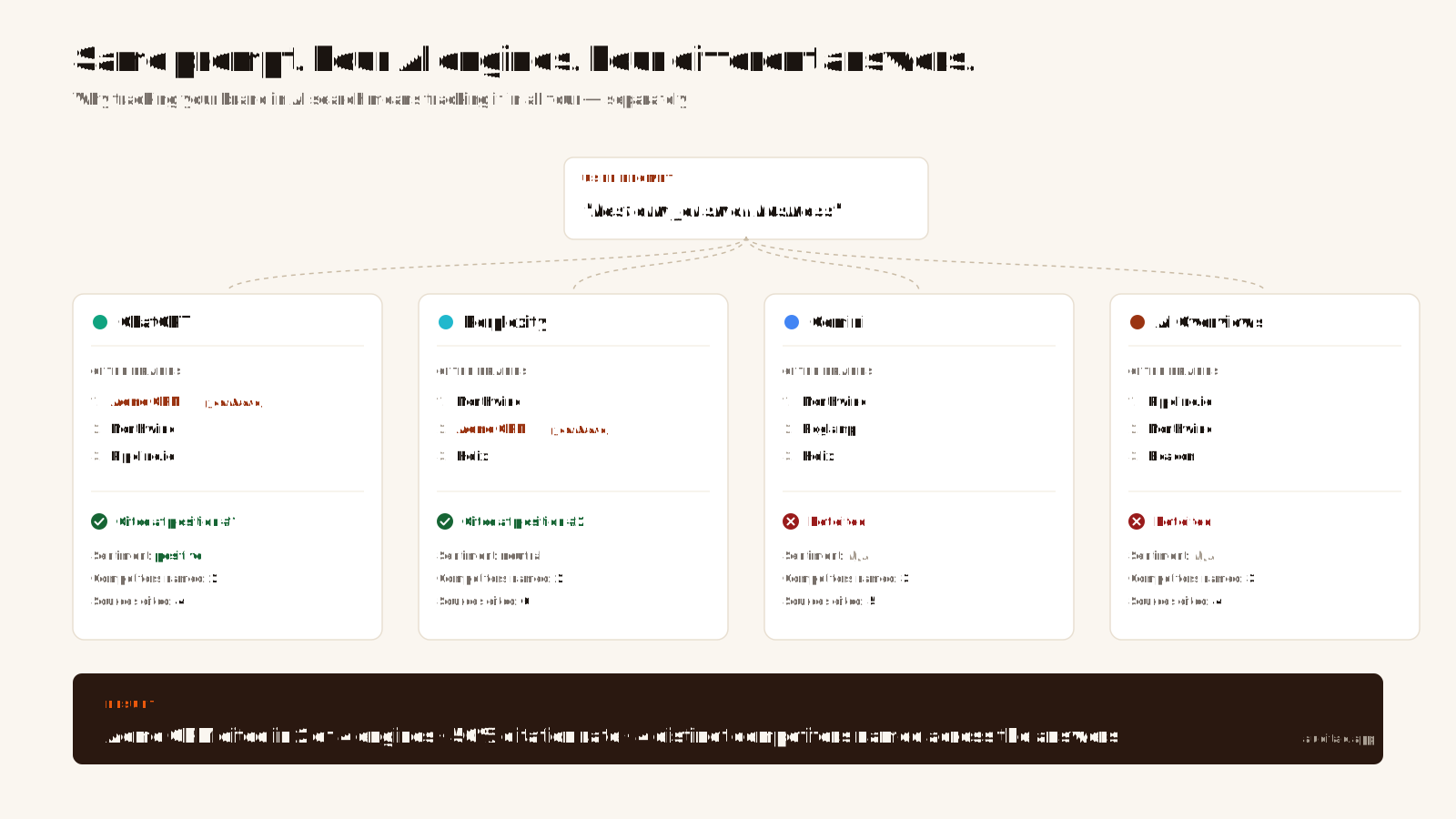
What to track
Forget keyword rankings. The four signals that matter for AI search are:
- Cited (yes/no) — does the engine name your brand or domain in its answer?
- Position in the answer — is your brand mentioned first, third, or buried in paragraph four?
- Sentiment — is the mention positive, neutral, or negative?
- Competitors — which other brands are named in the same answer?
The fourth is the most underrated. If a buyer asks "best CRM for small business" and your competitor is cited but you aren't, you've lost a deal you didn't know was happening.
(For the engine-by-engine breakdown of how each one defines a "citation," see What actually counts as a citation.)
The 4-step process
Step 1: Build your prompt list
You can't track every possible query, so start with the 20–50 prompts that matter most for your business. Mix three types:
- Brand prompts: "Is [your brand] any good?" / "[your brand] vs [competitor]"
- Category prompts: "Best [your category] for [audience]" / "Top [your category] in 2026"
- Problem prompts: "How do I [the job your product does]?"
Brand prompts tell you what the engines say about you. Category prompts tell you whether you're in the consideration set. Problem prompts tell you whether you're recommended at all.
Step 2: Run each prompt against all four engines
This is where it gets tedious. Each engine has its own UI, and answers vary by run, by user history, by region. To get clean signal you need to:
- Run the same prompt against all four engines on the same day
- Use a clean session (no logged-in personalization)
- Capture the full answer text, not just whether your brand showed up
- Pull the cited sources from each answer
Doing this manually for 50 prompts × 4 engines = 200 queries × ~5 minutes each = roughly 16 hours of clicking. Once a week. That's why people automate it.
Step 3: Score each result
For every (prompt, engine) cell, record:
| Field | What to capture |
|---|---|
cited | true/false — is your brand named? |
position | where in the answer the first mention appears |
sentiment | positive / neutral / negative |
competitors | every other brand named |
sources | every URL the engine cited |
Position matters because LLMs front-load their most confident answers. Being named in sentence one is dramatically more valuable than sentence eight, where most readers have stopped reading.
Step 4: Diff against last week
A single snapshot is a curiosity. Tracking changes over time is the actual product.
What you're looking for:
- Citations gained or lost
- New competitors entering the answer
- Sentiment shifting
- Sources the engines started citing instead of yours
When a citation disappears, that's the signal to investigate: did the source get removed from your site, did the engine update its index, did a competitor publish something better? (For the rewrite playbook when you find a gap, see AI search optimization.)
Manual vs automated tracking
You have three options:
Manual. Free, accurate, exhausting. Fine for under 10 prompts, untenable above that.
General-purpose social listening tools (Brandwatch, Brand24, Mention). These were built for Twitter and review sites. Most don't query AI engines directly — they scan the open web for quotes from AI tools, which misses the actual answers. Skip for AEO specifically.
Purpose-built AEO tools. Run your prompt list against ChatGPT, Perplexity, Gemini, and Google AI Overviews on a schedule, store the full results, and diff over time. AuditAE is the open one — pay-per-check at $0.05 per cell, no subscription floor, MCP server so you can wire it into Claude or Cursor and ask "where am I losing citations this week?"
How often should you check?
Depends on the prompt:
- Brand prompts: monthly is fine. Answers don't shift fast unless you publish something major.
- Category prompts: weekly. This is where competitors steal share and where you'll see new entrants first.
- Problem prompts: bi-weekly. Slower-moving but highest-leverage if you can win them.
The trap people fall into is daily tracking. AI engines have enough run-to-run variance that daily noise drowns out weekly signal. Pick a cadence and stick to it.
Want to see what ChatGPT, Perplexity, Gemini, and Google AI Overviews say about your brand right now? Run a free preview on AuditAE — no signup, no credit card.
FAQ
Is it possible to track brand mentions in AI search?
Yes. You query each engine programmatically (or through their official APIs) with your prompt list, parse the response for your brand, and store the result. The engines don't expose a 'who got cited' dashboard, so you build it yourself or use a tool that does.How do I monitor brand mentions in ChatGPT specifically?
Use the OpenAI Responses API with the web_search tool enabled. That gives you the same web-grounded answer a logged-in ChatGPT user gets, in JSON, with sources.How do I track brand mentions in Google AI Overviews?
Google doesn't expose AI Overviews via an official API. The standard workaround is SerpAPI or a similar SERP scraper that captures the AIO block when it appears.Can social listening tools do this?
Some claim to. In practice they monitor the open web for screenshots and quotes of AI answers, not the answers themselves. For AEO you want a tool that queries the engines directly.How much does it cost?
At AuditAE pricing ($0.05 per cell), 50 prompts × 4 engines weekly is about $40/month. Manual tracking is free but costs your time. Enterprise AEO tools start around $99–$500/month.How often should I check?
Brand prompts monthly, category prompts weekly, problem prompts biweekly. Daily creates more noise than signal — engines have enough run-to-run variance that small daily wiggles drown out real weekly movement.
Aaron is the founder of AuditAE. He has run AI-visibility audits for SEO agencies and in-house brand teams, and writes about how generative answer engines are reshaping the practice of search marketing.
Related reading
- 10 min readHow to rank on ChatGPT: the citation playbook for 2026ChatGPT picks citations from two pipelines at once — the model's trained recall and SearchGPT's live Bing retrieval. The breakdown, the eight levers, and a 14-day sprint.
- 9 min readHow to rank on Perplexity: the citation playbook for 2026Perplexity is the easiest of the four AI engines to win citations on with a content rewrite. The pipeline, the seven levers, and a 14-day sprint.
Run a free audit on your own brand.
See which prompts cite you on ChatGPT, Perplexity, and Google AI Overviews — no credit card, no signup required for the first one.
Start a free audit