FAQ Schema in 2026: Google Retired the Rich Result. Here's Why You Should Still Ship It
Google stopped showing FAQ rich results on May 7, 2026, which removed the only reason most sites ever added FAQ schema. The markup didn't stop working. Its audience changed. Here's what FAQPage does now, the rules that keep it valid, and how to write answers that answer engines actually quote.
On this page· 10 sections
FAQ schema had a good run as an SEO tactic. Add FAQPage markup, get expandable questions attached to your search listing, occupy more vertical space than the result below you. It worked well enough that it was abused, and Google spent three years walking it back: first restricting it in August 2023 to "well known, authoritative government and health websites," then retiring the appearance entirely on May 7, 2026.
So the honest headline is: the reason most sites added FAQ schema no longer exists. Google's FAQ rich-result documentation has been retired, the Search Console report is gone, and the Rich Results Test no longer reports on FAQ markup.
And yet I still recommend shipping it, and the case is arguably clearer now than it was in 2023, because the thing consuming it changed. This guide covers what FAQ schema actually is, what happened to it, what it does in 2026, the rules that keep it valid, and how to write answers an answer engine will quote.
What FAQ schema actually is
FAQ schema is a chunk of JSON-LD structured data that labels the question-and-answer pairs on a page so a machine doesn't have to infer them from your HTML. The type is FAQPage; the pairs live in a mainEntity array, each one a Question with an acceptedAnswer:
<script type="application/ld+json">
{
  "@context": "https://schema.org",
  "@type": "FAQPage",
  "mainEntity": [
    {
      "@type": "Question",
      "name": "How long does an AI citation audit take?",
      "acceptedAnswer": {
        "@type": "Answer",
        "text": "About three minutes for five prompts across four engines, run in parallel."
      }
    },
    {
      "@type": "Question",
      "name": "Do I need a credit card to start?",
      "acceptedAnswer": {
        "@type": "Answer",
        "text": "No. New accounts get free credit on signup, and top-ups never expire."
      }
    }
  ]
}
</script>
That's the whole thing. It goes anywhere in the page's HTML (<head> or <body> are both fine), and it changes nothing visually. The only claim it makes is a precise one: this string is a question, this string is its answer, on this page. You can generate it here without writing any of it by hand.
Note what it is not. It isn't a way to add an FAQ section to your page. The questions and answers have to already be there, in visible copy. The markup describes content; it doesn't substitute for it.
What happened: the three-year retirement
The timeline matters, because a lot of advice online is stranded at one stage or another of it.
August 2023: Google announced that FAQ rich results would only show for "well known, authoritative government and health websites," and that HowTo rich results were being limited to desktop (they were dropped entirely later). Overnight, FAQ schema stopped doing anything visible for ordinary commercial sites. Plenty of teams didn't notice, because the markup was already installed and nobody was checking a report that had quietly gone flat.
May 7, 2026: Google retired the FAQ search appearance altogether. Not restricted: gone. FAQ rich results no longer appear in Google Search for anyone.
Through 2026: the surrounding scaffolding came down with it. In June the FAQ search-appearance filter and rich-result report were withdrawn from Search Console and Rich Results Test support was removed. In August, FAQ support was removed from the Search Console API. Google's FAQ rich-result documentation itself was removed in June 2026.
What did not change: FAQPage is still a valid schema.org type, and Google's long-standing position is that structured data it doesn't use for a rich result causes no problems in Search. There is no penalty here and no cleanup task.
Should you remove it? No.
This comes up every time a rich result is deprecated, and the answer is the same. Removing FAQ schema is a migration with a guaranteed cost and no upside:
- It doesn't recover crawl budget in any measurable sense; it's a few hundred bytes of inline JSON.
- It doesn't fix a penalty, because there isn't one.
- It does delete the machine-readable version of your answers for every consumer that isn't Google's rich-result pipeline: AI crawlers, other search engines, your own internal search, and whatever parses your pages next year.
Leave it. If you were going to spend an afternoon on your FAQs, spend it on the answers.
What FAQ schema does in 2026
Here's the part worth thinking about properly, because it's genuinely different from the 2019–2023 pitch.
Classic search returned a ranked list of pages and let the user do the extraction. Answer engines don't. ChatGPT, Perplexity, Gemini, and Google's AI Overviews assemble a response out of passages: a couple of sentences pulled from a source, stitched together with passages from other sources, with attribution attached to whichever page each passage came from. This is why your #1 ranked page can be invisible in AI search: ranking is a page-level contest, citation is a passage-level one.
A question with an explicitly labelled, self-contained answer is about as extractable as content gets. FAQ schema is a machine-readable declaration that your page contains exactly those units, and precisely where each one starts and stops. For any system that reads the markup, you're removing the step where a model has to guess whether that <h3> was a question and whether the paragraph beneath it was the answer or the beginning of a sales pitch.
Now the caveat, because it matters more than the pitch. No engine publishes FAQPage as a ranking or citation factor, and I'm not going to claim one. Google's own guidance for its AI features says there's no special schema.org structured data you need to add to appear in AI Overviews or AI Mode. Nobody outside those companies knows the weight. What's observable is the shape of what gets cited (short, direct, self-contained answers to specific questions), and FAQ schema is the cleanest way to label that shape. The same honest framing applies here as to llms.txt files: worth doing because it's cheap, unambiguous, and aligned with how retrieval demonstrably works, not because someone proved a lift.
The rules that keep FAQ schema valid
Four rules cover the usual ways an implementation goes wrong.
1. The Q&A has to be visible on the page. Structured data must describe content the visitor can see. Marking up answers that don't appear in the rendered page violates Google's structured-data policies and can earn a manual action. It's also a poor bet for AI search: answer engines build answers from what's on the page, and there's no guarantee they read JSON-LD at all, so an answer that lives only in the markup may never be seen. Content first, schema second, always.
2. One FAQPage block per page. Put every pair into a single mainEntity array rather than emitting a separate blob per question. And check for duplicates: if Yoast, Rank Math, or All in One SEO is already outputting FAQ schema through an FAQ block, adding a second source produces two competing FAQPage entities on one URL. View the page source and search for FAQPage before you add anything.
3. FAQPage, not QAPage. FAQPage means the site asked and answered, with one official acceptedAnswer per question. QAPage is for user-generated Q&A, like a forum thread, and supports multiple suggestedAnswer entries with vote counts. If your visitors can contribute answers, it's QAPage. Getting this backwards is a common type error.
4. Not everything is an FAQ. Don't wrap your product page's feature list in Question entities because FAQ schema was the markup you knew how to add. Use the type that matches the content (Article, Product, HowTo, Organization) and reserve FAQPage for actual questions people ask.
Writing answers that answer engines quote
If the point of FAQ schema is now "hand a retrieval system a clean passage," then the copy matters far more than the markup. Four habits, all of which also make the page better for humans:
- Answer in the first sentence. Not context, not a windup: the answer, then the nuance. A model that summarizes your hedged three-paragraph preamble will attribute the resulting sentence to whoever said it plainly.
- Make it stand alone. No "as mentioned above," no "our tool does this too." The answer gets lifted out of the page or not at all, so it has to survive with the page stripped away.
- Use the question people actually type. "How much does an AI visibility audit cost?" beats "Pricing considerations." Question-shaped headings and question-shaped schema entries are the same tactic that works for AI Overviews; you're matching the retrieval query, not decorating a heading.
- Two to four sentences, with a specific in them. Include the number, the version, the date, the limit. Specifics are what make one answer more quotable than five vague ones, and they're what distinguish a real answer from generated filler.
Four honest questions with sharp answers beat twelve keyword variants of the same question. The variants add markup weight and no information, and repetition reads as padding to a model deciding which source to trust.
How to add FAQ schema
Generate and paste. Write your FAQ section, then run the pairs through the free FAQ schema generator. It validates against schema.org and hands you a copy-pasteable script tag. Fine for a handful of important pages; it does not scale to an archive, and hand-pasted JSON-LD goes stale the moment someone edits the visible copy without touching the markup.
On WordPress, make it a field. The free AuditAE plugin adds an FAQ editor to the post editor: enter Q&A pairs as fields on any post or page and they publish as FAQPage JSON-LD without anything being written into post content, so nothing breaks if you switch themes. The plugin outputs only the markup, so the same questions and answers still need to appear in the visible copy (rule 1 above). It also gives you a filtered view of the posts that still have no FAQ schema, which is how you work an archive instead of guessing. And it stands down on any post that already has a Yoast or Rank Math FAQ block, the same coexistence rule it follows for every overlapping signal, so those posts don't ship two blobs. Missing FAQ schema also costs points in the plugin's AI Readiness Score, which is the least annoying way I know to keep it from being forgotten.
Or use the SEO plugin you already run. Yoast's FAQ block and Rank Math's FAQ schema module both work. If you already have one configured, use it. A second plugin doing the same job is the duplicate-blob problem above.
How to verify it
Google's Rich Results Test is no longer the tool for this: FAQ support has been removed from it, so an empty result for FAQ markup in 2026 is expected and tells you nothing about validity. Two checks that do work:
- Schema Markup Validator: schema.org's own validator, which checks structure against the vocabulary rather than against Google's rich-result eligibility. Paste a URL or raw markup; it flags structural errors and unrecognized properties.
- View source and read it. Search the rendered HTML for
FAQPage. You're confirming three things: it's there, there's exactly one of it, and the answer text in the JSON matches the answer text on the page.
Then stop looking for the thing that no longer exists. There is no FAQ report in Search Console anymore, and its absence is not a bug in your implementation.
Measure the outcome, not the markup
The trap with any structured-data work is that it's satisfying to complete and invisible in results. You can ship perfect FAQPage markup across 200 posts, verify every blob, and have no idea whether it changed anything, because the outcome now happens inside an AI answer. Search Console counts AI Overviews and AI Mode impressions by page, without queries or clicks. It shows nothing for ChatGPT or Perplexity, and analytics only sees the visitors who click through.
That's the measurable part, and it's the actual scoreboard: for the questions your buyers ask, does ChatGPT name you? Does Perplexity link you, or link the review site that mentions you? Does the Google AI Overview cite your FAQ answer or a competitor's? AuditAE runs your prompts across all four engines and reports whether you were mentioned, URL-cited as a source, or skipped, plus the share-of-voice gap against the competitors named alongside you.
Ship the FAQ schema; it's twenty minutes and it removes ambiguity for every machine that reads your site. Then check whether the answers underneath it are the ones getting quoted. That's the part FAQ schema was never able to fix on its own, and it's the only part that shows up in revenue.
Not sure where your own site stands on these checks? The free AI search audit scores any domain 0–100 on robots.txt bot rules, llms.txt, Organization and Article schema, snippet directives, server-rendered text and freshness, and emails the fix for each one. No login, ten seconds.
FAQ
Yes, but not for the reason it was popular. Google retired FAQ rich results on May 7, 2026, so the markup will not change how your listing looks in search. What it still does is make your question-and-answer pairs unambiguous to any machine reading the page, and the machines that matter now are answer engines. ChatGPT, Perplexity, Gemini, and AI Overviews all build responses by extracting passages, and an explicitly labelled Q&A pair is the cleanest passage you can hand them. Adding FAQ schema is cheap; the honest framing is that it removes ambiguity rather than earning you a placement.
No. FAQPage remains a valid schema.org type, and Google has stated for years that structured data it doesn't use for a rich result causes no problems in Search. Removing it is work with no upside that also takes away the machine-readable version of your answers for every other consumer: AI crawlers, internal site search, your own CMS. Leave it in place and spend the time on the answers themselves.
FAQPage is for questions the site itself asks and answers, with one official acceptedAnswer per question. QAPage is for pages where a user poses a question and others answer it, like a forum thread or a community help board; it supports multiple suggestedAnswer entries with vote counts. Marking a discussion thread as FAQPage is a common mix-up. The test is simple: if visitors can contribute answers, it's QAPage.
Three routes. Most SEO plugins (Yoast, Rank Math, All in One SEO) include an FAQ block or module that emits it. The free AuditAE plugin adds a dedicated FAQ editor to the post editor: you enter Q&A pairs as fields, they publish as FAQPage JSON-LD without touching post content, and a filtered list view shows which posts still lack it. Or generate the JSON-LD by hand and paste the script tag into the page. Whichever you pick, check the page source afterwards to be sure only one plugin is emitting FAQPage.
Yes. Structured data must describe content the visitor can see. Marking up answers that don't appear in the page body violates Google's structured data guidelines and can draw a manual action. It's also a poor bet for AI search: answer engines build answers from what's on the page, and there's no guarantee they read JSON-LD at all, so an answer that exists only in the markup may never be seen. Write the FAQ section first, generate the schema from that copy second.
Use the Schema Markup Validator at validator.schema.org, which checks your JSON-LD against schema.org itself rather than against Google's rich-result eligibility. Paste the URL or the raw markup and it reports structural errors and unrecognized properties. Google's Rich Results Test no longer reports on FAQ markup at all, and the FAQ report has been withdrawn from Search Console, so an empty Rich Results Test result for FAQ is expected in 2026 and is not evidence your markup is broken.
It helps them parse you; it doesn't guarantee they cite you. No engine has published FAQPage as a ranking or citation factor, and anyone promising otherwise is guessing. Google says no special schema.org structured data is needed to appear in AI Overviews or AI Mode. What is observable is the shape of what gets cited: answer engines quote short, self-contained passages that directly answer a question, and FAQ schema is the most explicit way to label exactly that. Treat it as making a good answer legible, not as making a mediocre page competitive. Measure the citation outcome rather than assuming it.
Run the citation report on your own brand.
See which prompts cite you on ChatGPT, Perplexity, Gemini, and Google AI Overviews — the first one’s free, no card.
Aaron is the founder of AuditAE. He has run AI-visibility audits for SEO agencies and in-house brand teams, and writes about how generative answer engines are reshaping the practice of search marketing.
Related reading
- 5 min readWhat Is llms.txt? Format, Examples and a Free Generatorllms.txt is a Markdown file at your site root that gives AI tools a curated map of your most important pages. The format, copy-ready examples, how it differs from robots.txt and sitemap.xml, and a free generator to build yours.
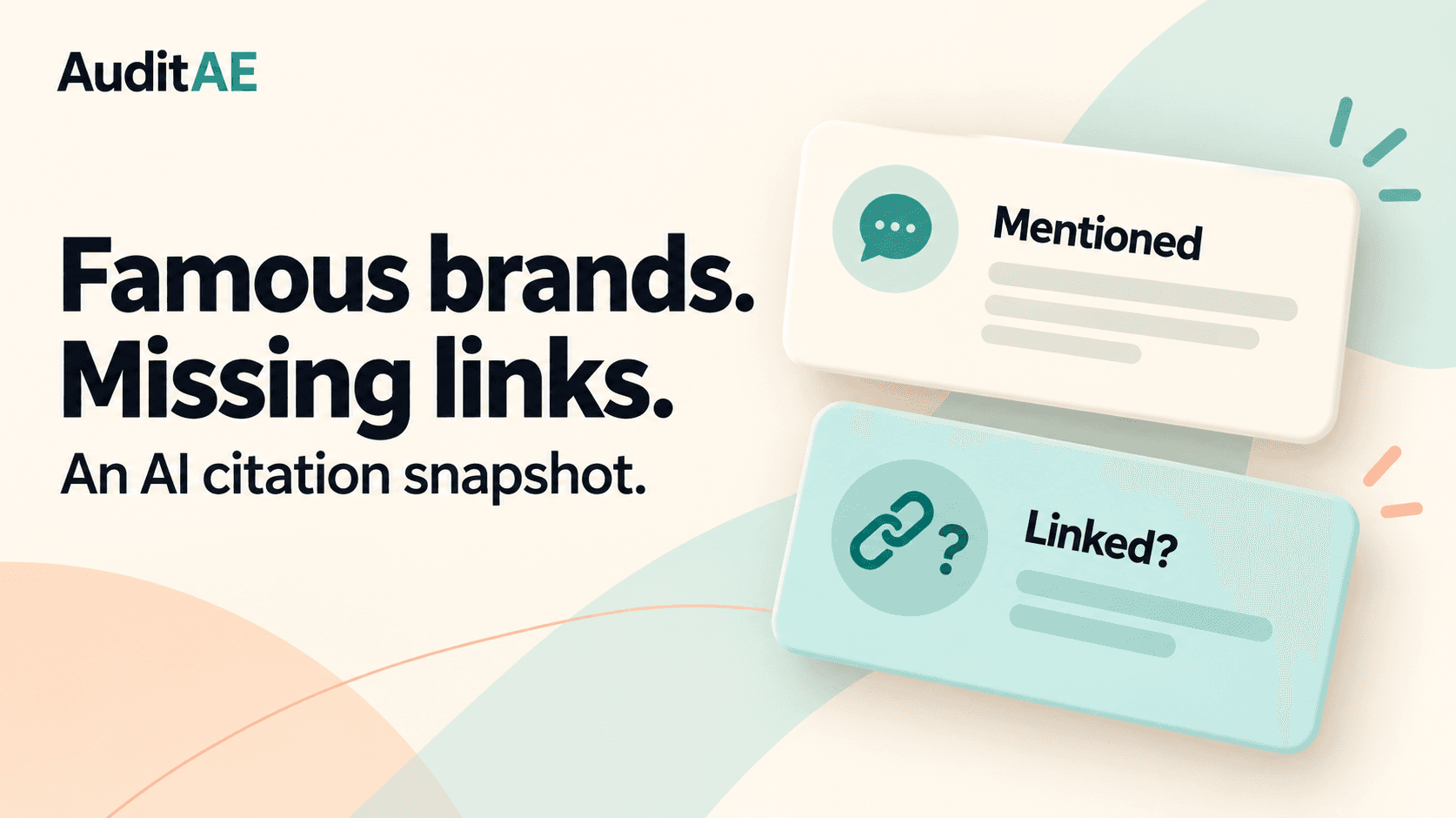
- 6 min readAI Citation Snapshot: We Asked 4 AI Engines About 5 Famous Brands. Notion Got Linked 0 Times.One buyer prompt each for HubSpot, Shopify, Canva, Mailchimp and Notion, run live across ChatGPT, Perplexity, Gemini and Google AI Overviews. The brands were named in 17 of 20 answers but linked in only 6, and Google's two engines linked none of them.
- 10 min readHow to Improve Brand Visibility in AI Search Engines: 8 Fixes You Can Ship This MonthAI engines already have an opinion about your brand. Here is how to check what it is, and the eight fixes, in order, that change it, with the WordPress path where there is one.