
AI Citation Snapshot: We Asked 4 AI Engines About 5 Famous Brands. Notion Got Linked 0 Times.
One buyer prompt each for HubSpot, Shopify, Canva, Mailchimp and Notion, run live across ChatGPT, Perplexity, Gemini and Google AI Overviews. The brands were named in 17 of 20 answers but linked in only 6, and Google's two engines linked none of them.
Everyone knows HubSpot, Shopify, Canva, Mailchimp and Notion. They lead their categories, they spend heavily on content, and their names come up whenever someone asks for a recommendation.
So we wanted to know: when someone asks an AI engine for a recommendation in their category, does the engine send the click to them?
We ran one buyer prompt per brand, live, through ChatGPT, Perplexity, Gemini and Google AI Overviews. Here is what came back.
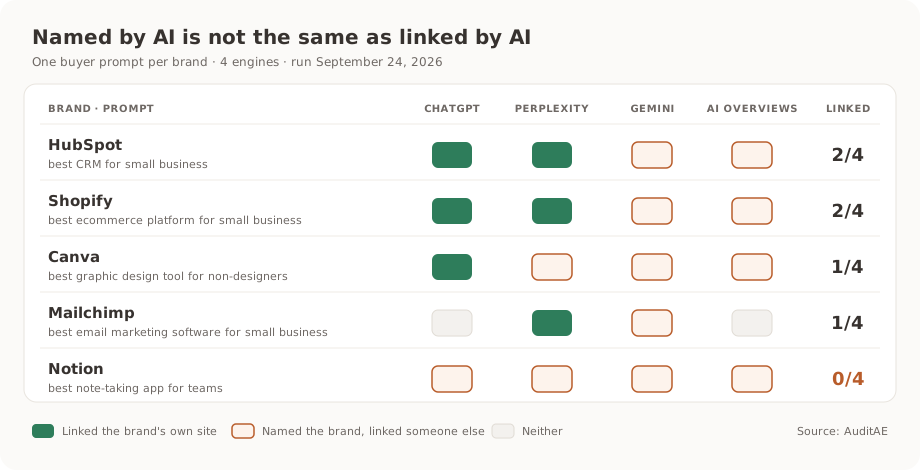
The headline numbers
- Named in 17 of 20 answers. The engines know these brands.
- Linked in 6 of 20. In most answers, the source that got the click was someone else.
- Gemini and Google AI Overviews: 0 of 10. Neither of Google's engines linked any of the five brands' own sites, even when they called the brand the best pick.
- ChatGPT and Perplexity: 3 of 5 each. Better, but not reliable.
That gap between named and linked is the whole story. A mention with someone else's link is free advertising for the site that got the link.
Brand by brand
Notion: named by all four, linked by none
Prompt: "best note-taking app for teams"
Perplexity and Google AI Overviews both said Notion is the best note-taking app for teams. Gemini and ChatGPT named it too. Not one of them linked notion.so.
Where the links went instead:
- ChatGPT linked three Microsoft support pages (OneNote, Loop, Teams notes) and evernote.com.
- Perplexity linked evernote.com, clickup.com, PCMag, Zapier and a stack of listicles.
- Gemini linked evernote.com, PCMag, Zapier and AI note-taker blogs.
- AI Overviews linked a Microsoft support page, a Reddit thread and a OneNote-alternatives blog.
Notion's competitors own the pages the engines read to answer this question. Notion is the answer, and Microsoft and Evernote get the clicks.
Mailchimp: the engines are recommending someone else
Prompt: "best email marketing software for small business"
This is the one that should worry a brand team most. Mailchimp was only named by one engine, Gemini.
- ChatGPT recommended MailerLite first, and its sources were constantcontact.com and getresponse.com, two competitors' own blogs.
- Google AI Overviews opened with "MailerLite is the best overall email marketing software for small businesses," and linked constantcontact.com.
- Perplexity did link a mailchimp.com page in its sources, but its answer recommended MailerLite, Constant Contact and AWeber and never named Mailchimp.
When a competitor's blog post is the source an engine trusts for your category, the engine repeats that competitor's opinion.
See the full Mailchimp report →
Canva: the default answer, linked once
Prompt: "best graphic design tool for non-designers"
All four engines named Canva, and three called it the top pick. Only ChatGPT linked canva.com.
Perplexity pulled from roughly 40 sources for this answer, including PCMag, Creative Bloq, G2 and HubSpot's blog. None of them were canva.com. AI Overviews linked 99designs, a LinkedIn post and a small design blog. Adobe Express was the runner-up almost everywhere.
HubSpot: fine on ChatGPT and Perplexity, missing on Google
Prompt: "best CRM for small business"
ChatGPT called HubSpot "the safest default pick" and linked its CRM page. Perplexity linked hubspot.com too. Gemini and AI Overviews both recommended HubSpot, but sent the links to the US Chamber of Commerce, PCMag, Slack's blog, Reddit and YouTube. Zoho CRM was the competitor named most often.
Shopify: same split as HubSpot
Prompt: "best ecommerce platform for small business"
Every engine named Shopify, and AI Overviews called it "the overall best ecommerce platform for small businesses." ChatGPT and Perplexity linked shopify.com. Gemini linked Stripe, Salesforce, Wise and ecommerce blogs. AI Overviews linked Stripe, Zapier, a design blog and five YouTube videos.
Three patterns worth noticing
1. Being famous gets you named, not linked. The engines clearly know who leads each category. What they link is whatever page best answers the exact question, and for "best X for Y" questions that is usually a comparison page, a listicle, or a forum thread, not the brand's homepage.
2. Google's engines are the biggest leak. Gemini and AI Overviews linked zero of the five brands. They lean on third-party reviews, Reddit and YouTube. If your AI visibility work only checks ChatGPT, you are missing where most searches still happen.
3. Competitors' content can set the answer. Constant Contact's and GetResponse's blog posts were the sources behind "best email marketing software." Microsoft's support pages were the sources behind "best note-taking app for teams." A competitor that publishes the comparison page you didn't write gets to frame the answer.
How we ran it, and what this isn't
- One prompt per brand, one run each, on September 24, 2026, through AuditAE's free citation check.
- "Named" means the brand appears in the engine's answer text. "Linked" means the brand's own domain appears in the sources the engine listed.
- AI answers change from run to run. Run the same prompt tomorrow and some cells will flip. That is why this is a snapshot, not a study, and why every report above is public with the raw answer excerpts and source lists.
- We have no relationship with any of these brands. We picked them because everyone knows them.
To judge a real brand's AI visibility you want 10 or more buyer prompts, tracked over weeks. We wrote up what counts as a citation and why ranking doesn't mean you get cited if you want the longer version, and 8 fixes that move brand visibility in AI search if you've already found your gap.
Check your own brand
If Notion can be the answer on every engine and still get zero links, it is worth ten seconds to see what happens with yours. Run a free citation check: one buyer question, four engines, no signup.
FAQ
What is the difference between being mentioned and being cited by AI?
Mentioned means the engine names your brand in its answer. Cited (or linked) means your own site appears in the list of sources the engine used. Only the link sends a click to you; a mention with someone else's link sends the click to them.Is one prompt enough to judge a brand's AI visibility?
No. AI answers change from run to run and from prompt to prompt. One prompt is a snapshot that shows a pattern worth checking. To judge a brand properly, track 10 or more buyer prompts over several weeks.How can I check whether AI engines cite my own brand?
Run a free citation check on AuditAE. You enter your brand, domain and a buyer question, and it asks ChatGPT, Perplexity, Gemini and Google AI Overviews live, then shows who they named and which sites they linked.
Aaron is the founder of AuditAE. He has run AI-visibility audits for SEO agencies and in-house brand teams, and writes about how generative answer engines are reshaping the practice of search marketing.
Related reading
- 10 min readHow to Improve Brand Visibility in AI Search Engines: 8 Fixes You Can Ship This MonthAI engines already have an opinion about your brand. Here is how to check what it is, and the eight fixes, in order, that change it — with the WordPress path for each one.
- 18 min readSEO, GEO, and AEO in 2026: What 20+ Studies Actually Show About AI CitationsZero-click searches hit 68%. Brand mentions predict AI visibility 3× better than backlinks. Two-thirds of AI Overview citations now come from pages that never reached page one. A research report built from 20+ primary studies — with the disagreements reported, not averaged.
Run the citation report on your own brand.
See which prompts cite you on ChatGPT, Perplexity, Gemini, and Google AI Overviews — the first one’s free, no card.