SEO, GEO, and AEO in 2026: What 20+ Studies Actually Show About AI Citations
Zero-click searches hit 68%. Brand mentions predict AI visibility 3× better than backlinks. Two-thirds of AI Overview citations now come from pages that never reached page one. A research report built from 20+ primary studies, with the disagreements reported, not averaged.
On this page· 12 sections
SEO, AEO, and GEO are not three disciplines competing for a budget line. They are three surfaces that the same underlying work has to satisfy: a ranked list, a direct answer, and a synthesised recommendation.
This is a research report, not an opinion piece. Every figure below is attributed and dated. Where two credible studies disagree (and on several important questions they disagree sharply), the disagreement is reported and explained rather than averaged into a comfortable middle. Figures published by vendors who sell AI-visibility tooling are flagged as such.
The six findings that matter
1. 68% of US Google searches ended without a click. Rand Fishkin's June 2026 study on Similarweb's clickstream panel put zero-click at 68.01% for January–April 2026, up from 60.45% two years earlier and roughly 45% a decade ago. That is the fastest acceleration in a decade. Traffic is no longer the scoreboard.
2. Brand mentions predict AI visibility about 3× better than backlinks. Across 75,000 brands, Ahrefs measured a 0.664 correlation for branded web mentions against 0.218 for backlink count.
3. Being cited is worth ~120% more clicks per impression. Seer Interactive found cited pages earn roughly double the CTR of uncited pages on the same results page. Being named is the lever you can actually pull.
4. Only 38% of AI Overview citations come from top-10 organic pages, down from 76%. Query fan-out reaches far past page one. Cluster coverage now beats one head-term win.
5. 53% of AI citations go to editorial blog and content pages, about 80% once brand-owned queries are excluded. Syndicated press releases account for 0.04%.
6. 97% of llms.txt files received zero bot requests in May 2026. The most-recommended GEO tactic of 2025 has no measured effect.
The opportunity, stated plainly: the signals that decide AI visibility are cheaper to build than the ones that decided 2018 SEO, and almost nobody is systematically working them. McKinsey's 2025 survey of Fortune 500 consumer-brand CMOs found only 16% of brands systematically track AI search performance, and a GoodFirms survey of 100 marketers found only 14% track their AI citations.
Three acronyms, one job
The tactics diverge at the margins. The foundations are shared.
Google put this in writing in May 2026. Its guide to optimizing for generative AI features says: "From Google Search's perspective, optimizing for generative AI search is optimizing for the search experience, and thus still SEO." The independent evidence agrees: Zyppy's meta-analysis of 54 studies scores classic search rank 9.4/10 as a citation factor, second only to whether the page is reachable at all.
| Goal | What it covers | |
|---|---|---|
| SEO (Search Engine Optimization) | Rank in a list | Keywords, crawlability, site speed, links, content quality. Still the base layer, and still the strongest predictor of everything below it. |
| AEO (Answer Engine Optimization) | Be the answer | Question-shaped headings, self-contained passages, direct two-to-three sentence answers before the detail, featured-snippet formatting. |
| GEO (Generative Engine Optimization) | Be named and recommended | Entity clarity, off-site brand presence, third-party credibility, extractable evidence. The competition is for the handful of sources an answer cites. |
There is no separate machine to feed. The same work pays out in three places.
The new traffic math
Fishkin's study, built on Similarweb's desktop and mobile panel, found AI Overviews now render on 20%+ of searches and cut CTR by close to 60% when they do. AI Mode was not the cause during that window (only 0.34% of searches reached it), but Google reported at I/O 2026 that AI Mode had passed one billion monthly users with query volume more than doubling each quarter.
Pew's behavioural study of 68,879 real searches found users clicked a traditional result on 8% of searches with an AI Overview versus 15% without. Google has publicly disputed Pew's methodology, arguing the analysis window overlapped unrelated algorithm testing. Both numbers point the same direction.
Then the curve broke
Seer Interactive's third CTR study (53 brands, 5.47M queries, 2.43B impressions, January 2025 to February 2026) found organic CTR on AI Overview queries bottomed at 1.3% in December 2025 and climbed to 2.4% by February 2026. That is an 80% rebound on Seer's unrounded figures (1.31% to 2.36%), and Seer's own September 2025 model had predicted continued decline.
Seer calls it a levelling off, not a recovery, and warns against forecasting from two months of data. Two plausible mechanisms: low-intent clicks left the denominator, and Google widened the citation surface inside overviews.
Organic CTR by citation status (Seer, informational queries, January 2025 to February 2026)
| Result page | Organic CTR |
|---|---|
| No AI Overview present | 3.3% |
| AI Overview present, page cited | 2.1% |
| AI Overview present, not cited | 0.9% |
Cited pages earn roughly 120% more clicks per impression than uncited pages on the same results page. Seer flags the causation caveat honestly: strong brands may simply earn both.
The under-reported second finding
CTR on searches with no AI Overview rose from 2.8% in early 2025 to 3.8% by February 2026. Queries Google has not chosen to summarise are becoming more valuable, not less.
AI Overviews trigger on roughly 95% of comparison queries and 86% of question-format queries, but only about 5% of transactional ones. Intent mix, not content quality, decides most of your exposure.
You cannot control whether Google shows an AI Overview. You can influence whether it names you.
What actually earns a citation
In May 2026 Cyrus Shepard of Zyppy published the first evidence-weighted ranking of AI citation factors: 54 experiments, patents, and case studies scored on repeatability, evidence strength, and official platform support. Paired with Ahrefs' large correlation datasets, it produces a hierarchy that is unglamorous and highly actionable.
| Factor | Evidence score | What it means in practice |
|---|---|---|
| URL accessibility | 9.5 | Blocked, paywalled, or erroring pages cannot be cited. The highest-evidence factor and the cheapest to fix. |
| Search rank | 9.4 | Classic top-10 placement still carries a real citation edge. Win SEO, win AI citations, with extra steps. |
| Fan-out rank | 9.3 | Engines expand one question into many sub-queries. Rank across the cluster, not just the head term. |
| Preview control | 9.2 | A nosnippet directive set years ago for SERP reasons can silently suppress AI citations. |
| Query–answer match | 9.2 | Answering the exact phrasing beats being topically adjacent. |
| Topic cluster ranking | 8.9 | Depth across a topic makes you a repeated fan-out destination. |
| Answer near the top | 8.8 | Lead each section with the answer. In Kevin Indig's analysis of 18,012 ChatGPT citations, 44% came from the first 30% of a page. |
| AI-ready structure | 8.6 | Clear headings and tables so passages extract cleanly as standalone answers. |
| Self-contained passages | 8.0 | Each section should read as a complete answer without the surrounding page. |
| Cites sources internally | 8.0 | Attach a source, a date, and a number to claims. Verifiable content gets reused. |
| Freshness | 7.0 | Real but moderate. Do it after the higher-weight work, not instead of it. |
| llms.txt | 2.0 | Lowest-scoring factor in the study. No credible evidence it influences citations. |
Scores are out of 10 and measure weight of evidence, not guaranteed cause and effect.
Brand presence beats link count
Ahrefs ran Spearman correlations across 75,000 brands (DR > 40, keywords with 800+ monthly volume) against AI Overview visibility. The three strongest signals are all off-site brand signals, not link metrics. A December follow-up extending to ChatGPT and Google AI Mode found YouTube brand mentions the single strongest signal measured.
| Signal | Correlation | vs backlinks |
|---|---|---|
| YouTube mentions (follow-up study) | 0.737 | 3.4× |
| Branded web mentions | 0.664 | 3.0× |
| Branded anchor texts | 0.527 | 2.4× |
| Branded search volume | 0.392 | 1.8× |
| Domain Rating | 0.326 | 1.5× |
| Number of backlinks | 0.218 | 1.0× baseline |
Honest caveat. Ahrefs' own authors state this is correlation, not causation, and Ahrefs sells AI-visibility tooling. Brands with heavy editorial coverage also tend to have invested in PR and product. A separate reading, SALT.agency's 5,825-URL study, puts backlink correlation with ChatGPT, Perplexity, and Gemini visibility at a moderate 0.39–0.42, higher than Ahrefs found for AI Overviews.
The defensible synthesis: links are a threshold that gets you into the retrieval set; mentions decide whether you get picked out of it. That distinction is the practical heart of why ranking doesn't mean cited.
Fan-out changed the geometry
Ahrefs analysed 863,000 keywords and 4 million AI Overview URLs:
| Where cited pages rank | Share of AI Overview citations |
|---|---|
| Organic top 10 | 38% |
| Ranks 11–100 | 31.2% |
| Beyond rank 100, or unranked | 31.0% |
That top-10 share was 76% in mid-2025. BrightEdge, on different methodology, puts the overlap nearer 17%.
Search Engine Journal flags a caveat worth carrying: part of the 76%→38% shift reflects improved citation detection in Ahrefs' tooling, not purely a change in Google's behaviour. The two waves are not perfectly comparable, but both agree on direction.
The upside for smaller sites is real. Nearly two-thirds of AI Overview citations now go to pages that never reached page one. A well-structured answer on a mid-authority domain can be pulled into an answer that a decade of link building could not have bought.
Content patterns that get cited
BuzzStream analysed 4 million citations from 3,600 prompts across 10 industries, collected over one week from late January 2026. Treat the exact percentages as directional.
| Content type | Share of citations | Read |
|---|---|---|
| Editorial blog and content pages | 53.5% | Invest here first. Rises to ~80% once brand-owned queries are excluded. |
| News content | 14.1% | Matters where the query carries a recency requirement. |
| Social and community | 8.7% | Tinuiti put social's share at ~9% in Q1 2026, Reddit dominant within it. |
| Syndicated press releases | 0.04% | Effectively invisible to citation systems. |
The page-level pattern
- Answer first, elaborate second. Open each section with a direct two-to-three-sentence answer, then supporting detail. Kevin Indig found 44% of ChatGPT citations come from the first 30% of a page.
- Question-shaped headings. H2s and H3s phrased as the query a person actually types. Query–answer match scores 9.2/10.
- Self-contained passages. Engines lift chunks, not pages. Every section must survive being read alone, with no "as discussed above."
- Attach evidence to claims. A source, a date, and a number per assertion. Internally-cited content scores 8.0/10, and it is what makes a passage quotable.
- Tables and lists. Comparison queries trigger AI Overviews about 95% of the time, and a clean comparison table is the most extractable object on the web.
- Server-rendered HTML. AI crawlers do not execute your JavaScript the way a browser does. Client-side-rendered content is content that may not exist. Adobe found retail product pages only 66% machine-readable versus 75% for homepages, so the pages that convert parse worst.
- Consistent entity naming. Brand, author, and service names identical across the site, Google Business Profile, LinkedIn, and Wikipedia-adjacent sources. Entity confusion is a silent citation killer.
Freshness, corrected
Across 16.975 million cited URLs on seven platforms, AI-cited content averages 1,064 days old (~2.9 years) versus 1,432 days (~3.9 years) for organic top-10 results, a 25.7% freshness advantage. ChatGPT shows the strongest recency bias at 958 days; Google AI Overviews behaves most like classic search.
Do not repeat this stat: "fresh content is cited 4.3× more often." The figure traces to no primary study. It appears in neither the Zyppy analysis nor the Ahrefs freshness data, surfacing only on secondary aggregation blogs with no published methodology. The real, replicable effect is 25.7%: meaningful, and a long way from a multiplier.
Where video sits now
YouTube is the single most-cited domain in AI Overviews in Ahrefs' tracking, accounting for about 5.6% of all AI Overview citations and growing 34% in six months. Among citations that did not rank in Google's top 100 for the same keyword, 18.2% were YouTube URLs.
Pair that with the 0.737 correlation for YouTube brand mentions and the implication is hard to dodge: for many categories, a competent video answer is now a first-class SEO asset, not a nice-to-have.
Who the engines actually trust
Peec AI's analysis of 30 million sources ranked Reddit the most-cited domain across ChatGPT, Google AI Mode, Gemini, Perplexity, and AI Overviews, with YouTube, LinkedIn, Wikipedia, and Forbes filling out the top five. Semrush data compiled in May 2026 found the same ordering. Muck Rack's December 2025 analysis found 94% of AI citations come from non-paid, non-brand-owned sources.
The engines are not interchangeable. Profound's platform analysis found Wikipedia is ChatGPT's most-cited single source while Reddit leads for Perplexity and AI Overviews. 5W's synthesis of 680M+ tracked citations reports only about 11% of domains are cited by both ChatGPT and Perplexity. Ahrefs found AI Mode correlates most strongly with branded authority signals (branded anchors 0.628) while ChatGPT correlates weakest with classic authority (DR 0.266). This is exactly why what counts as a citation has to be defined per engine before you compare anything.
Sources disagree, sharply
Reddit's share of AI citations is reported anywhere from ~10% (Everything-PR's post-September-2025 ChatGPT equilibrium) to ~40% (their consolidated index) to 46.7% of Perplexity's top-10 share (5W). Evertune's 200-million-prompt analysis reaches the opposite conclusion entirely: no single domain exceeds about 5% of citations, and Wikipedia, Reddit, LinkedIn, and YouTube combined rarely top 5%, with the other 95% spread across thousands of domains.
These are not reconcilable by averaging. They measure different things (share of top-10 sources versus share of all citations) across different prompt sets and dates, and citation share has proven violently unstable: ChatGPT's Reddit citation rate fell from roughly 60% of responses in early August 2025 to about 10% by mid-September.
Treat any single "most-cited domain" number as a snapshot, and read the distribution claim as the strategically important one: the long tail is large, which is precisely why a mid-sized brand can win.
Platform tendencies, triangulated
- ChatGPT: encyclopaedic and editorial bias; strongest recency preference (958-day average); weakest link to classic domain authority. Reportedly ~87% of visible AI referral traffic (Conductor).
- Perplexity: heaviest community-content concentration; Reddit is its single largest source by a wide margin.
- Google AI Overviews: most distributed source mix, closest to classic search behaviour, growing YouTube share, increasingly citing outside the top 10.
- Google AI Mode: strongest correlation with branded authority signals; visible preference for Google-owned properties; 1B+ monthly users, with queries more than doubling each quarter.
- Gemini / Copilot: smaller measured referral share; Gemini rose to about 13% of AI referrals by April 2026 (BrightEdge), the fastest mover behind ChatGPT.
Consumer trust is not a straight line up. Fractl's 2026 survey of 1,008 US consumers found the share who rate AI more helpful than traditional search fell from 82% to 54% in a year, buyers now check an average of 2.4 platforms before deciding, and Google still leads AI tools roughly three-to-one for trusted product recommendations (39% vs 14%), with Reddit at 15% between them. Validation behaviour is intensifying, which raises the value of being consistently present across surfaces rather than optimised for one.
Stop doing these
Publishing and maintaining llms.txt
Ahrefs analysed 137,210 domains: 97% of llms.txt files received zero bot requests in May 2026, and no AI bot ever requested a file that did not already exist. OtterlyAI's 90-day test logged 84 of 62,100 AI bot requests hitting the file: 0.1%, three times worse than an average content page. SE Ranking found no correlation with citations across roughly 300,000 domains. Google's Gary Illyes confirmed Google does not support it; John Mueller compared it to the keywords meta tag; Google's 2026 AI-features guide says Google Search doesn't use llms.txt or similar AI text files.
Keep it only if AI coding assistants and agent frameworks consume your docs. That is a real and different use case, and the fuller argument is in do llms.txt files help AI search. The harm was never the file; it was teams reporting llms.txt as their AEO strategy while skipping the work that is supported.
Buying links as your AI visibility plan
Backlinks correlate at 0.218 with AI Overview visibility against 0.664 for unlinked brand mentions. Semrush's 1,000-domain study (October 2025) found authority only pays off above a certain tier; below it, more links barely move the needle.
Not "links are dead." They are a threshold for entering the retrieval set. The point is the marginal dollar: it now buys more visibility in earned conversation than in placement.
Wire-service press releases for AI visibility
0.04% of 4 million citations in the BuzzStream dataset. Syndicated releases are close to invisible to citation systems, while earned editorial accounts for roughly 80% of citations on non-brand queries. Releases still have legal and IR uses. They are not a GEO tactic.
Reporting rank and sessions as the whole story
With 68% of searches clickless and two-thirds of citations coming from outside the top 10, a rank-and-sessions dashboard now measures a shrinking slice of the outcome. The Digital Bloom estimates around 70% of AI-referred traffic arrives with no referrer data at all, because in-app browsers and noreferrer links strip it. Whatever you currently measure is a floor.
Blocking the crawlers by accident
URL accessibility is the highest-evidence citation factor (9.5/10) and the most commonly self-inflicted failure. Since July 2025, Cloudflare blocks known AI crawlers by default on new domains, so a site can lose access without anyone choosing to. Check robots.txt for OAI-SearchBot, GPTBot, ChatGPT-User, PerplexityBot, and Google-Extended; check server logs and the Metrics tab in Cloudflare's AI Crawl Control; audit nosnippet and max-snippet directives, which can suppress citations outright. In Search Console, check that the Search generative AI setting is on Include: Exclude removes the site from AI Overviews and AI Mode. Our guide to AI crawlers covers which bots to allow bot-by-bot.
Mass-producing thin "what is" content
Informational queries carry the highest zero-click rates; transactional queries trigger AI Overviews only about 5% of the time. Top-of-funnel explainers are now a citation and brand-recall play, not a traffic play. Measure them that way, or stop producing them at volume. Original research, proprietary data, and expert commentary are what earn the citation.
Does the traffic pay?
This is where the published data is genuinely contradictory, and where most vendor content quietly picks the flattering number. Here is the full spread, with what separates the readings.
| Source | Finding | Sample | Why it differs |
|---|---|---|---|
| Adobe Analytics, Apr 2026 | AI-referred retail shoppers converted 42% better than non-AI traffic in March 2026 | 1T+ visits, US retail | Relative lift, not an absolute rate. The same series showed AI traffic converting 38% worse in March 2025, so the flip happened inside a year. |
| Contentsquare, 2026 benchmark | AI-referred traffic converted at 1.3% in 2025, up 55% YoY, below email at 1.9% | 99B sessions, 6,500 sites | Full-year 2025 average, so it sits mostly on the wrong side of Adobe's flip. Also benchmarked against email, a much higher bar. |
| Ruler Analytics, 2026 | AI referral converting at 5.8% average, above direct, email, and organic | 110M sessions, 5M conversions | Lead-gen conversions across 13 industries, not ecommerce purchases. Different denominator entirely. |
| Opollo, 2026 | 14.2% vs 2.8% for Google organic, roughly 5× | 312 B2B tech firms | High-consideration B2B only, GA4 + CRM attribution. Not a cross-industry rate. |
| Ahrefs, Jun 2025 | 0.5% of sessions drove 12.1% of signups, a 23× differential | Single company | One B2B SaaS case study. A ceiling for that category, not a benchmark. |
What survives the disagreement
Three things replicate across every dataset regardless of methodology. AI referral volume is still small (Conductor ~1.08% of traffic; Contentsquare 0.2% of visits). It is growing very fast (632% YoY in Contentsquare's data). And the visitors behave better: 53% longer sessions, 23% more pages, 36% lower bounce in Adobe's data, with Shopify reporting half of AI-referred sessions landing straight on a product page, 2.5× the rate of traditional search.
What does not replicate is any single conversion multiple. Anyone quoting "AI traffic converts 5× better" as a settled fact is quoting one sample.
The measurement stack that follows
- Visibility score: the percentage of your tracked prompt set where the brand is mentioned. The impression-equivalent, and the primary KPI.
- Citation share, split owned vs earned: most citations point at third parties; the split tells you whether to write or to pitch.
- Sentiment and accuracy: what the answer says about you, and whether it is wrong.
- Branded search volume and direct traffic: the downstream signal of zero-click influence, and the closest honest proxy for it.
- Self-reported attribution: a "how did you hear about us" field with an explicit AI option catches what no UTM will.
- AI crawler hit logs: server-side evidence that GPTBot, OAI-SearchBot, and PerplexityBot reach your key pages at all. Google-Extended is a robots.txt token with no crawler of its own, so it never shows up in logs.
The ninety-day playbook
Sequenced by evidence weight, not by novelty. Accessibility and rank are prerequisites; brand presence and cluster coverage are the differentiators; structure and freshness are refinements. Working out of order is the most common way these programmes waste a quarter.
Days 0–30: make yourself citable
- Crawler audit. robots.txt (including the Google-Extended token), Cloudflare bot rules, server logs for GPTBot, OAI-SearchBot, ChatGPT-User, and PerplexityBot. Confirm 200s on money pages.
- Preview audit. Find and remove legacy
nosnippetandmax-snippetdirectives on pages you want cited. - Render check. View key pages with JavaScript off. Anything invisible is invisible to the engines.
- Build the prompt set. 50–150 real buyer questions across the funnel. This is your new keyword list and your baseline.
- Baseline visibility across ChatGPT, Perplexity, Gemini, and AI Overviews, with competitor presence recorded alongside.
- Entity hygiene. Identical brand, author, and service naming across site, Google Business Profile, LinkedIn, and major directories.
Days 31–60: restructure and cover
- Rewrite the top 20 pages to the answer-first pattern: question headings, a direct answer opening each section, self-contained passages, a comparison table where the intent is comparative.
- Add evidence. Source, date, and number on every load-bearing claim. Visible "last updated" stamps.
- Close cluster gaps. Map the sub-queries fan-out generates around your three priority topics and publish against the holes. Breadth beats one more head-term push.
- Schema where it genuinely fits: Organization, Product, Article with author entities. Google says its AI features need no special schema, FAQ rich results ended in May 2026, and HowTo rich results were retired in 2023, so treat FAQ and HowTo markup as optional.
- Refresh cornerstone content older than about 18 months, ChatGPT-skewed topics first.
- Fix what the engines get wrong about you, then rerun the same prompts to confirm the answers changed.
Days 61–90: build off-site presence
- Reallocate link budget to digital PR. Target unlinked mentions in editorial outlets your category's answers already draw from. Mentions correlate 3× better than links.
- Publish original data. A single proprietary benchmark earns more citations than a quarter of explainer posts. This report is an example of the format.
- Ship video. YouTube answers to your top ten buyer questions: the highest-correlating single signal measured, and a surface most competitors are ignoring.
- Show up in community, transparently. Real participation in the subreddits and forums that map to your category. Disclosed, useful, not astroturfed.
- Get review-platform presence right. G2, Yelp, Capterra, and category listicles surface heavily in recommendation queries.
- Move to a standing cadence. Citation share shifted 76%→38% in eight months; a quarterly check misses the swing that should have triggered a response.
The order is the strategy. Fix accessibility, win classic SEO, build brand mentions, cover the cluster, structure for extraction, keep content current, in that order. A team refreshing content weekly while a Cloudflare rule blocks GPTBot is optimising the wrong variable at speed.
Where this leaves you
The evidence points somewhere unusually specific: fix what you can reach, rank where you already compete, and spend the marginal dollar on being talked about rather than linked to.
In McKinsey's survey, only 16% of brands tracked this systematically. That gap is the opportunity, and it closes. If you want the baseline described in Days 0–30 without building the tooling yourself, that is what an AI search optimization programme starts with: a fixed prompt set, run on a schedule, with citations counted the same way every time.
Sources
Primary studies first. Several correlations below are reported by vendors with a commercial interest in the conclusion, noted where relevant. Access dates August to October 2026.
- Fishkin, R., "In 2026, Less than One Third of Google Searches Still Send a Click", SparkToro with Similarweb panel data, 9 June 2026. Zero-click 68.01%.
- Seer Interactive, "AIO Impact on Google CTR: 2026 Update", 24 April 2026. 53 brands, 5.47M queries, 2.43B impressions; CTR floor and rebound, citation uplift. Covered by Search Engine Land.
- Shepard, C., AI Citation Ranking Factors meta-analysis, Zyppy Signal, 7 May 2026. 54 studies, 23 factors scored by evidence strength.
- Ahrefs: brand visibility correlation study, 75,000 brands (2025) and December 2025 follow-up across ChatGPT and AI Mode. Vendor-published.
- Ahrefs: AI Overview citation analysis, 863,000 keywords and 4M URLs, March 2026; content-freshness study across 16.975M cited URLs; llms.txt analysis across 137,210 domains.
- Search Engine Journal: coverage of the 76%→38% top-10 citation drop, including the detection-methodology caveat.
- Pew Research Center: behavioural study of 68,879 Google searches, 22 July 2025. 8% vs 15% click rate; Google has publicly disputed the methodology.
- Peec AI: analysis of 30M sources, March 2026. Most-cited domains across five engines.
- Semrush: "The Most-Cited Domains in AI: A 3-Month Study", 230,000+ prompts over 13 weeks. Source of the Reddit/Wikipedia volatility finding.
- Profound: "AI Platform Citation Patterns". Per-platform source concentration, August 2024 to June 2025.
- 5W: "The State of AI Citations 2026", June 2026. 680M+ tracked citations; ~11% cross-platform domain overlap.
- OtterlyAI: 90-day llms.txt test, 62,100 bot requests; the file drew 84 visits against about 265 for an average content page. Google's position via Search Engine Journal and John Mueller's public comments.
- Conversion spread: Adobe Analytics (April 2026), Contentsquare 2026 benchmark (99B sessions), Ruler Analytics 2026, Opollo 2026, Ahrefs June 2025.
- Also drawn on: BuzzStream citation-type analysis (4M citations, January 2026); Muck Rack (December 2025); Fractl consumer trust survey (n=1,008, 2026); Evertune 200M-prompt analysis; SALT.agency 5,825-URL study; Conductor and BrightEdge referral-share benchmarks; Tinuiti Q1 2026; Google Search Central guide to optimizing for generative AI features (May 2026); Kevin Indig's Growth Memo analysis of 18,012 ChatGPT citations, via Search Engine Land (February 2026); McKinsey, "New front door to the internet" (CMO survey, September 2025); GoodFirms marketer survey (n=100, April 2026); Semrush backlinks study (1,000 domains, October 2025).
A note on epistemics. Correlational findings are labelled as such throughout. Where two credible studies disagree (Reddit's citation share, AI referral conversion rates, top-10 citation overlap), this report states the disagreement and what explains it rather than selecting a number. Nothing here should be treated as a guaranteed lever.
Not sure where your own site stands on these checks? The free AI search audit scores any domain 0–100 on robots.txt bot rules, llms.txt, Organization and Article schema, snippet directives, server-rendered text and freshness, and emails the fix for each one. No login, ten seconds.
FAQ
No. They are three surfaces the same underlying work has to satisfy: a ranked list, a direct answer, and a synthesised recommendation. Google's own 2026 documentation on generative AI features states that optimizing for generative AI search is still SEO, and Zyppy's meta-analysis of 54 studies scores classic search rank 9.4/10 as an AI citation factor, second only to whether the page is reachable at all.
They matter less than brand mentions. Ahrefs found backlinks correlate with AI Overview visibility at 0.218 versus 0.664 for unlinked branded web mentions across 75,000 brands. The defensible reading is that links are a threshold that gets you into the retrieval set, while mentions decide whether you get selected out of it. The marginal dollar now buys more visibility in earned conversation than in placement.
There is no credible evidence that it does. Ahrefs found 97% of llms.txt files across 137,210 domains received zero bot requests in May 2026, and no AI bot ever requested a file that did not already exist. OtterlyAI logged 84 of 62,100 AI bot requests hitting the file over 90 days. Google's Gary Illyes has confirmed Google does not support it. Keep one only if AI coding assistants or agent frameworks consume your documentation.
Still very little, but growing fast. Conductor puts AI referral at roughly 1.08% of traffic and Contentsquare at 0.2% of visits, against 632% year-over-year growth. Conversion rates are contested: published figures range from 1.3% (Contentsquare, 99B sessions) to 14.2% (Opollo, B2B tech only), so treat any single conversion multiple as one sample, not a benchmark.
Visibility score across a fixed prompt set, citation share split into owned versus earned, sentiment and factual accuracy of what the answers say about you, branded search volume and direct traffic as the zero-click proxy, self-reported attribution, and AI crawler hit logs. With 68% of searches clickless and two-thirds of citations coming from outside the top 10, a rank-and-sessions dashboard measures a shrinking slice of the outcome.
Run the citation report on your own brand.
See which prompts cite you on ChatGPT, Perplexity, Gemini, and Google AI Overviews — the first one’s free, no card.
Aaron is the founder of AuditAE. He has run AI-visibility audits for SEO agencies and in-house brand teams, and writes about how generative answer engines are reshaping the practice of search marketing.
Related reading
- 6 min readAI Citation Snapshot: We Asked 4 AI Engines About 5 Famous Brands. Notion Got Linked 0 Times.One buyer prompt each for HubSpot, Shopify, Canva, Mailchimp and Notion, run live across ChatGPT, Perplexity, Gemini and Google AI Overviews. The brands were named in 17 of 20 answers but linked in only 6, and Google's two engines linked none of them.
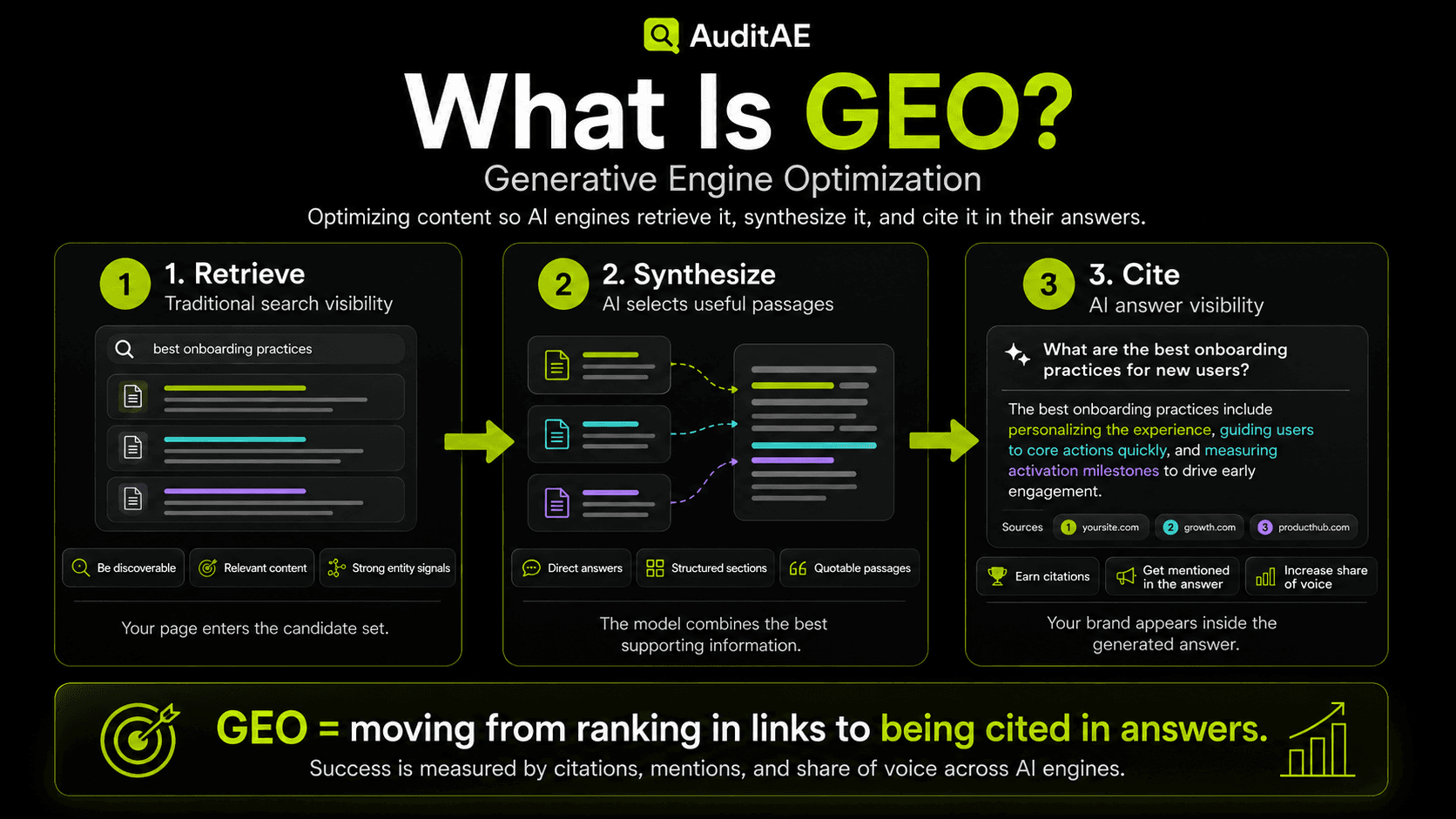
- 9 min readWhat is Generative Engine Optimization (GEO)? A 2026 guideGenerative engine optimization (GEO) is the practice of getting your brand named inside AI answers from ChatGPT, Perplexity, Gemini, and Google AI Overviews. Here's what GEO is, how it differs from SEO and AEO, and how to measure it.
- 5 min readWhat Is llms.txt? Format, Examples and a Free Generatorllms.txt is a Markdown file at your site root that gives AI tools a curated map of your most important pages. The format, copy-ready examples, how it differs from robots.txt and sitemap.xml, and a free generator to build yours.