
What is Generative Engine Optimization (GEO)? A 2026 guide
Generative engine optimization (GEO) is the practice of getting your brand named inside AI answers — ChatGPT, Perplexity, Gemini, and Google AI Overviews. Here's what GEO is, how it differs from SEO and AEO, and how to measure it.
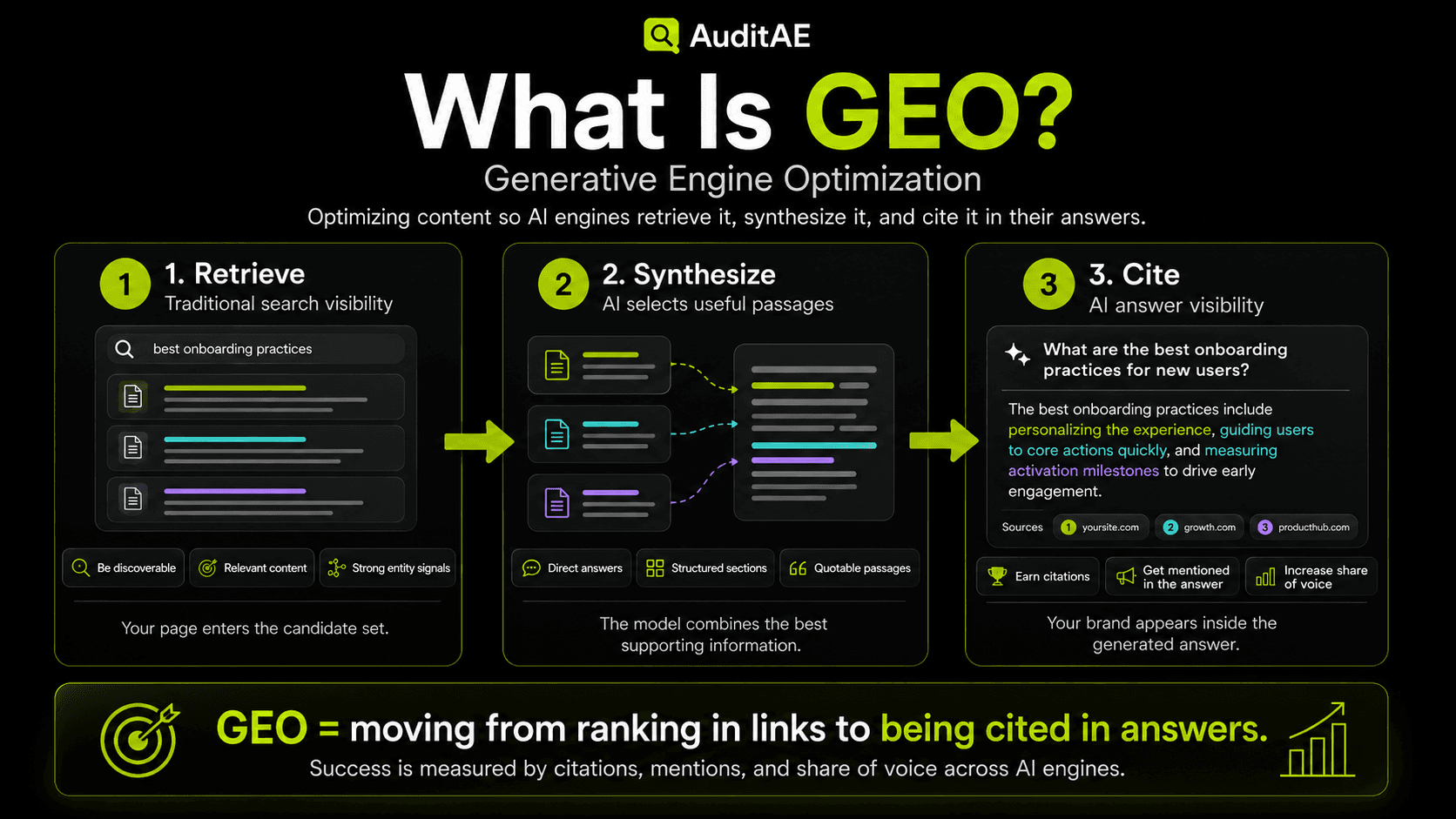
Generative engine optimization (GEO) is the practice of getting your brand named inside the answers that AI engines generate: ChatGPT, Perplexity, Gemini, and Google's AI Overviews. Instead of competing for a position in a list of blue links, you are competing to be part of the synthesized answer the model hands the user. This guide covers what GEO is, how it differs from SEO and the term you have probably also seen, AEO, and how you actually measure whether it is working.
A quick note on the name before we start. "GEO" is an ambiguous acronym (it also means geography), so throughout this guide we use the spelled-out term, generative engine optimization, to keep the meaning clear.
What is generative engine optimization?
Generative engine optimization is the work of making your content visible inside the answers produced by generative AI search tools. The term comes from a 2023 research paper by Pranjal Aggarwal and colleagues, later published at the KDD 2024 conference, which formalized the idea of a "generative engine": a system that uses a language model plus a retrieval step to gather sources and write a single grounded answer with citations.
The paper's central insight is what makes GEO different from anything that came before. A traditional search engine lists pages in ranked order, so visibility means ranking. A generative engine reads several sources, pulls passages from them, and weaves those passages into one answer. Visibility now means how much of your content makes it into that answer and how prominently you are cited. The research found that optimization happens at the passage level, not the page level, because the model extracts small chunks of text rather than sending a visitor to your page.
So the unit of success moves from the click to the citation. That single shift is the whole reason GEO exists as a separate practice.
GEO vs AEO vs SEO: what's actually different?
This is the section most people are actually searching for, because the terminology is genuinely confusing. Here is the honest comparison.
| SEO | AEO | GEO | |
|---|---|---|---|
| What it optimizes | Position in the ranked list of links | Inclusion in an answer engine's reply | Inclusion in a generative model's reply |
| Surface | Google / Bing SERP | ChatGPT, Perplexity, Gemini, AI Overviews | The same four engines |
| Framing | Rank the page | Get named by the engine | Get named in the generated text |
| Unit of success | Click | Citation / mention | Citation / mention |
| Core question | "Do I rank?" | "Does the engine cite me?" | "Does the model name me in its answer?" |
| Measurement | Position, CTR, organic traffic | Cited or not, share of voice across prompts | Cited or not, share of voice across prompts |
| Best content shape | Long-form pillar pages | Self-contained answers plus Q&A blocks | Self-contained answers plus Q&A blocks |
| Off-page signal | Backlinks | Backlinks plus unlinked brand mentions | Backlinks plus unlinked brand mentions |
Look at the table closely and the answer to the terminology question becomes obvious. SEO separates cleanly from the other two: different surface, different unit of success, different metric. But the AEO and GEO columns line up almost row for row. The only real difference is emphasis. AEO frames the goal around the answer engine citing you. GEO frames it around the generated text naming you. Same outcome, same tactics, same measurement.
The takeaway: most practitioners use generative engine optimization and answer engine optimization interchangeably, and SEO is the foundation both are built on. Some try to draw a line between the two, but the tactics, surfaces, and measurement are the same. The useful move is to treat GEO and AEO as synonyms and put your energy into the work that actually changes results.
How do generative engines decide what to cite?
Most answer engines combine a retrieval step with a generation step, but they source, rank, and cite differently, so do not assume what works on one works identically on another. Still, a common pattern holds: the engine retrieves candidate sources, synthesizes an answer, and cites a handful of them. To get named, your content generally has to clear all three stages. Here is how to influence each one.
Findable. The engine can only cite what its retrieval step surfaces. For tools grounded in live search (Google's AI Overviews, Perplexity, ChatGPT with web search, Gemini with grounding), that still depends on classic discoverability: you need to be indexed, relevant to the query, and present in the candidate set the model pulls from. This is where SEO remains the floor under GEO.
Quotable. Once retrieved, your content competes to be the passage the model lifts. Self-contained answers win here. A paragraph that states a complete, standalone fact is far easier to extract than the same fact buried across three sentences that depend on each other for context.
Trusted. Models lean on sources they can corroborate. Consistent entity signals (your brand named the same way everywhere, clear authorship, structured data) and agreement across multiple independent sources both tend to be associated with getting cited. Ahrefs's analysis of AI Overview brand visibility found branded web mentions had the strongest correlation with being cited, though it cautions that correlation is not the same as causation.
For a deeper breakdown of what actually counts as a citation across each engine, see the answer engine optimization pillar guide.
Why does generative engine optimization matter now?
Because the click is drying up on exactly the queries you used to win.
On the queries where Google shows an AI Overview, Seer Interactive's September 2025 study of more than 3,000 informational queries found organic click-through rate fell 61%. Pew Research, looking at the browsing behavior of real users, found that people click an external link 8% of the time when an AI Overview is present, versus 15% when it is not, and click a link inside the overview only 1% of the time. The pattern is sharpest in news: Similarweb found that news-related searches ending without a click to a website rose from 56% in May 2024 to nearly 69% in May 2025.
Here is the shift that should reframe your strategy: being named in an AI answer is increasingly a separate contest from ranking. (The 2026 research report collects 20+ studies on this, disagreements included.) For the standalone AI assistants, Ahrefs found that only about 12% of the URLs cited by ChatGPT, Perplexity, and Copilot rank in Google's top 10 for the same prompt, and 80% do not rank in the top 100 at all. Google's AI Overviews used to track rankings closely, with 76% of citations coming from top-10 pages in mid-2025, but a larger early-2026 Ahrefs study put that figure at 38%, and a separate BrightEdge analysis lower still, around 17%. The link between ranking and citation is real for AI Overviews but weakening fast, and for the assistants it was never strong. Ranking alone will not reliably get you cited.
The citations are also unstable. Ahrefs found the content of AI Overviews changed about 70% of the time between observations, and that the specific URLs cited shifted roughly half the time from one response to the next, with no tidy link back to organic position. That volatility is the argument for measuring on a schedule rather than once.
And standard analytics do not break this out. Google Search Console folds any AI surface clicks into its overall totals without telling you whether ChatGPT, Perplexity, or Gemini name you or a competitor. The only way to know is to ask the engines directly and watch what they say.
How do you measure generative engine optimization?
The method is simple to state. Build a list of the real prompts your buyers would type, run each one through every engine that matters to you, record whether you were cited and who was cited instead, then re-run the same list on a schedule so you can see the trend. The output you care about is share of voice: across your prompt set, how often does the answer name you versus your competitors?
The reason this has to be a recurring measurement rather than a one-time check is the volatility above. An answer that names you today can drop you next month with no change to your rankings. A single snapshot tells you almost nothing.
This is the job AuditAE is built to do: it runs your prompts across ChatGPT, Perplexity, Gemini, and AI Overviews, returns whether you were cited on each, and lets you re-run on a schedule to track the trend. No subscription, and you can start for free. The full measurement workflow, including how share of voice is scored, is covered in the answer engine optimization pillar guide.
A starter generative engine optimization checklist
If you want a place to begin this week, work through these in order.
- Lead with the answer. Put a direct, self-contained answer to each page's core question in the first paragraph, before any windup. This is the passage most likely to get extracted.
- Structure for extraction. Use clear question-shaped headings, short answer blocks underneath them, and lists or tables where the content fits. Make it easy for a model to lift one clean chunk.
- Add real Q&A blocks. Answer one genuine question per block, fully, without making the reader hold context from elsewhere on the page.
- Strengthen your entity. Name your brand consistently everywhere, add clear authorship and about information, and mark up pages with Organization and Article structured data so engines can identify you cleanly. FAQ blocks still help readability and extraction, but do not count on FAQ schema for rich results: Google restricted those to government and health sites in 2023 and retired the appearance entirely in May 2026.
- Earn mentions on trusted sources. Brand mentions on places the engines already lean on (industry roundups, community threads, reference sites) correlate strongly with getting cited, even without a backlink. Ahrefs flags this as a correlation rather than a proven cause, but the association is consistent enough to be worth pursuing.
- Include verifiable specifics. Statistics, dates, and named sources raise extractability. The original generative engine optimization research found that adding this kind of concrete detail measurably increased visibility in generated answers.
- Re-audit monthly. Citations shift constantly, so treat measurement as a standing habit, not a launch task.
Want to know whether the AI engines name you or your competitor right now? Run a free audit and see your citations across all four engines.
FAQ
What is generative engine optimization?
It is the practice of optimizing your content so AI search engines name and cite you inside their generated answers, rather than just ranking your page in a list of links. The surfaces it targets are ChatGPT, Perplexity, Gemini, and Google's AI Overviews.Is generative engine optimization the same as answer engine optimization?
Effectively yes. They are two names for the same discipline. AEO emphasizes the answer engine citing you and GEO emphasizes the generated text naming you, but the tactics, surfaces, and measurement are the same. Most practitioners use the terms interchangeably.How is GEO different from SEO?
SEO optimizes for a position in the ranked list of links and is measured in clicks and traffic. GEO optimizes for inclusion in the AI-generated answer and is measured in citations and share of voice. SEO is still the foundation, because the engine has to be able to find you before it can cite you.Does generative engine optimization replace SEO?
No. It sits on top of it. Strong discoverability still decides whether your content enters the pool a model retrieves from. GEO adds a second layer of work focused on being extracted and cited once you are in that pool.How do you measure generative engine optimization?
You run a fixed list of real buyer prompts through each AI engine, record whether you were cited and who else was, and re-run on a schedule to track share of voice over time. Because answers change frequently, recurring measurement matters more than any single check.Is GEO worth it for a small business?
It can be, and the bar is lower than it looks. Generative engines pull from passages, not just high-authority domains, so a small site with sharply written, well-structured answers can get cited on specific questions where a larger competitor is vague. Start by measuring where you stand on the handful of prompts that matter most to your buyers.
Deep dives in this cluster
Aaron is the founder of AuditAE. He has run AI-visibility audits for SEO agencies and in-house brand teams, and writes about how generative answer engines are reshaping the practice of search marketing.
Related reading
- 18 min readSEO, GEO, and AEO in 2026: What 20+ Studies Actually Show About AI CitationsZero-click searches hit 68%. Brand mentions predict AI visibility 3× better than backlinks. Two-thirds of AI Overview citations now come from pages that never reached page one. A research report built from 20+ primary studies — with the disagreements reported, not averaged.
- 10 min readHow to Improve Brand Visibility in AI Search Engines: 8 Fixes You Can Ship This MonthAI engines already have an opinion about your brand. Here is how to check what it is, and the eight fixes, in order, that change it — with the WordPress path for each one.
Run the citation report on your own brand.
See which prompts cite you on ChatGPT, Perplexity, Gemini, and Google AI Overviews — the first one’s free, no card.