
How to Show Up in ChatGPT Results (2026): A Complete, Tested Playbook
Two paths get you into ChatGPT's answers: be crawlable and indexed in Bing so ChatGPT Search can cite you live, and build mentions across the web so the model brings you up on its own. The complete playbook — real schema, the Bing setup, multi-engine differences, and how to measure it.
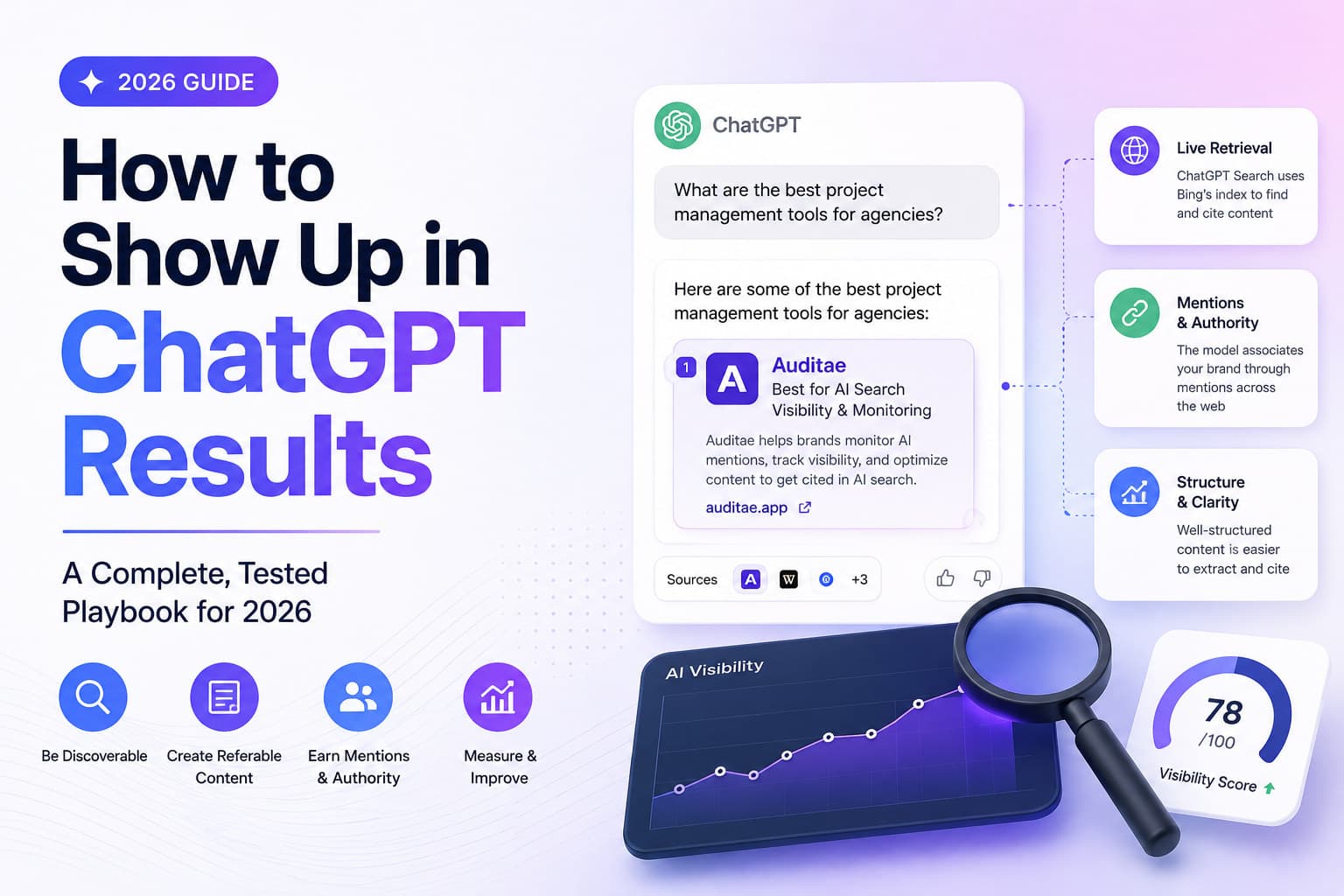
Quick answer: To show up in ChatGPT results you need two things. ChatGPT has to be able to find you live, which means being crawlable and indexed in Bing, since ChatGPT Search runs on Bing's index. And your brand has to be mentioned often enough across the web that the model associates it with your topic. Getting cited is mostly an outcome of mentions and structure, not backlinks.
That's the short version. The rest of this guide is how each piece actually works, including the parts most other guides skip: real schema markup, how live retrieval differs from training, and how to measure whether any of it is working.
How ChatGPT actually decides what to mention
Most advice gets this wrong by treating ChatGPT like Google with a chat box. It isn't. There are two separate paths to being mentioned, and they have almost nothing to do with each other.
Path one: the training data. The base model learned from a huge slice of the web. When you ask it an open question with no live search, it answers from patterns it picked up during training. Rand Fishkin framed the mental model well in a 2024 SparkToro talk: large language models run on words that frequently appear near other words. If "your brand" shows up near "best project management tool for agencies" across thousands of pages, the model learns that association. This is about mentions accumulated over time, not links, and not anything you can submit.
Path two: live retrieval. When ChatGPT runs a search to answer you, through ChatGPT Search or browsing inside a chat, it pulls live results, reads a handful of pages, and cites them. ChatGPT Search uses Bing's index as its backbone. So for this path the question is whether you are crawlable, indexed in Bing, and structured clearly enough that the model picks your page as a source.
You want both. Path one makes the model bring you up unprompted. Path two gets you cited when someone runs a live query in your space. The steps below are organized around making each one happen. For the deeper mechanics of both pipelines, see how to rank on ChatGPT.
Step 1: Make sure ChatGPT can find you
If ChatGPT can't retrieve your site, nothing else matters. Start here.
Get into the Bing index. Because ChatGPT Search relies on Bing, Bing Webmaster Tools is the single highest-leverage account you probably aren't using. Verify your site, submit your sitemap, and confirm your key pages are actually indexed. Indexing in Google does not guarantee indexing in Bing, and plenty of sites that rank fine on Google are thin or missing there.
Don't block the crawlers. OpenAI uses separate bots for different jobs. OAI-SearchBot fetches pages for ChatGPT Search results, GPTBot is used for training, and ChatGPT-User handles live browsing inside a chat. If your robots.txt or firewall blocks these, you remove yourself from the surfaces you're trying to win. Decide deliberately, because blocking GPTBot keeps you out of future training, and blocking OAI-SearchBot keeps you out of live citations. If you're on WordPress, track which AI bots are crawling you before you change anything.
On llms.txt: you'll see advice to add an llms.txt file as a kind of sitemap for AI. It's an emerging proposal, and OpenAI has not confirmed that ChatGPT reads it. Adding one costs nothing, but treat it as a bet, not a proven lever. Crawlability and Bing indexing are the parts that move the needle today.
So yes, there is a way to appear in ChatGPT results, but it starts with the unglamorous infrastructure: be crawlable, be in Bing, don't block the bots.
Step 2: Structure your pages so ChatGPT can extract you
Once ChatGPT can reach your page, it has to be able to lift a clean answer off it. Pages that are easy to extract get cited more.
- Answer first. Put a direct, one or two sentence answer to the page's core question at the very top, before any throat-clearing. This is the line the model is most likely to quote.
- Headings that mirror real questions. Use H2s and H3s phrased the way people actually ask ("How do you get cited by ChatGPT?") instead of clever labels. The model maps questions to headings.
- Tables for comparisons. "Best X for Y" and "A versus B" content is easier to cite as a structured table than buried in paragraphs.
- FAQ schema, done properly. Everyone says to add JSON-LD FAQ schema. Almost nobody shows the markup, or mentions that Google retired the FAQ rich result in May 2026 and it's now purely an answer-engine play. Here's a real block you can adapt:
{
  "@context": "https://schema.org",
  "@type": "FAQPage",
  "mainEntity": [
    {
      "@type": "Question",
      "name": "How do you show up in ChatGPT results?",
      "acceptedAnswer": {
        "@type": "Answer",
        "text": "Be crawlable and indexed in Bing so ChatGPT Search can retrieve you, and build mentions across the web so the model associates your brand with your topic."
      }
    },
    {
      "@type": "Question",
      "name": "Does ChatGPT use Bing?",
      "acceptedAnswer": {
        "@type": "Answer",
        "text": "Yes. ChatGPT Search uses the Bing index to find and cite live web pages, which is why Bing Webmaster Tools matters for AI visibility."
      }
    }
  ]
}
Drop it into a <script type="application/ld+json"> tag, validate it with Google's Rich Results Test or the Schema.org validator, and make sure the visible text on the page matches the schema. Schema that doesn't match the page gets ignored.
Step 3: Build mentions on the sources ChatGPT trusts
This is the half that decides whether ChatGPT brings you up on its own. It comes down to being mentioned, in the right places, in the right context.
- Directories with consistent details. Get listed on the directories that matter for your category, and keep your name, description, and core facts identical across all of them. Inconsistency weakens the association.
- Get into the listicles. "Best [category] tools" and "alternatives to [competitor]" round-ups are exactly what ChatGPT pulls from when someone asks for a recommendation. Pitch to be included. One placement in a widely-cited round-up can do more than ten of your own blog posts.
- PR into publications your buyers already read. Fishkin's method, generalized: find the sites that already rank for your "[topic] [qualifier]" phrases, then do the outreach to get genuinely mentioned there. For a SaaS that means industry blogs, newsletters, podcast show notes, and comparison sites, not press releases.
The shift in mindset is the point here. You are not chasing backlinks for ranking. You are building the density of mentions that teaches the model what you are known for.
Step 4: Reputation and entity signals
ChatGPT leans on signals that establish you as a real, trusted entity.
- Reviews and ratings. Sustained, recent reviews on the platforms in your category feed both the model's training and the live sources it cites.
- Proof entities on your own pages. Concrete facts the model can attach to your brand help: years in business, number of customers served, specific results. The copywriter Andrea Shah also argues for optimizing your 404 page, on the theory that ChatGPT is more likely than Google to send people to a broken or hallucinated URL. That's a single-source claim rather than a proven rule, but a helpful 404 that redirects lost visitors is cheap insurance either way.
Can you "submit" your site to ChatGPT?
A lot of people search for "submit website to ChatGPT," expecting something like the old submit-a-URL flow in Search Console. There is no general "add my site and get cited" button. The closest real mechanisms are the ones already covered: submit your sitemap to Bing Webmaster Tools so ChatGPT Search can retrieve you, and make sure OpenAI's crawlers aren't blocked. OpenAI's product surfaces keep changing, so check current OpenAI documentation before assuming any new submission or feed program exists. As things stand, you earn citations, you don't submit for them.
How ChatGPT compares to Perplexity, Gemini, and AI Overviews
ChatGPT is one of four answer engines worth tracking, and they don't all source the same way. Perplexity is heavily live-retrieval and citation-first. Gemini leans on Google's index and grounding. Google's AI Overviews sit inside the search results and pull from the Google ecosystem. The fundamentals carry across all of them, which is to be crawlable, structured, and mentioned, but the specifics differ. Each gets its own guide: ranking in Google AI Overviews, showing up in Gemini, and what answer engine optimization actually is.
How to measure whether it's working
This is the step almost every other guide skips or gives up on. The common advice stops at Google Analytics: filter your traffic to referrals from chatgpt.com or openai.com and call that your AI visibility. That tells you about clicks, but it misses the actual question.
The question isn't how many people clicked through from ChatGPT. It's whether ChatGPT mentions you or your competitor when someone asks about your category, and how often. Most citations never produce a click. The brand still wins the recommendation. Referral traffic can't see that.
What you actually want to track:
- Citations, not just referrals. Whether your brand is named or linked in the answer, click or no click.
- Share of voice across a prompt set. Pick the 20 to 50 prompts your buyers would really ask, run them on a schedule, and measure how often you appear versus competitors.
- Movement over time, by engine. Whether the work in Steps 1 through 4 is actually shifting your citation rate.
This is what AuditAE was built for. You give it the prompts that matter in your space, and it checks whether ChatGPT, Perplexity, Gemini, and Google AI Overviews cite you, where, and against which competitors. To start with the ChatGPT side specifically, see ChatGPT brand monitoring. No subscription, and you can start for free.
Common mistakes
- Treating ChatGPT like Google. Optimizing only for rankings and ignoring mentions leaves the training-data path completely untouched.
- Ignoring Bing. It's the index behind ChatGPT Search, and skipping it is the most common own-goal.
- Faking it on Reddit. Self-promotional posts and planted reviews get caught, and Reddit is one of the sources these models read closely. Earn the mention or skip it.
- Measuring clicks instead of citations. If your only metric is referral traffic, you're blind to most of your actual AI visibility.
Want to see whether ChatGPT cites you today? Run a free audit on AuditAE — drop in your brand and the prompts your buyers actually ask, and see which engines name you, which name competitors, and where the gap sits across ChatGPT, Perplexity, Gemini, and Google AI Overviews.
FAQ
Is there a way to appear in ChatGPT results?
Yes. There are two paths: be crawlable and indexed in Bing so ChatGPT Search can retrieve and cite you on live queries, and accumulate brand mentions across the web so the base model brings you up unprompted. You earn both — there's no submission form.Does ChatGPT use Bing?
Yes. ChatGPT Search uses Bing's index to find and cite live web pages, which is why Bing Webmaster Tools — verifying your site and submitting your sitemap — is the highest-leverage technical move for ChatGPT visibility.Can you submit your website to ChatGPT?
No. There's no "add my site and get cited" button. The closest real mechanisms are submitting your sitemap to Bing Webmaster Tools so ChatGPT Search can retrieve you, and making sure OpenAI's crawlers (OAI-SearchBot, GPTBot, ChatGPT-User) aren't blocked. Check current OpenAI documentation before assuming any new feed exists.How do I get mentioned in ChatGPT?
Build mentions of your brand near your core topics across directories, listicles, and publications your audience reads, and make sure you're crawlable and indexed in Bing so live answers can cite you. Mentions drive the unprompted recommendations; crawlability drives the live citations.How do I appear in AI search results generally?
The same fundamentals apply across ChatGPT, Perplexity, Gemini, and AI Overviews: be retrievable, structure your pages for extraction, and accumulate mentions. Each engine weights these a little differently, which is why tracking them separately is worth doing.Does ChatGPT show your search results?
When ChatGPT runs a live search it retrieves and cites real web pages, and it can link to them. Whether yours is one of them depends on your Bing index presence and how cleanly your page answers the query. Without a live search it answers from training data, where mentions over time decide whether you come up at all.
Aaron is the founder of AuditAE. He has run AI-visibility audits for SEO agencies and in-house brand teams, and writes about how generative answer engines are reshaping the practice of search marketing.
Related reading
- 10 min readHow to rank on ChatGPT: the citation playbook for 2026ChatGPT picks citations from two pipelines at once — the model's trained recall and SearchGPT's live Bing retrieval. The breakdown, the eight levers, and a 14-day sprint.
- 10 min readHow to rank on Gemini: the Gemini SEO playbook for 2026Gemini grounds its answers in Google Search — which makes it the most SEO-native of the four AI engines. The grounding pipeline, the eight levers, and a 14-day sprint.
Run the citation report on your own brand.
See which prompts cite you on ChatGPT, Perplexity, Gemini, and Google AI Overviews — the first one’s free, no card.