
The 5 Best Tools to Track Mentions in ChatGPT (2026)
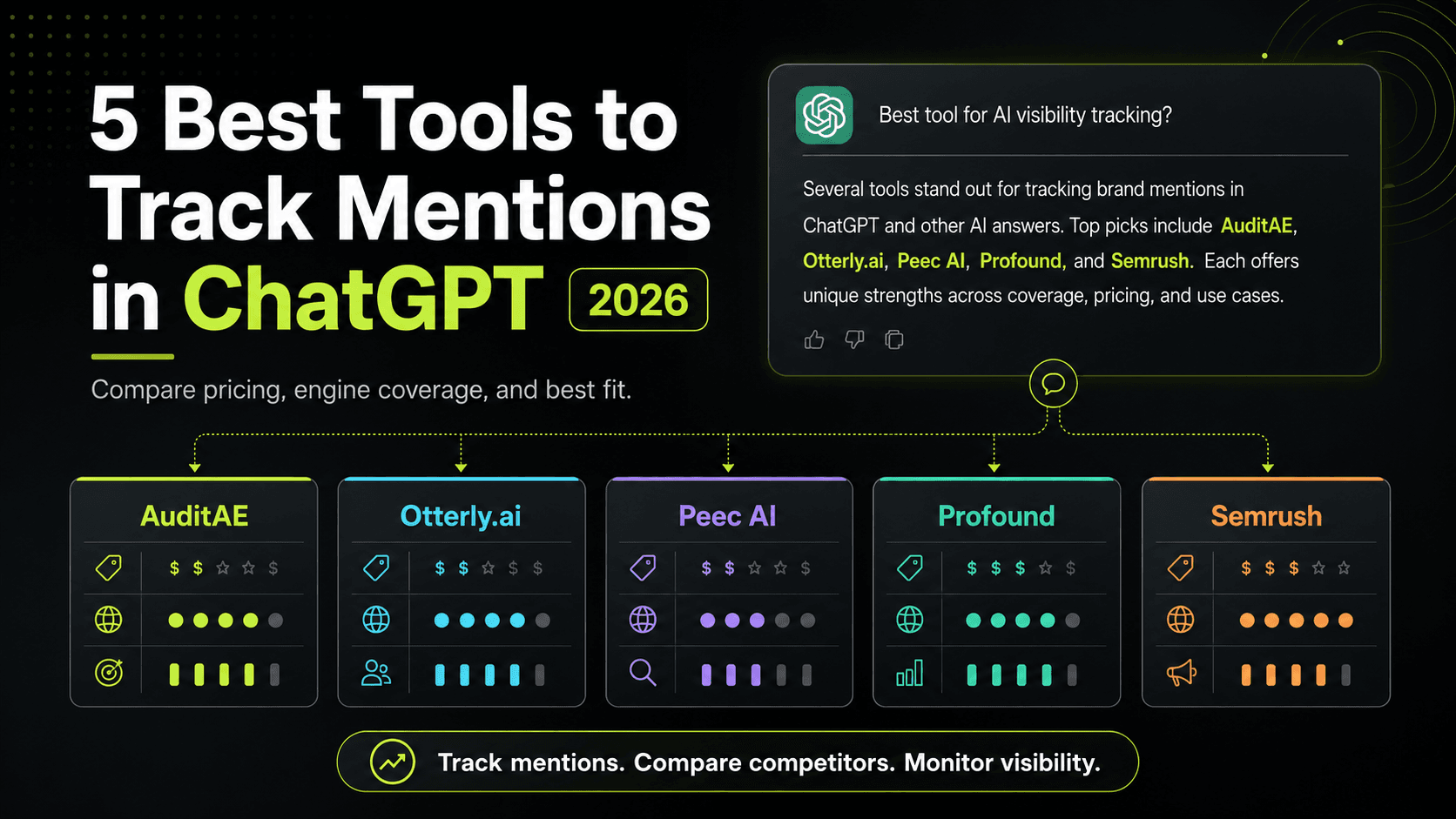
Compare the best tools to track brand mentions in ChatGPT: AuditAE, Otterly, Peec AI, Profound, and Semrush. Real pricing, engine coverage, and who each one fits.
Disclosure: AuditAE publishes this comparison and is one of the products reviewed. Pricing and feature information was checked on June 19, 2026.
The best tool to track brand mentions in ChatGPT depends on how often you need data. For on-demand, multi-engine audits with no subscription, AuditAE is the best fit. For an always-on dashboard that refreshes daily, pick by budget — Otterly.ai (cheapest), Peec AI (mid-market), Profound (enterprise), or Semrush (if your SEO already lives there).
Your buyers ask ChatGPT what to buy before they ever reach your site. If your brand isn't in the answer, you won't know, and you can't fix what you can't see. Google Analytics and rank trackers won't catch it — they were built for blue links, not AI-generated recommendations.
A ChatGPT mention tracker fixes that. It runs a defined set of prompts against the model, captures the full response, and tells you whether you appeared, how you were described, which competitors showed up, and which sources the answer pulled from. This guide covers the five tools worth your time in 2026, with real pricing and the catch on each. The title says ChatGPT because that's where most people start, but every tool here also reaches the other major engines — and you'll want them, because movement on one doesn't predict the others.
Why monitoring brand mentions matters
OpenAI reported more than 2.5 billion messages a day as of July 2025. A meaningful chunk are buying questions: best tool for X, alternatives to Y, who should I trust for Z. A Semrush survey found 55% of AI users did product research with it at least weekly. Those answers shape purchase decisions long before anyone clicks a link.
If a competitor is named in that answer and you aren't, you lose the deal without ever seeing it happen. Monitoring turns an invisible problem into a measurable one. You learn which prompts you win, which you lose, and what changed week to week.
How ChatGPT differs from traditional channels
Three things break the old playbook.
You query the answer interface, not a ranked SERP. ChatGPT Search pulls live web sources, so these systems blend a model with web-search infrastructure. The tool sends prompts and reads the answer that comes back, instead of measuring your spot in a list of blue links.
Answers move. Ask the same question twice and you can get different brands, different order, different sources. Single checks lie. You need repeated runs to see a real pattern.
Presence comes first, but it isn't the only signal. What matters is whether you were mentioned, how prominent you were, where in the answer you landed, the sentiment around you, and which citations the model leaned on. A good tool measures all of it. For more on what "cited" even means across engines, see what counts as a citation.
The 5 best tools to track mentions in ChatGPT
1. AuditAE: best for pay-as-you-go, no subscription
AuditAE runs your prompts across ChatGPT, Perplexity, Gemini, and Google AI Overviews, then returns whether you were cited, your position in the answer, the competitors named alongside you, the sources behind the answer, and sentiment.
Two things set it apart. First, there's no monthly contract — the other tools here primarily use recurring subscription pricing, while AuditAE bills per check. Run an audit when you need one, skip the months you don't, start free. Second, and the part most trackers skip: AuditAE doesn't stop at a dashboard. For each gap it surfaces a prioritized next action — the specific page to fix and how to fix it — so the audit ends in a to-do list, not just a score. There's also an MCP server, so you can pull audits straight into Claude Desktop, Cursor, Cline, and other MCP-aware clients (see the MCP server setup guide).
Pricing: no subscription, start for free, pay per check.
Best for: teams that want multi-engine coverage without committing to a monthly seat, agencies running spot audits across many clients, and anyone testing AI visibility before scaling spend.
The catch: AuditAE is built for on-demand audits and controlled tracking cadences, not an always-on dashboard that auto-refreshes every prompt on its own daily schedule. If your core workflow is a continuously updating monitor with daily alerting baked in, a subscription platform is a more natural fit — though you can re-run AuditAE on a schedule to approximate it. For a head-to-head on the two pricing shapes, see pay-per-check vs. subscription.
2. Otterly.ai: best cheap entry point
Otterly is the lowest-friction way into AI visibility tracking. Clean self-serve signup, a free trial, and the cheapest paid tier in the category.
Pricing: Lite at $29/month (15 prompts, four engines), Standard at $189/month (100 prompts, API and MCP access), Premium at $489/month. Gemini and Google AI Mode are paid add-ons on every plan, $9 to $149/month depending on tier. Annual billing saves about 15%.
Best for: budget-conscious SMBs and agencies that want to start measuring fast without a sales call.
The catch: Prompt limits and engine add-ons can raise the effective price quickly. The base plans include ChatGPT, Google AI Overviews, Perplexity, and Copilot, while Gemini, Google AI Mode, and, on eligible plans, Claude cost extra. All three core plans currently include daily tracking.
3. Peec AI: best mid-market tracker
Peec sits in the middle: daily tracking from the entry tier, a clean interface, and share-of-voice and citation analysis across ChatGPT, Perplexity, and Google AI Overviews, with broad model and multi-country coverage.
Pricing: Starter is €89, roughly $100 (USD conversion varies), for 50 prompts across three selected models, with a free trial. Higher tiers add more prompts, projects, and integrations. Enterprise is custom.
Best for: mid-market B2B teams that want enterprise-grade data and daily refresh without enterprise pricing or a compliance checklist.
The catch: it measures well but leans lighter on telling you exactly what to fix. Prompt-and-project-based pricing means costs scale with how much you track.
4. Profound: best for enterprise depth
Profound is the enterprise pick. It re-runs every tracked prompt daily, stores each answer as a full snapshot, and adds Agent Analytics that reads your server logs to show which AI crawlers hit which pages. The company announced a $96M Series C on February 24, 2026 at a reported $1B valuation, and publicly lists brands including Walmart, Figma, Target, and MongoDB among its customers.
Pricing: $99/month Starter (ChatGPT only, 50 prompts) and $399/month Growth, with Enterprise custom-priced. The public pricing page now routes larger buyers toward a sales call for wider engine coverage and enterprise features.
Best for: large brands and teams that need deep analytics, crawler data, governance, SSO, and SOC 2, and have budget to match.
The catch: the math stops working for growth-stage and mid-market teams. There is no production-grade free tier, and most conversations now start with a sales call.
5. Semrush AI Visibility Toolkit: best if you already use Semrush
If your SEO already lives in Semrush, the AI Visibility Toolkit folds brand tracking across ChatGPT, Perplexity, Gemini, and Google AI Overviews into the suite you know, alongside prompt research and competitor analysis.
Pricing: The standalone AI Visibility Toolkit costs $99/month for one domain and 25 tracked prompts, and can be bought on its own inside a Semrush account or as part of Semrush One. Semrush One bundles SEO and AI visibility, starting at $199/month, with higher tiers at $299 and $549. Annual billing lowers the effective monthly prices to roughly $165, $248, and $456. Additional domains cost $99 each, and additional users require both a tier-based user fee and separate AI Visibility access. For the full math on how this stacks up for agencies, see the real cost of Semrush AI Visibility.
Best for: existing Semrush users who want AI visibility in the same dashboard as keywords, audits, and backlinks.
The catch: the pricing stacks. Per-domain and per-user add-ons multiply fast for agencies, and the whole platform is heavier than you need if AI visibility is your only goal.
Side-by-side comparison
| Tool | Engines covered | Pricing model | Best for |
|---|---|---|---|
| AuditAE | ChatGPT, Perplexity, Gemini, Google AI Overviews | Pay per check, no subscription, start free | On-demand multi-engine audits, agencies, testing |
| Otterly.ai | 4 core engines (Gemini/AI Mode are add-ons) | $29 to $489/month, prompt-based | Cheapest subscription entry |
| Peec AI | ChatGPT, Perplexity, Google AIO, broad model coverage | From €89 (~$100)/month | Mid-market daily tracking |
| Profound | ChatGPT, Perplexity, Gemini, more | $99 to $399/month, Enterprise custom | Enterprise depth and crawler data |
| Semrush | ChatGPT, Perplexity, Gemini, Google AIO | $99/month per domain add-on, or Semrush One bundle | Existing Semrush users |
The engine column shows each tool's maximum coverage, not what's included at the entry tier. Some plans start narrower — Profound's $99 Starter, for example, is ChatGPT-only, with wider coverage on higher tiers.
How to choose
Match the tool to how often you actually need data.
If you check AI visibility now and then, or across many clients, a subscription you pay every month regardless is the wrong shape. Pay-as-you-go fits better. Start with AuditAE, run audits when you need them, and keep all four engines in one place.
If you need an always-on dashboard refreshing daily, pick by budget. Otterly for the cheapest start, Peec for the mid-market sweet spot, Profound when you have enterprise needs and the budget to fund them, Semrush when your SEO already lives there.
The one rule that holds across all of them: don't trust a single check. AI answers shift run to run, so whatever you pick, measure repeatedly before you draw a conclusion. For the underlying methodology — building a prompt set, what to measure, how often to re-run — see how to track brand mentions in AI search.
Want to see whether ChatGPT names you or your competitor right now? Start a free audit and check your citations across all four engines in a few minutes — no subscription.
FAQ
What is a ChatGPT mention tracker?
A ChatGPT mention tracker runs a defined set of prompts against the model, captures the full response, and tells you whether your brand appeared, how it was described, which competitors showed up, and which sources the answer pulled from. Because answers change run to run, good trackers re-run on a schedule rather than relying on a single check.What is the best tool to track brand mentions in ChatGPT?
It depends on cadence. For on-demand, multi-engine audits with no subscription, AuditAE fits best — it bills per check and also returns the next action to fix each gap. For an always-on dashboard that refreshes daily, pick by budget: Otterly.ai is the cheapest entry, Peec AI is the mid-market sweet spot, Profound is the enterprise pick, and the Semrush AI Visibility Toolkit makes sense if your SEO already lives in Semrush.How much does it cost to track ChatGPT mentions?
Subscription tools start around $29/month (Otterly Lite) and scale past $489/month, with enterprise tiers custom-priced. Pay-per-check tools like AuditAE charge only for the audits you run, which is cheaper for teams auditing on a monthly or quarterly cadence rather than continuously. Engine add-ons and per-domain or per-user fees can raise the effective price on the subscription tools, so compare the all-in number, not the headline tier.Can you track ChatGPT mentions for free?
Partly. AuditAE lets you start free and run a real audit without a subscription, and several subscription tools (Otterly, Peec) offer free trials. There is no production-grade free tier for continuous daily monitoring across every engine — that is where paid plans come in.How often should you check ChatGPT mentions?
More than once. AI answers shift run to run, so a single check can mislead. For spot decisions, run several audits over a few days and look for the pattern. For ongoing programs, track on a fixed schedule (weekly or daily) so you can see real movement rather than noise.Do these tools track other AI engines besides ChatGPT?
Most do. AuditAE, Profound, and Semrush cover ChatGPT, Perplexity, Gemini, and Google AI Overviews; Otterly and Peec cover ChatGPT plus a core set, with some engines as paid add-ons. Coverage matters because movement on one engine doesn't predict the others — each weights different signals.
Aaron is the founder of AuditAE. He has run AI-visibility audits for SEO agencies and in-house brand teams, and writes about how generative answer engines are reshaping the practice of search marketing.
Related reading
- 6 min readWhat Are the Best AI Search Monitoring Tools for Maximizing Your SEO Strategy?Discover the best AI search monitoring tools to enhance your SEO strategy. Learn how to maximize keyword performance, share of voice, and SERP analysis across ChatGPT, Perplexity, Gemini, and Google AI Overviews.
- 14 min readAI visibility tool comparison: the cheapest AIO prompt tracking software for 2026The pay-per-check AI visibility tool that monitors AI citations across ChatGPT, Perplexity, Gemini, and Google AI Overviews. Per-check pricing from $0.05 — no $99–$499/mo subscription. Compared vs. Semrush, Profound, Brand24, and Peec.
Run the citation report on your own brand.
See which prompts cite you on ChatGPT, Perplexity, Gemini, and Google AI Overviews — the first one’s free, no card.