
How to Improve Brand Visibility in AI Search Engines: 8 Fixes You Can Ship This Month
AI engines already have an opinion about your brand. Here is how to check what it is, and the eight fixes, in order, that change it — with the WordPress path for each one.
Type your category into ChatGPT right now. "Best [what you sell] for [who you sell to]." Read the answer. Either your brand is in it, or a competitor's is, or the engine picked three brands you've never heard of because they happened to have a page structured the way the engine likes.
That answer is your brand visibility in AI search. Not a ranking, not a traffic number. Whether you exist in the response a buyer reads instead of clicking.
This post is the fix list for how to improve brand visibility in AI search engines: eight changes, in the order they pay off, with the WordPress path where one exists. Nothing here requires a rebuild.
What "brand visibility in AI search" actually means
There are two levels, and the gap between them is where most brands live.
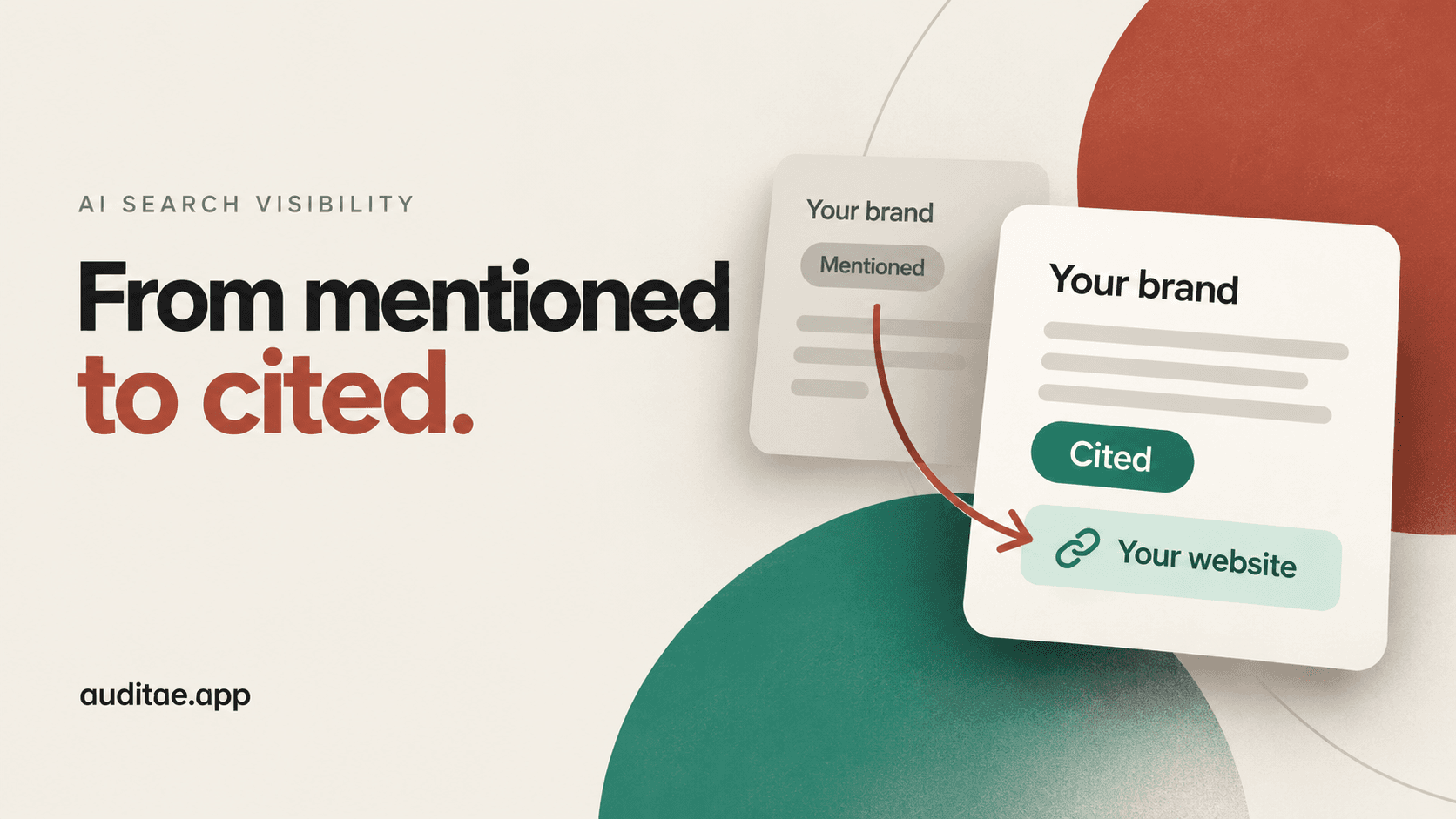
Mentioned. The engine names you in the answer text. Good. The buyer sees the brand.
Cited. The engine includes a source URL pointing to your domain. Better. The buyer can click, and the engine is treating your page as the evidence, not just a name it remembered. (What counts as a citation covers how each engine defines it.)
Engines know about brands they never cite. They learned the name from training data, from Reddit, from a review site. When they need a source link, they pick whichever page answered the question most directly, and that is often not yours.
We ran this on Yoast, the most-installed SEO plugin on WordPress. Five prompts, four engines, twenty answers. Yoast was named in 19 of them and cited by URL in 9. On "best wordpress seo plugin," the single most valuable prompt in the category, AIOSEO won the link on two of the four engines. The engines know Yoast. They just didn't hand it the credit.
So "improve brand visibility" is really two jobs. Get mentioned where you aren't. Get cited where you're only mentioned. The fixes below cover both, but the second one is where the traffic is.
Step 0: check your AI search visibility before you fix anything
Skip this and you'll ship eight changes and have no idea which one worked.
Pick five to ten prompts your buyers actually type. Not your keywords. Questions. "Which CRM works for a two-person real estate team." "Is [your brand] worth it." "[Your brand] vs [competitor]." Run every prompt against ChatGPT, Perplexity, Gemini, and Google AI Overviews, and record two columns per cell: mentioned yes/no, cited yes/no, plus which domains got the citation instead.
You can do this by hand in a spreadsheet. It takes about an hour for ten prompts, and you'll want to repeat it in two weeks, so most people don't. AuditAE runs the same grid in about two minutes and stores it so the re-run is a button. Either way, do it. The rest of this post assumes you have the grid.
What you're looking for: the prompts where you're mentioned but not cited (fixable with on-page work), the prompts where you're absent entirely (needs off-page work), and the domains that keep showing up instead of you (your real competitor list, which is usually not the one in your pitch deck).
Fix 1: let the right AI crawlers in
Confirm the engines can read your site. A surprising number of sites block them without knowing it, through a security plugin, a CDN bot rule, or a robots.txt line someone copied from a blog post in 2023.
The bots are not interchangeable, and this is where most robots.txt advice goes wrong:
- OAI-SearchBot is what ChatGPT search uses to find and cite pages. GPTBot is OpenAI's training crawler. Blocking GPTBot does not remove you from ChatGPT answers; blocking OAI-SearchBot does. OpenAI documents the split on its bots page.
- PerplexityBot feeds Perplexity's citations.
- Googlebot feeds Google Search, which is what AI Overviews and Gemini's grounding draw on. Google-Extended only controls whether your content trains Gemini models. Blocking it does not affect whether you appear in AI Overviews or Gemini answers.
- ClaudeBot is Anthropic's training crawler; Claude's search uses a separate fetcher.
The decision: allow the search bots. Training bots are your call. If a search bot is blocked in robots.txt or returning 403s at the server level, no amount of content work will help.
WordPress path. The free AuditAE plugin logs hits from around thirty AI crawlers and audits robots.txt for blocks. Install it and check the log after a few days. Zero hits from a search bot on a site with real traffic is a reason to check for a block upstream, not proof of one. Repeated 404s from a bot mean it's working from stale URLs; redirect them. How to track AI bots on WordPress is the deep dive.
Fix 2: get indexed where the engines look
This is the fix people skip because it sounds like 2012.
ChatGPT search draws heavily on Bing's index, and OpenAI has said it uses multiple search providers plus its own crawler. Perplexity and Copilot lean on Bing too. Practical version: a page that isn't in Bing is much less likely to be cited by the Bing-fed engines, and most WordPress sites have never touched Bing Webmaster Tools. Their Bing index is a stale partial copy from whenever Bing last got around to it.
Verify the site in Bing Webmaster Tools and submit the sitemap. Then set up IndexNow so every publish and update notifies Bing immediately instead of waiting for a recrawl. IndexNow is a notification, not a guarantee of indexing, but it removes the waiting. The full Bing-plus-IndexNow workflow is in How to rank on ChatGPT.
Google doesn't participate in IndexNow. For AI Overviews and Gemini, the path is the one you already know: Search Console, sitemap, normal Google crawling.
WordPress path. The AuditAE plugin auto-pings IndexNow on publish and update.
Fix 3: restructure the page that should be cited
Take the prompts where you're mentioned but not cited. Open the page that should be the citation. Now read it the way an engine does: it's looking for a passage, not a page, that answers the question in the first sentence or two.
Most commercial pages fail this. They open with a hero line, a value proposition, three paragraphs of context, and the actual answer is in paragraph six under an H2 that doesn't match the question.
The rewrite pattern: put the question in an H2, in the buyer's words. Answer it in the first sentence under that H2, declaratively, with the specific fact or number. Then elaborate. Do this for every question the page should win.
If you mark those question-and-answer pairs up as FAQ schema, do it as a label on structure that already exists, not as a substitute for it. Google says plainly that no special markup is required for AI features, and we've seen no evidence that schema alone earns a citation. It costs nothing when the content is already answer-first, and it can help a parser find the passage. Don't expect more than that.
WordPress path. No plugin needed for the rewrite. If the site is connected to AuditAE, AEBOT can read the audit, read the post, draft the restructured section with the SEO title and meta rewritten to match, and write it back through Yoast or Rank Math. You approve, it publishes. The plugin's FAQ schema editor injects the JSON-LD and deduplicates against Yoast and Rank Math so you don't end up with two competing FAQPage blocks.
Fix 4: publish something worth citing
This is the fix that separates brands that get cited from brands that get mentioned, and it has nothing to do with markup.
Look at what the engines actually cite in your grid. It's rarely a service page. It's a comparison table with real numbers, a test someone ran, a page with a specific figure the engine can quote, a documented result. The engine needs evidence to point at, and "we're the leading provider of" is not evidence.
The Yoast example above is this fix in action. A page that says "Yoast was cited on 9 of 20 answers and lost the link to AIOSEO on 2 of 4 engines for the top prompt" is quotable. "Yoast is popular" is not.
For your category: run the test your buyers wish someone would run. Compare the options with a table. Publish the numbers from your own data. Document the outcome of a real project with the specifics left in. One page like this will earn more citations than ten restructured service pages, because it's the only page in the category that answers the question with something the engine can point at.
Fix 5: earn mentions on the pages engines already trust
This is the fix for prompts where you're absent entirely. Look at the citation column in your grid. The same third-party domains will keep appearing: a review site, a comparison blog, a Reddit thread, a directory. Those are the sources the engines trust for your category.
Get on them. A listing, a review, a mention in a comparison post, a real answer in the Reddit thread. This is old-fashioned PR and it's still the fastest way to go from absent to mentioned, because the engine already trusts the page; you just need to be on it.
Prioritize by frequency. A domain cited on six of your ten prompts is worth more than one cited once.
Fix 6: clear the technical blockers
Engines trip on the same things Google does, plus a few of their own: pages that render only client-side, missing canonical tags, thin or missing author information, broken internal links to the pages that should carry the citation, slow responses that make a fetcher give up.
None of this earns a citation on its own. All of it can cost you one.
WordPress path. The plugin's AI Readiness Score walks this checklist and tells you what's failing. Fix the reds, ignore the score itself. The score is a to-do list, not a KPI.
Fix 7: keep the dates honest
On time-sensitive queries, "best X in 2026," "current pricing," "latest version," engines weight recency, and Perplexity and AI Overviews visibly favor recently updated sources. On evergreen queries it matters much less. Don't rewrite everything; update the pages that should carry citations when facts change, and set a real dateModified when you do.
Don't fake it. A page that claims to be fresh with stale numbers reads as exactly what it is, to the engine and to the buyer.
Fix 8 (optional): ship an llms.txt
llms.txt is a plain-text file at your site root that describes the site and its most important pages in your words. Google says it's not needed for AI features and no engine has confirmed it as a ranking signal. Treat it as a five-minute courtesy to any system that reads it, not as a lever. If you're on WordPress the AuditAE plugin generates one at the site root from your published content; otherwise write it by hand or skip it. Do llms.txt files help AI search? has the evidence either way.
Re-run the grid: how to monitor AI search visibility over time
Fourteen days after the last fix ships, run the exact same prompts against the exact same engines. Compare cell by cell, and report each engine on its own; they move at different speeds and for different reasons.
Rough pattern from our own audits, not a promise: Perplexity tends to reflect changes first. ChatGPT moves once Bing picks up the change. AI Overviews and Gemini move slowest because they're tied to Google's crawl and ranking. If nothing moved in 14 days, recheck Fix 1 and Fix 2 before touching content; the index gap is the usual culprit.
The delta shows that something changed. It doesn't tell you which fix did it. If you need attribution, ship the technical fixes (1, 2, 6) as one batch, measure, then ship the content fixes (3, 4, 7) as a second batch and measure again. Seven changes at once will get you a result you can't explain.
Then keep the cadence. Weekly if the category is competitive, monthly if it isn't. Brand visibility in AI search is not a project you finish. The engines re-decide every time someone asks.
Where to start today
Run the grid tonight. Ten prompts, four engines, two columns. It's the one step nothing else depends on and the only way you'll know later whether anything worked.
While it settles, do Fixes 1 and 2 tomorrow: they don't depend on the grid, they're mostly configuration, and on WordPress the plugin handles the crawler log, the robots audit, and IndexNow. Then open the grid, find the prompts where you're mentioned but not cited, and start with those pages. They're the cheapest wins on this list.
Start free, no subscription: run your first prompt grid on AuditAE, or install the free plugin from WordPress.org and let it handle Fixes 1, 2, 6, and 8 for you. For the bigger picture on how engines pick what to cite, the pillar is AI search optimization.
FAQ
How long does it take to improve brand visibility in AI search?
It varies by engine and by fix. Perplexity often reflects changes within days. ChatGPT tends to follow Bing's reindex. Google AI Overviews and Gemini follow Google's crawl and are usually slowest. Treat 14 days as a checkpoint and 30 days as the first real read.Is brand visibility in AI search the same as SEO?
They overlap on the technical layer (crawlable, indexed, fast) and diverge on the content layer. SEO optimizes a page to rank; AI visibility optimizes a passage to be quoted. A page can rank first on Google and never be cited.Do I need a tool to check AI search visibility?
No. Ten prompts across four engines by hand is about an hour. A tool matters when you want to repeat it on a schedule and compare runs, which is the part that shows whether the fixes did anything.Does blocking GPTBot remove my site from ChatGPT?
No. GPTBot is OpenAI's training crawler. ChatGPT search uses OAI-SearchBot to find and cite pages. Block GPTBot if you don't want to train models; block OAI-SearchBot only if you don't want to be cited.
Aaron is the founder of AuditAE. He has run AI-visibility audits for SEO agencies and in-house brand teams, and writes about how generative answer engines are reshaping the practice of search marketing.
Related reading
- 6 min readImage SEO for WordPress: How to Name, Rename & Tag Images So AI Engines Read ThemImage SEO is mostly two text signals: the file name and the alt text. Here's how to name images for SEO, rename bad filenames in WordPress without breaking anything, and write alt text — by hand or with the free AuditAE plugin.
- 11 min readHow to Add an llms.txt File to WordPress: A Step-by-Step GuideAdding an llms.txt file to WordPress takes about two minutes. Here's the easy way with the free AuditAE plugin, the manual method, and how to confirm AI bots are actually reading it.
Run the citation report on your own brand.
See which prompts cite you on ChatGPT, Perplexity, Gemini, and Google AI Overviews — the first one’s free, no card.