

Why use AI search optimization tools for your business
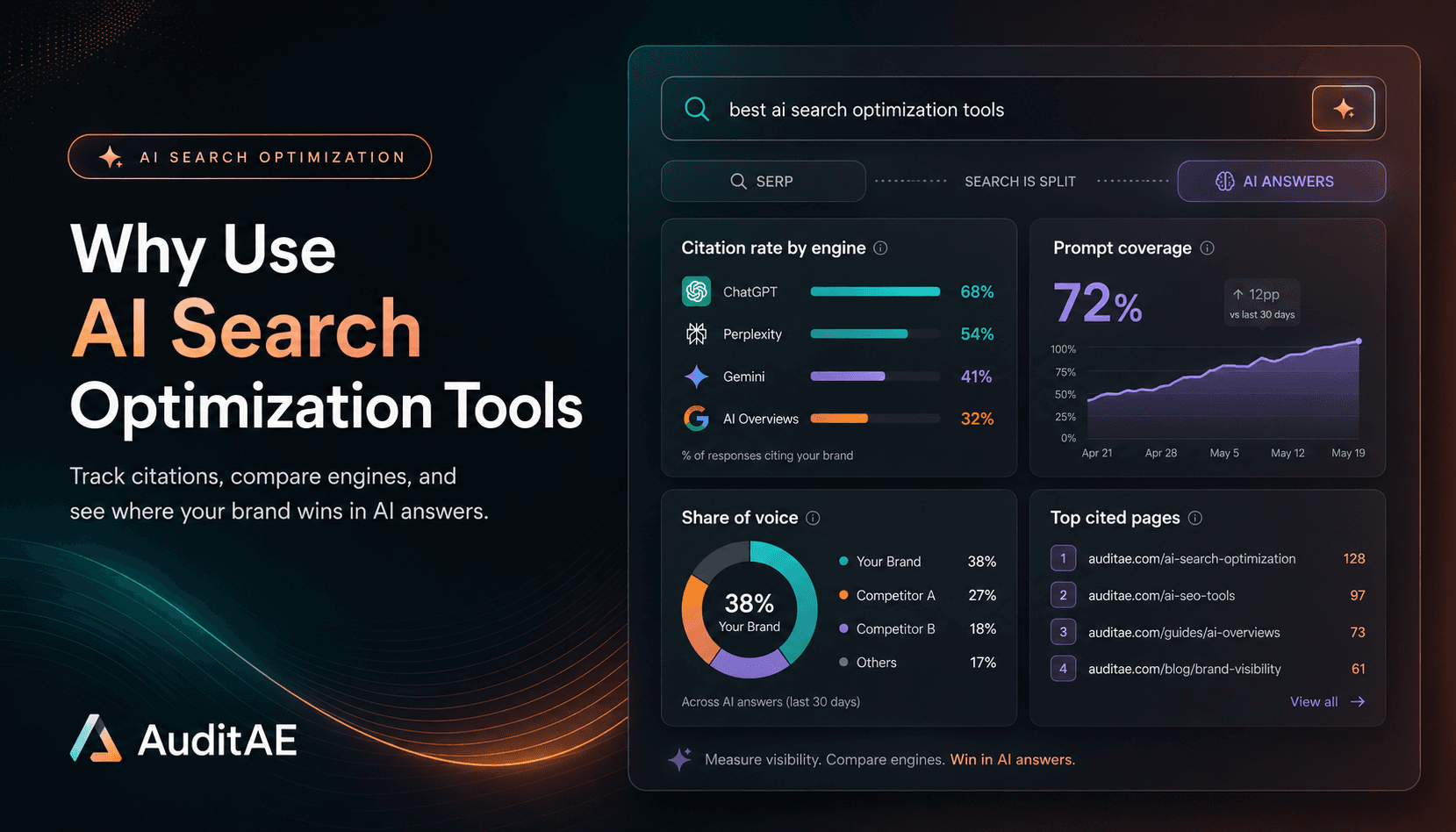
Search has split into two surfaces: classic SERPs and AI answers. Here's why AI search optimization tools matter, what they actually do, the features that move the needle, and how to put one to work.
On this page· 7 sections
Search has split in two. There is the SERP you know, with blue links and snippets, and there is the AI layer sitting on top of it, where ChatGPT, Perplexity, Gemini, and Google AI Overviews answer questions directly and name a handful of brands as they do it. Most teams still measure only the first one. The second one is where buyers increasingly form their first opinion of you.
AI search optimization tools exist to close that gap. They tell you what AI assistants are saying about your category, whether they cite your brand, which competitors get named more often, and what you would need to change to be one of the brands cited. This guide explains why that capability is worth your time, what these tools actually do, and how to put one to work.
Understanding AI search optimization
Definition of AI SEO
AI SEO covers two overlapping things, and conflating them costs people money. The first is using AI to do classic SEO faster: keyword research, content briefs, technical audits, internal linking suggestions. The second is optimizing your content so AI search engines surface and cite it when someone asks a question your brand should answer.
The second one is the bigger shift. AI search engine optimization means writing, structuring, and earning citations in a way large language models can extract and trust. The audience for your page now includes Perplexity Sonar, OpenAI's web search tool, Gemini's grounding layer, and Google's AI Overviews. They read your pages differently than Googlebot does, and they cite very differently than the ten blue links do. For the full framing, see AI search optimization: the 2026 playbook and What is Answer Engine Optimization (AEO)?.
The role of artificial intelligence in SEO
The reason this matters is distribution. When a buyer asks ChatGPT for "best AI brand visibility tools" or "alternatives to my current SEO platform," the assistant gives them a handful of names. If you are not in that set, you do not get the click, the consideration, or the demo request. Traditional rank tracking will not flag this. Your Google Search Console traffic can stay flat while your real share of voice in AI answers is collapsing.
Artificial intelligence search engine optimization is a discipline because the inputs are different. Citation behavior depends on how often you appear in training data and grounding sources, how structured your content is, how recently you have been written about, and how well your pages answer the actual prompt patterns buyers use. None of that shows up in a standard position report. For the deeper contrast, see How AI visibility differs from traditional SEO.
Benefits of using AI SEO tools
Enhanced SERP rankings
The first benefit is the obvious one. AI driven SEO tools surface gaps in your content that human auditors miss, suggest schema you are not using, identify queries you almost rank for, and propose internal links you should add. The result is more first-page placements on Google itself.
Less obvious is what happens at the AI layer. When you optimize content to be cleanly extractable, with direct answers, defined terms, and well-attributed claims, you tend to do better in both Google's classic SERP and in AI Overviews. The same structural choices that help an LLM cite you help Google's quality systems trust you. For the mechanism behind that, see Why your #1 ranked page is invisible in AI search.
Data-driven insights and strategies
AI based SEO tools are useful because they replace guessing with measurement. Instead of debating whether your blog should target a topic, you can see how often that topic comes up in AI assistants, who gets cited today, and what sources those citations point back to. That tells you whether you need original research, a comparison page, a glossary entry, or a vendor list page to break in.
For agency SEO leads, the practical win is being able to walk into a client meeting with a real number. "Your brand is cited in 12 percent of AI answers in your category, your top competitor is at 41 percent, here are the prompts where you lose." That is a different conversation than "your rankings improved on three long-tail keywords."
Time and resource efficiency
The third benefit is leverage. A small team with the right AI powered SEO tools can run audits, generate briefs, monitor competitors, and track AI citations across four engines in the time it used to take to update one spreadsheet. The work that used to require a junior analyst and two weeks now runs on a schedule, and the team's time shifts to interpretation and editorial decisions.
Key features of AI search optimization tools
Content optimization capabilities
Look for tools that go beyond keyword density. The features that actually move the needle are entity coverage, question coverage, and answer extractability. Entity coverage means your page mentions the people, products, and concepts AI engines associate with the topic. Question coverage means your page answers the specific sub-questions buyers ask. Answer extractability means an LLM can pull a clean, attributable sentence from your page without rewriting it.
If a tool can score those three dimensions and tell you what to add, it is worth the seat. If it just gives you a keyword count, it is solving last decade's problem.
Technical SEO automation
Technical SEO is where AI tooling has matured fastest. Crawl, render diff, broken link detection, schema validation, log file analysis, internal link graph mapping. All of this is now table stakes. The differentiator is whether the tool can prioritize fixes by expected traffic impact and whether it can prepare the fix as a pull request or a CMS edit rather than a ticket.
For WordPress sites in particular, the practical version of this is a tool that can read your site, identify the high-leverage fixes, and apply them through the admin without you copying instructions back and forth.
Competitive analysis
In classic SEO, competitive analysis means looking at who outranks you for shared keywords. In AI search, it means looking at who gets named when buyers ask the question. Those are not always the same companies. You will find competitors you have never heard of cited next to you, and you will find legacy competitors you have always benchmarked against simply absent from the AI conversation.
A useful tool shows you both, side by side, and tells you where the divergence is. For the methodology behind that comparison, see The complete guide to AI brand monitoring.
How AI tools improve SERP rankings
Improved keyword analysis
Keyword analysis has changed shape. The unit of optimization is no longer the keyword, it is the prompt. Real buyers do not type "ai seo tools," they type "what's the best ai seo tool for a small agency that already uses Ahrefs." AI tools cluster prompts, surface the long-form variants people actually use, and tell you which ones your content covers.
This is also where you find the gaps. If you cover the head term but none of the natural-language sub-questions, you will rank in Google and still lose every AI citation to a competitor whose page reads like an answer.
Natural language processing (NLP) benefits
NLP is the engine under almost every modern SEO feature. It is how a tool understands that "customer support software" and "help desk platform" are the same topic, how it identifies entities on your page, and how it scores readability and tone. This matters for ranking because Google's own systems also use language models (BERT and MUM among them), so a tool that scores your page the way an LLM would gives you a rough preview of how Google reads it.
User experience and engagement metrics
Engagement still matters. Google has confirmed that click data feeds its ranking systems, and dwell time, scroll depth, and return visits are a good read on whether a page actually answered the question. A tool that connects content changes to engagement deltas, rather than just to position changes, gives you a more honest picture of whether the edit worked.
Implementing AI search optimization
Developing an AI SEO strategy
A workable AI SEO strategy has three layers.
The first is visibility measurement. Before you change anything, know where you stand. Run audits across ChatGPT, Perplexity, Gemini, and Google AI Overviews for the prompts your buyers actually use. Capture which competitors get cited, what sources the engines lean on, and what your share of voice looks like by engine.
The second is content investment. Use what you found to decide where to invest. If competitors are cited because they have a comparison page you do not have, write it. If they are cited because of an original study, commission one. If they are cited because they appear in a third-party list, get on the list. AI search content optimization best practices are mostly about being the most useful, most extractable source for the question, not about chasing keyword density.
The third is technical hygiene. Make sure your content is crawlable, your schema is correct, your canonicals are clean, and your site is fast. None of this gets you cited, but all of it can prevent citation if you get it wrong.
Measuring success: KPIs and metrics
The metric that matters most is citation rate, the percentage of relevant AI prompts where an engine cites your site as a source. Being named in the answer without a link is a separate, weaker signal worth tracking too. Track it per engine, because ChatGPT, Perplexity, Gemini, and AI Overviews each behave differently. A brand can be heavily cited on Perplexity and invisible on Gemini, and the fix is rarely the same.
Other KPIs worth watching:
- Share of voice per engine, compared against your top three competitors.
- Citation position, where in the answer your brand appears.
- Source quality, which domains the engines pull from when they cite you.
- Prompt coverage, what percentage of your target prompts you appear on at all.
- Downstream conversion, whether AI-referred traffic converts at the same rate as organic.
If your tool cannot give you those, it is not enough. For the per-engine definitions of what counts as a citation in the first place, see What actually counts as a citation.
Conclusion
The future of AI in SEO
The direction of travel is clear. AI search will keep absorbing top-of-funnel queries, classic search will keep its place for transactional and navigational ones, and the brands that show up in both will win disproportionately. The skill that will matter is being able to measure across both surfaces and translate findings into specific edits, not just dashboards.
Final thoughts on embracing AI
You do not need a six-figure platform to start. You need to know which prompts matter in your category, which engines your buyers use, and whether your brand is in the answer. That is the first audit. Everything else follows from what you find there.
AuditAE runs that audit. There's no subscription: start for free with $5 of signup credit (no card needed), point it at the prompts you care about, and see where you stand across ChatGPT, Perplexity, Gemini, and Google AI Overviews before you decide what to change.
FAQ
A tool that measures and improves how AI answer engines (ChatGPT, Perplexity, Gemini, and Google AI Overviews) surface your brand. The good ones run your buyers' real prompts against each engine, capture which brands and sources got cited, score your content for extractability, and tell you what to change to be one of the brands named in the answer.
Because traditional rank tracking doesn't see the AI layer. Your Google Search Console traffic can stay flat while your share of voice in ChatGPT, Perplexity, and AI Overviews collapses. AI assistants usually name only a few brands per answer. If you're not in that set, you don't get the consideration, regardless of where you rank in the blue links.
Start with the four that matter for most B2B and consumer categories: ChatGPT, Perplexity, Google Gemini, and Google AI Overviews. Google AI Mode is a useful fifth. Each weights different signals and cites different sources for the same prompt. Measuring only ChatGPT gives you half the picture; a blended 'AI visibility' score gives you none of it.
Build a fixed prompt set that reads like things your buyers would actually type, run it against each engine on a schedule, and track five things: citation rate, position in the answer, share of voice against competitors, which sources the engines pulled from, and prompt coverage. A weekly or monthly cadence suits most programs.
Overlapping but not the same. Strong technical and content SEO carries the most weight in Google AI Overviews, and Perplexity cites Google's top-ranking pages more often than other assistants do. ChatGPT and Gemini mostly cite pages outside Google's top 10, and weight content shape and brand mentions in ways traditional SEO programs underinvest in. Treat AI search optimization as a measurement and content discipline that builds on top of SEO, not a replacement for it.
Pick 10–25 prompts your buyers actually ask, run them against the four engines, and see where you stand. That baseline tells you whether your problem is content shape, retrieval, or brand recall. Each one has a different fix. You can do the first pass manually; past 20 prompts on a recurring cadence, automation pays for itself fast.
Run the citation report on your own brand.
See which prompts cite you on ChatGPT, Perplexity, Gemini, and Google AI Overviews — the first one’s free, no card.
Aaron is the founder of AuditAE. He has run AI-visibility audits for SEO agencies and in-house brand teams, and writes about how generative answer engines are reshaping the practice of search marketing.
Related reading
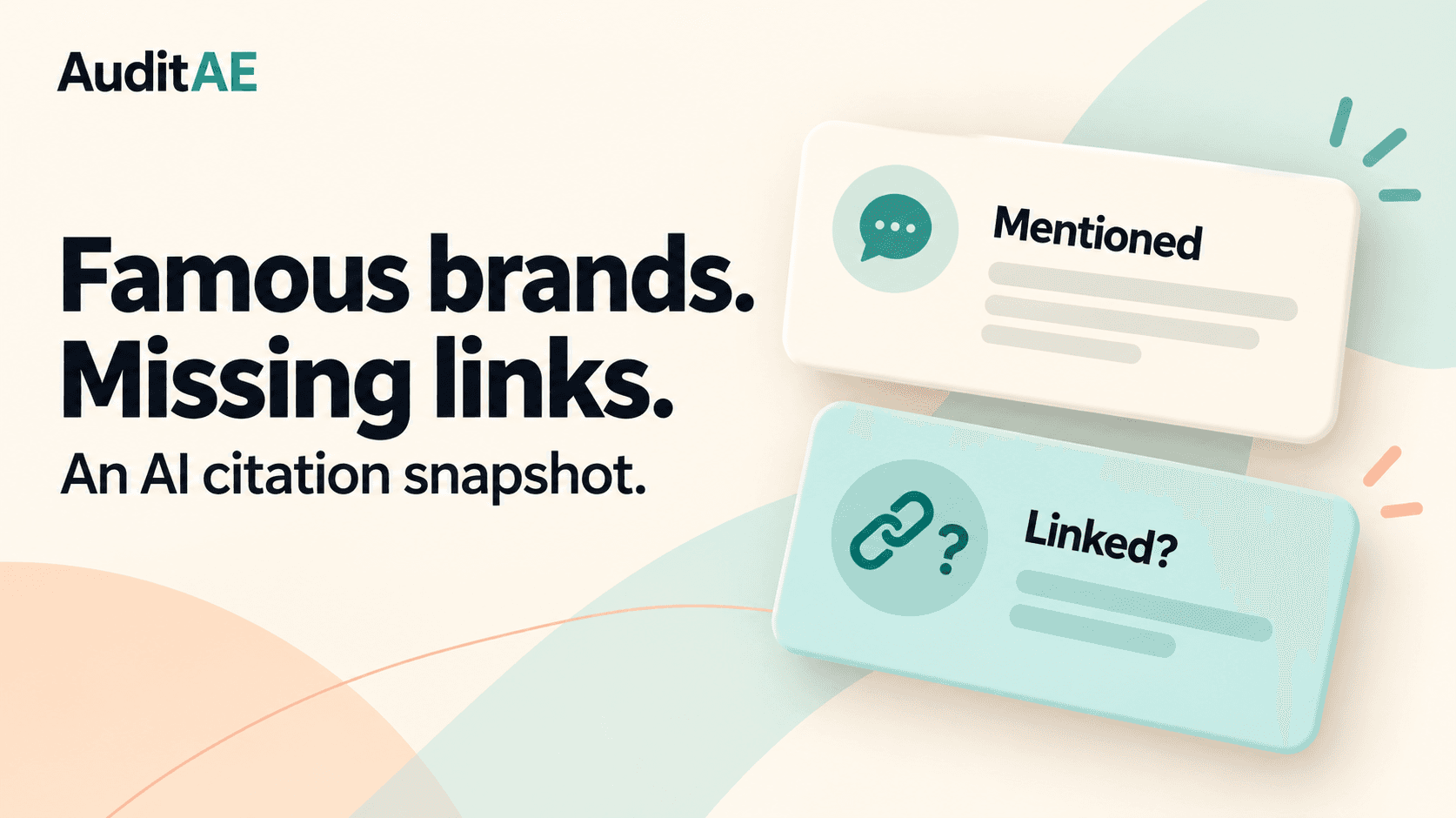
- 6 min readAI Citation Snapshot: We Asked 4 AI Engines About 5 Famous Brands. Notion Got Linked 0 Times.One buyer prompt each for HubSpot, Shopify, Canva, Mailchimp and Notion, run live across ChatGPT, Perplexity, Gemini and Google AI Overviews. The brands were named in 17 of 20 answers but linked in only 6, and Google's two engines linked none of them.
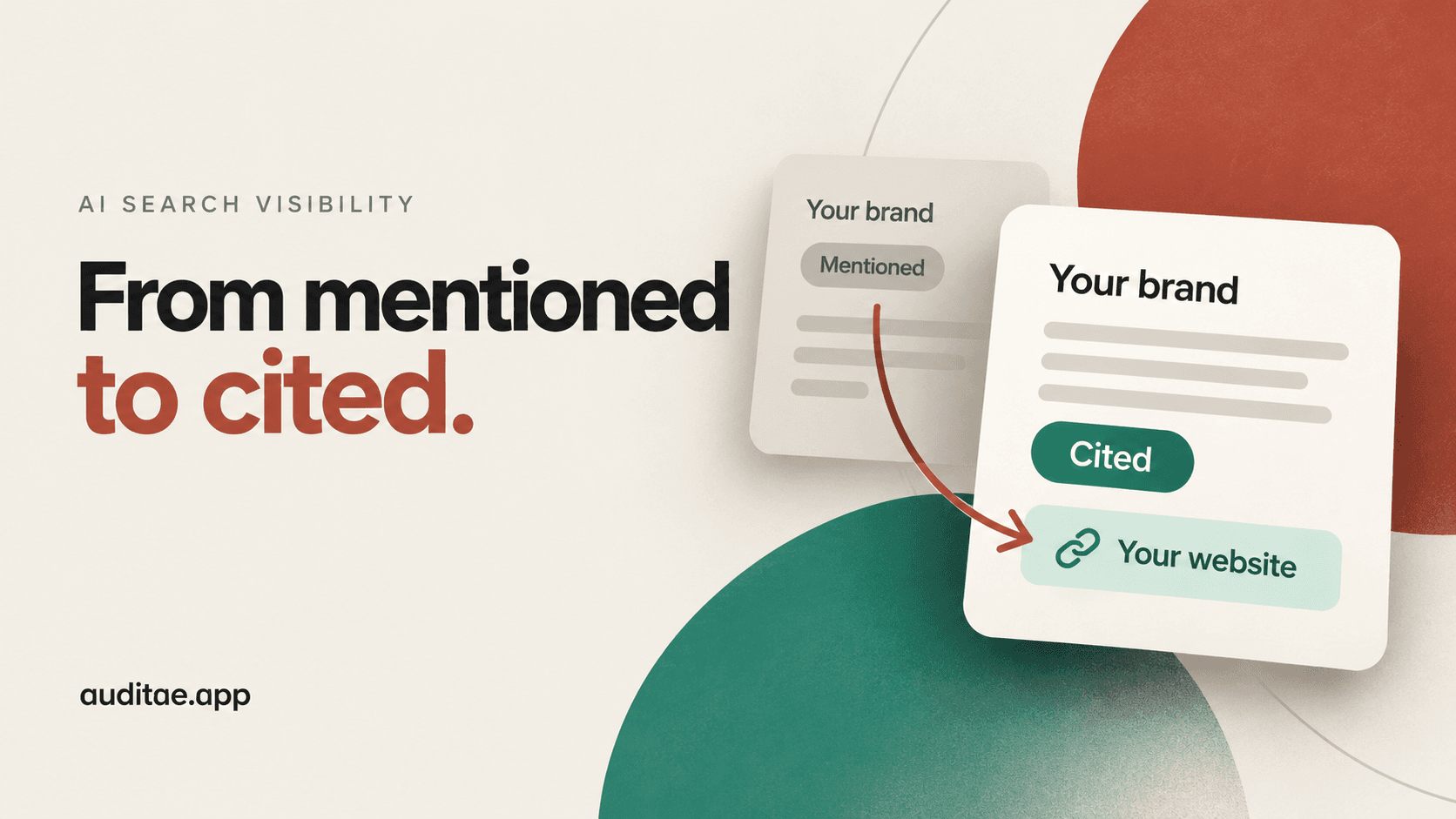
- 10 min readHow to Improve Brand Visibility in AI Search Engines: 8 Fixes You Can Ship This MonthAI engines already have an opinion about your brand. Here is how to check what it is, and the eight fixes, in order, that change it, with the WordPress path where there is one.
- 18 min readSEO, GEO, and AEO in 2026: What 20+ Studies Actually Show About AI CitationsZero-click searches hit 68%. Brand mentions predict AI visibility 3× better than backlinks. Two-thirds of AI Overview citations now come from pages that never reached page one. A research report built from 20+ primary studies, with the disagreements reported, not averaged.