
Top 6 Semrush Alternatives for SEO (2026)
Semrush is powerful but pricey, and it wasn't built for AI search. Here are the 6 best Semrush alternatives in 2026 — including the pay-per-use tool that tracks whether ChatGPT, Perplexity, and Gemini actually cite you.
Nobody shops for a Semrush alternative in the abstract. People go looking for one of two reasons, and which one you have determines the answer completely.
The first is price. Semrush's entry plan runs $139/month, the tiers above it climb to $199, $299, and $549, and tracked domains and extra seats add up on top. For a team using four modules out of forty, that math stops working.
The second is fit. Semrush was built to measure Google's ranked links. When your buyer asks ChatGPT, Perplexity, or Google's AI Overviews a question in your category, that answer is what they see — and a tool built for blue links can't tell you whether you're in it.
This guide covers six alternatives. Five are traditional SEO suites, and they're genuinely good at the job Semrush does. The first is built for the second problem. Where each one falls short is included, because a roundup where every tool is excellent is a roundup that helps nobody.
Prices below were checked in July 2026 and are the entry tier billed monthly. Vendors reshuffle plans constantly — verify before you buy.
Why look for a Semrush alternative?
- Budget. The entry plan is expensive, extra users and extra tracked domains add up fast, and a lot of the catalog goes unused.
- Complexity. It's a big surface. Plenty of teams need keyword research, rank tracking, and a site audit — not forty modules.
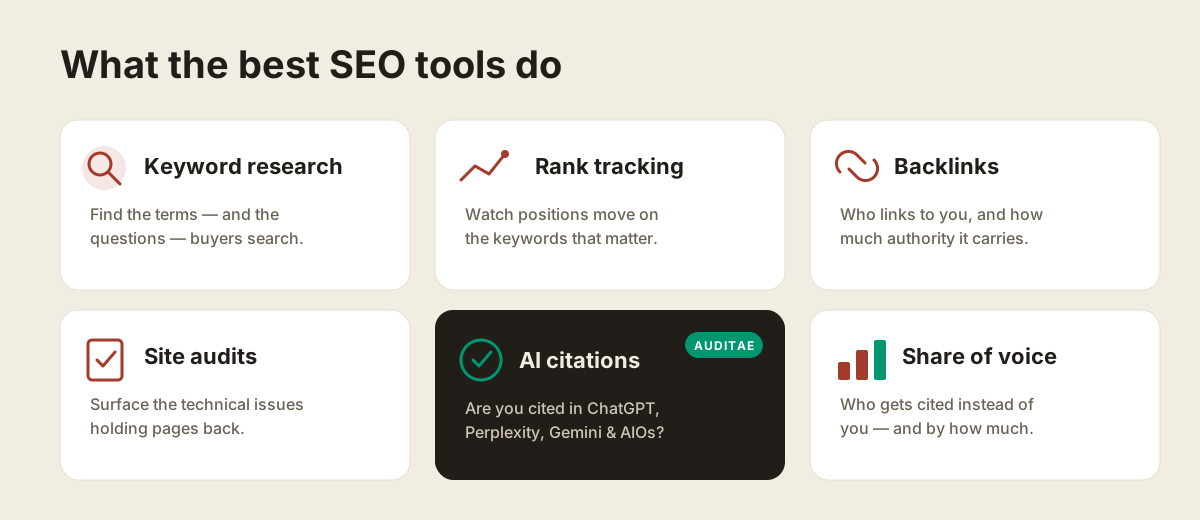
- AI search. This is the new one. Classic SEO suites measure your position in a ranked list. They don't measure whether an answer engine named you as the source — and ranking well doesn't mean you get cited.
The right alternative depends on which of those is your reason. Match the tool to the job.
Comparing the top Semrush alternatives
| Tool | Best for | AI-citation tracking | Pricing model | Starts at |
|---|---|---|---|---|
| AuditAE | AI-search visibility, pay-per-use | Yes — core feature | Pay-per-use, no subscription | $5 free, 5–12¢/check by engine |
| Ahrefs | Backlink analysis, SEO experts | No | Subscription | $29/mo (Starter), $129 (Lite) |
| Moz Pro | Beginners, domain authority | No | Subscription | $59/mo (Starter) |
| SpyFu | Competitor & ad intelligence | No | Subscription | $39/mo |
| Ubersuggest | Budget keyword research | No | Subscription / free tier | ~$12/mo |
| SE Ranking | Agencies, white-label reports | Limited | Subscription | ~$65/mo |
1. AuditAE
AuditAE is the alternative for the reason most people don't see coming: your buyers are starting to get their answers from AI engines instead of the ten blue links, and no classic SEO suite tells you whether you're in those answers. AuditAE does exactly that.
It runs your real buyer prompts against ChatGPT, Perplexity, Google Gemini, and Google's AI Overviews in parallel, and reports whether your brand was mentioned, cited as a source, or quietly skipped — plus your share of voice against the competitors who got cited instead of you. On top of that it bundles the bread-and-butter you'd expect from an SEO tool: Google rank tracking (with AI-Overview citation status per keyword), brand-mention monitoring across AI answers and the open web, technical site audits, and backlink-authority snapshots.
The model is the other half of the pitch. AuditAE is pay-per-use — no subscription, $5 of free credit at signup with no card, a few cents per check, and top-ups that never expire. For a light user or an agency spinning checks up and down across clients, that can cost dramatically less than any monthly seat-based plan.
Where it wins: it's the only tool here that answers "does ChatGPT cite us?" directly, and the pay-per-use model means an agency can spin checks up for a pitch and down again without carrying a seat all year.
Where it doesn't: it isn't a 1:1 replacement for a forty-module suite. If you need the deepest backlink index on the market, pair it with Ahrefs rather than replacing Ahrefs with it. It's also newer than every incumbent below, which is a fair thing to weigh.
AuditAE pricing
Pay-per-use. $5 free credit at signup (no card), then 5–12¢ per check depending on the engine (Perplexity 5¢, ChatGPT 7¢, Google AI Overviews 9¢, Gemini 12¢ — priced at what each engine costs us) with no subscription and no expiry on top-ups. See the full rate card — and our breakdown of the real cost of Semrush's AI Visibility add-on, which is where the per-check math actually bites.
If you'd rather see the whole category before deciding, we compare the purpose-built options in best AI search monitoring tools.
2. Ahrefs
Ahrefs is the closest like-for-like swap for Semrush's core work, and its backlink index is the reason. If your job involves link building, competitor link gaps, or diagnosing why a competitor outranks you, this is the tool with the deepest data behind the answer. Content Explorer is genuinely useful for finding what's already working in a niche, and the site audit is solid.
Where it wins: link data, full stop. Nothing else in this list is close.
Where it doesn't: the price steps are steep — Starter is deliberately limited, and the jump to Lite is where most teams actually land. It tracks no AI-answer citations, and the sheer surface area overwhelms beginners.
Ahrefs pricing
Starter is $29/month with restricted limits; the Lite plan is $129/month billed monthly, which is the realistic entry point for professional use. There's a free tier (Webmaster Tools) for your own verified sites. The old $7 seven-day trial is long gone.
3. Moz Pro
Moz Pro is the gentlest on-ramp in this list. The interface assumes less prior knowledge than Ahrefs or Semrush, Domain Authority remains the metric most clients recognize by name, and the community and learning material around it are a real asset if you're training someone up.
Where it wins: approachability, and the page-optimization suggestions are concrete enough to hand to a writer.
Where it doesn't: data refreshes less often and the index is smaller than Ahrefs'. Domain Authority is a Moz metric, not a Google one — useful for tracking your own trend, misleading if treated as a score Google cares about. No AI-answer visibility.
Moz Pro pricing
The Starter plan is $59/month billed monthly (about $39 on annual billing), with Standard above it. Trial length depends on the plan — the widely advertised 30-day trial no longer applies across the board, so check what your tier actually includes.
4. SpyFu
SpyFu specializes in competitive analysis — it's purpose-built for uncovering competitors' strategies, with detailed insight into their keywords and ads. It tracks keyword performance over time with useful historical data, identifies where competitors earn their links, and its keyword-spy tooling surfaces new opportunities. The interface looks straightforward but offers real depth.
Where it wins: the ad-history archive. Seeing which paid keywords a competitor has quietly renewed for six straight years tells you which ones convert, and no general-purpose SEO suite exposes that as cleanly.
Where it doesn't: it's a specialist wearing an all-in-one costume. The backlink database is thinner than its peers', the interface looks a decade old, and there's no AI-search tracking. Buy it for competitive intelligence, not as your only tool.
SpyFu pricing
$39/month for the Basic plan billed monthly, which is genuinely cheap for what it does. A limited free view lets you check a competitor domain before paying.
5. Ubersuggest
Ubersuggest, developed by Neil Patel, caters to users who want a straightforward, affordable SEO tool. It excels at generating keyword ideas, includes site audits to pinpoint critical issues, offers basic competitive analysis, and integrates with Google Analytics. Its simplicity makes it especially appealing to beginners and startups on any budget.
Where it wins: price and the absence of a learning curve. For a solo founder who needs keyword ideas and a list of what's broken on their site, it's enough.
Where it doesn't: data granularity. Volume and difficulty estimates drift further from reality than the pricier tools', which matters most on the low-volume long-tail terms a small site should actually target. No AI-citation tracking.
Ubersuggest pricing
The Individual plan is around $12/month, the cheapest subscription here, though the advertised figure moves with promotions and the periodically resurfacing lifetime deal — check the current number rather than trusting any roundup, including this one. There's a limited free tier.
6. SE Ranking
SE Ranking stands out with a comprehensive, versatile suite that suits all business sizes: rank tracking, keyword research, competitor analysis, and a robust website audit. For agencies, its white-label reports are a standout, letting you hand branded insights to clients. The keyword database is extensive, the interface is clean, and its marketing-plan feature offers step-by-step guidance with a useful emphasis on local SEO.
Where it wins: white-label reporting. If you bill clients monthly and the report is part of the product, SE Ranking delivers a branded one for a fraction of what the enterprise suites charge for the same capability. Local SEO coverage is strong too.
Where it doesn't: setup takes real time, and the pricing has a trap — plans scale with your keyword-tracking volume and check frequency, so the advertised entry price is rarely what an agency actually pays. It has started adding AI-visibility features, but they're a module bolted onto a rank tracker rather than the core job.
SE Ranking pricing
SE Ranking restructured its tiers in late 2025, retiring the old Essential/Pro/Business split. Entry pricing now lands around $65/month billed monthly (roughly $52 annually), and climbs with tracked keywords and check frequency. Third-party roundups still quote the old $39 figure — they're out of date. There's a free trial.
Free alternatives to Semrush
On a tight budget, free tools won't match the paid suites but can still deliver real value for basic keyword data and simple audits:
- Google Keyword Planner — keyword volume and ideas straight from Google Ads.
- Bing Webmaster Tools — indexing and keyword data (and it feeds ChatGPT/Copilot retrieval).
- Screaming Frog — a limited free version for technical crawls.
- AuditAE — $5 of free pay-per-use credit, no card, so you can run real AI-citation checks before spending anything.
How to choose the best Semrush alternative for your needs
Selecting the right tool comes down to your reason for switching. Weigh these factors:
- Budget — subscription vs. pay-per-use, and per-domain costs.
- Required features — keyword research, backlinks, site audits, AI-citation tracking.
- Ease of use — how fast your team gets value.
- Customer support and reporting — especially white-label needs for agencies.
A simple way to decide: if you need a deep, traditional all-in-one suite, Ahrefs or Moz Pro is the closest swap, SE Ranking is the agency value pick, and Ubersuggest is the cheapest way in. If your reason for leaving Semrush is price or AI-search visibility, start with AuditAE — it's the one built for where search is going, and it's free to try.
The short version
Leaving Semrush over cost? Ubersuggest or SpyFu if you need one job done cheaply; Moz Pro's Starter tier if you want a full suite at half the price.
Leaving over depth? Ahrefs. It's not cheaper, it's better at the thing you're presumably leaving for.
Running an agency? SE Ranking, for the white-label reports — just price it against your real keyword volume, not the entry tier.
Leaving because your buyers now ask ChatGPT instead of Google? None of the five suites measure that, which is the whole reason AuditAE exists. If you're not sure it's a real gap yet, the honest test is cheap: run one AI-citation check on a prompt your buyers actually type and see whose name comes back. Often that answer settles the tooling question faster than any comparison table — including this one.
Two free tools to see where you stand, no login: the citation check shows whether ChatGPT, Perplexity, Gemini and Google AI Overviews cite you for a real buyer prompt; the AI search audit shows whether those engines can fetch, read and trust your site in the first place.
FAQ
What is the best free Semrush alternative?
For a genuinely free start, Ubersuggest and AuditAE both let you do real work without a subscription — Ubersuggest has a limited free tier for keyword ideas, and AuditAE gives you $5 of free pay-per-use credit (about 100 AI-citation checks) with no card. Google Keyword Planner, Bing Webmaster Tools, and the free tier of Screaming Frog cover basic keyword and crawl data too.What is the cheapest Semrush alternative?
Ubersuggest is the cheapest subscription at around $12/month. If you'd rather not subscribe at all, AuditAE is pay-per-use — you pay a few cents per check and top-ups never expire, so a light user can spend far less than any monthly plan.Is there a Semrush alternative for AI search?
Yes — this is the gap the classic tools leave open. AuditAE is built specifically to track whether ChatGPT, Perplexity, Gemini, and Google's AI Overviews mention and cite your brand for the prompts your buyers ask, and to show your share of voice against competitors in those answers.Do Ahrefs, Moz, and the other tools track ChatGPT or Perplexity citations?
Largely no. They're built around Google's ranked results — keyword positions, backlinks, and site audits. A handful are adding early AI-visibility features, but none make AI-answer citation tracking their core job the way AuditAE does. If AI search is your reason for switching, that's the deciding factor.
Aaron is the founder of AuditAE. He has run AI-visibility audits for SEO agencies and in-house brand teams, and writes about how generative answer engines are reshaping the practice of search marketing.
Related reading
- 8 min readAI SEO tool pricing: pay-per-check vs $99/month subscriptionsEvery major AI visibility tool is subscription-only — $29 to $1,000+/month, often per domain. Here's what each tier delivers, where the hidden costs are, and when pay-per-check beats a monthly commitment.
- 14 min readAI visibility tool comparison: the cheapest AIO prompt tracking software for 2026The pay-per-check AI visibility tool that monitors AI citations across ChatGPT, Perplexity, Gemini, and Google AI Overviews. Per-check pricing of 5–12¢ by engine — no $99–$499/mo subscription. Compared vs. Semrush, Profound, Brand24, and Peec.
Run the citation report on your own brand.
See which prompts cite you on ChatGPT, Perplexity, Gemini, and Google AI Overviews — the first one’s free, no card.